
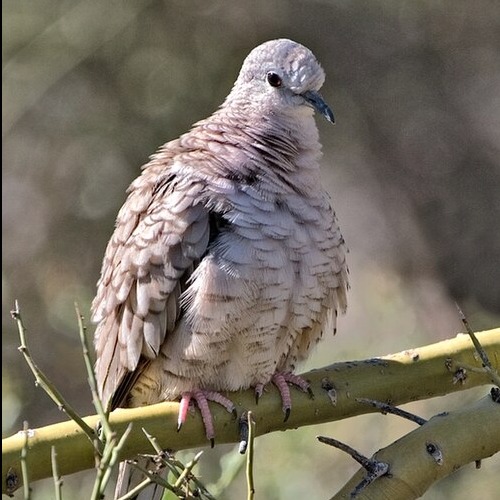
Columbina inca
Inca Dove
(Lesson, 1847)
Added by
Anonymous Curator
Reviewed by
Under Review
Last modified by
Julia Trouin
TaxonomyBiological classification ranks placing this species within the tree of life, from Kingdom down to Genus.
Ecology & StatusHow this species lives: habitat preferences, diet, behavior, population status, and role in its ecosystem.
OriginWhether the species is native (evolved here), endemic (found only here), or introduced by human activity.
Native
Population TrendDirection of change in population size over time: increasing, stable, decreasing, or unknown.
Increasing
Breeding SeasonTime of year when this species typically reproduces or flowers.
Year Round
Trophic RolePosition in the food chain: producer, herbivore, carnivore, omnivore, decomposer, or parasite.
Herbivore
Recent SightingsWhether this species has been observed in the wild in Costa Rica within recent years.
Yes
Habitat SummaryOverview of the specific ecosystems and environments where this species is found in Costa Rica. Multi-lang
It is a specialist of dry, open areas that are heavily disturbed by human activity. It completely avoids dense and primary forests. It thrives in savannas, thorny scrub, pastures, agricultural areas, and is a truly urban bird that dominates parks, squares, gardens, and streets in cities and towns. In Costa Rica, it is exceedingly abundant in the warm, dry region of Guanacaste and in the Central Valley (Greater Metropolitan Area).BehaviourDaily activity patterns, movement, territory use, foraging style, and seasonal behavioral changes. Multi-lang
It is a bird of diurnal, highly social, and walking habits. It forages on open ground, walking rapidly with short steps and rhythmically nodding its head, in the same way as city pigeons but on a miniature scale. When faced with danger, the birds in a flock usually explode together into the air towards nearby trees. In the scorching midday heat, they often rest on the ground exposing one wing to the sun to aid in thermoregulation and feather maintenance.Social ActivitySocial structure: whether the species is solitary, paired, or colonial; hierarchy and communication. Multi-lang
Highly gregarious. Rarely seen alone; they commonly travel in pairs, but outside the breeding season, they congregate in noisy flocks that can range from 10 to 50 individuals foraging or resting together.Feeding GuildWhat the species eats, how it forages or hunts, and its role as a consumer in the food web. Multi-lang
Herbivore / Ground granivore.Trophic Chain DetailsSpecific interactions in local food webs: prey species, predators, competitors, and scavengers. Multi-lang
Primary consumer (Granivore). It feeds almost exclusively on small seeds (from wild herbs, weeds, and grasses) gleaned from bare ground, being a frequent visitor to backyard bird feeders. They are regular prey for small falcons (merlin, kestrel), urban owls, and terrestrial predators like cats and snakes.Reproductive BehaviourMating strategies, courtship displays, nesting or spawning behavior, and parental care. Multi-lang
They are monogamous. They build a tiny and precarious-looking nest (a loose platform of rootlets, twigs, and interwoven stems) in the fork of a small tree or an urban thorny shrub, usually about 2-4 meters off the ground. They frequently reuse abandoned nests of other birds. The female lays 2 white eggs. Incubation is shared and lasts 13 to 15 days. Like all doves, they feed their squabs with crop milk. The young mature incredibly quickly and leave the nest between 14 and 16 days after hatching, allowing the pair to have multiple broods per year.Physical Measures
Length (cm)
16.5 - 23.0 cm
Weight (Grams)
30 g - 58 g
Lifespan
Sexual MaturityAge at which the individual becomes capable of reproducing for the first time.
4 - 6 Months
Gestation / IncubationDuration from fertilization to birth (mammals) or to hatching (egg-laying species).
13 - 15