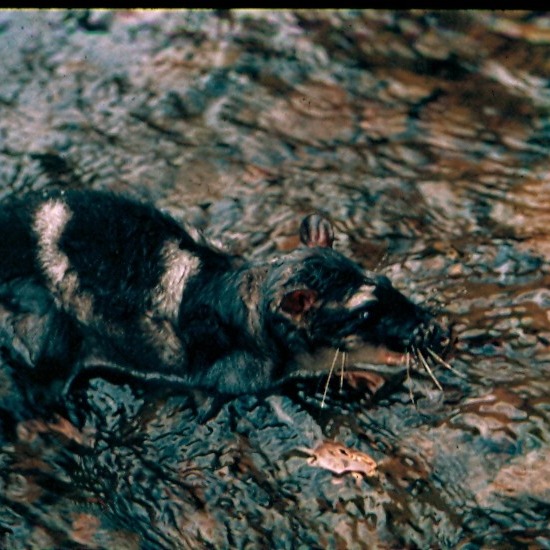
Chironectes minimus
Water Opossum / Yapok
(Zimmermann, 1780)
Added by
Anonymous Curator
Reviewed by
Under Review
Last modified by
Julia Trouin
TaxonomyBiological classification ranks placing this species within the tree of life, from Kingdom down to Genus.
Ecology & StatusHow this species lives: habitat preferences, diet, behavior, population status, and role in its ecosystem.
OriginWhether the species is native (evolved here), endemic (found only here), or introduced by human activity.
Native
Population TrendDirection of change in population size over time: increasing, stable, decreasing, or unknown.
Decreasing
Breeding SeasonTime of year when this species typically reproduces or flowers.
Year Round
Trophic RolePosition in the food chain: producer, herbivore, carnivore, omnivore, decomposer, or parasite.
Carnivore
Recent SightingsWhether this species has been observed in the wild in Costa Rica within recent years.
Yes
Habitat SummaryOverview of the specific ecosystems and environments where this species is found in Costa Rica. Multi-lang
It is a strict specialist of freshwater habitats. It resides in rivers, clear fast-flowing streams, lakes, and wetlands of tropical and subtropical forests (both primary and mature secondary). It relies on stable, forested riverbanks where it can dig its burrows just above the water level. In Costa Rica, it is found in lowland and mid-elevation zones on both slopes, though sightings are rare due to its nocturnal habits and elusive nature.BehaviourDaily activity patterns, movement, territory use, foraging style, and seasonal behavioral changes. Multi-lang
It is a strictly nocturnal and solitary hunter. At nightfall, it emerges from its burrow to hunt in rivers and streams. It is an extraordinary and agile diver, swimming with alternating strokes of its hind legs. Its hunting method consists of swimming along the bottom, feeling stones and crevices with its agile front feet extended forward to catch crustaceans, aquatic insects, frogs, and small fish. Its fur retains air, keeping its skin dry and warm under cold water.Social ActivitySocial structure: whether the species is solitary, paired, or colonial; hierarchy and communication. Multi-lang
Strictly solitary. Sexes only meet briefly for copulation.Feeding GuildWhat the species eats, how it forages or hunts, and its role as a consumer in the food web. Multi-lang
Carnivore / Piscivore / Insectivore.Trophic Chain DetailsSpecific interactions in local food webs: prey species, predators, competitors, and scavengers. Multi-lang
Carnivore (Aquatic specialist). Apex predator of small riparian micro-ecosystems. Occasionally hunted by jaguars, ocelots, caimans, large water snakes (like anacondas or large boas), and nocturnal raptors.Reproductive BehaviourMating strategies, courtship displays, nesting or spawning behavior, and parental care. Multi-lang
Breeds year-round in tropical zones, but with a peak during the dry season. Gestation is about 12 to 14 days. The young (usually 1 to 5) are born tiny and migrate to the mother's watertight marsupium. Incredibly, they can survive without breathing for several minutes inside the closed pouch while the mother dives, thanks to their low metabolic rate and hypoxia tolerance. After 20 days they grow fur, and weeks later they open their eyes, at which point they no longer fit in the pouch and wait in the burrow while the mother hunts.Physical Measures
Length (cm)
27.0 - 32.0 cm
Weight (Grams)
600 g - 800 g
Lifespan
Sexual MaturityAge at which the individual becomes capable of reproducing for the first time.
10 - 12 Months
Gestation / IncubationDuration from fertilization to birth (mammals) or to hatching (egg-laying species).
12 - 14