
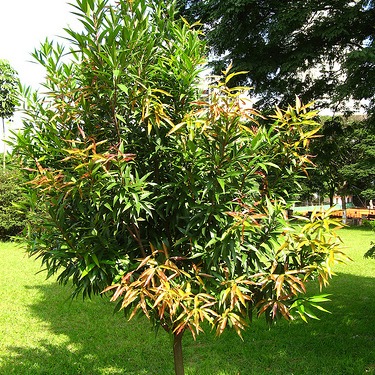
Carapa guianensis
Crabwood / Andiroba
Aubl., 1775
Added by
Anonymous Curator
Reviewed by
Under Review
Last modified by
Julia Trouin
TaxonomyBiological classification ranks placing this species within the tree of life, from Kingdom down to Genus.
Ecology & StatusHow this species lives: habitat preferences, diet, behavior, population status, and role in its ecosystem.
OriginWhether the species is native (evolved here), endemic (found only here), or introduced by human activity.
Native
Population TrendDirection of change in population size over time: increasing, stable, decreasing, or unknown.
Stable
Trophic RolePosition in the food chain: producer, herbivore, carnivore, omnivore, decomposer, or parasite.
--
Growth HabitPhysical form and structure of the plant: tree, shrub, herb, vine, epiphyte, aquatic, etc.
--
Leaf TypeLeaf characteristics: deciduous (seasonal shed), evergreen, simple, compound, needle-like, etc.
--
Flowering SeasonTime of year when this species typically reproduces or flowers.
--
Recent SightingsWhether this species has been observed in the wild in Costa Rica within recent years.
Yes
Habitat SummaryOverview of the specific ecosystems and environments where this species is found in Costa Rica. Multi-lang
It thrives mainly in humid and very humid tropical forests, showing a notable preference for alluvial soils and areas near rivers that flood seasonally (várzea forests). Although it adapts well to well-drained upland soils (terra firme), it reaches its maximum density in heavy clay soils rich in organic matter in the Caribbean and the lowlands of the Southern Pacific. In Costa Rica, it is commonly found in the Northern Zone and the floodplains of Tortuguero and the Osa Peninsula.Light & Water NeedsSunlight intensity and moisture levels this plant needs to grow and reproduce successfully. Multi-lang
Information not available in English. Help us expand this record!BehaviourDaily activity patterns, movement, territory use, foraging style, and seasonal behavioral changes. Multi-lang
Carapa guianensis plays a critical role in hydrochory (seed dispersal by water). Its fruits often fall into rivers or flooded areas, where the capsules float and are transported by the current over long distances. Once the capsule degrades or hits the shore, it releases the seeds, which can remain viable in the water for weeks. This strategy allows for the efficient colonization of sandbars and newly formed floodplains.Toxicity / UsesToxic compounds present and their documented effects on humans or other organisms. Multi-lang
Information not available in English. Help us expand this record!Physical Measures
Length (cm)
1500.0 - 4500.0 cm