
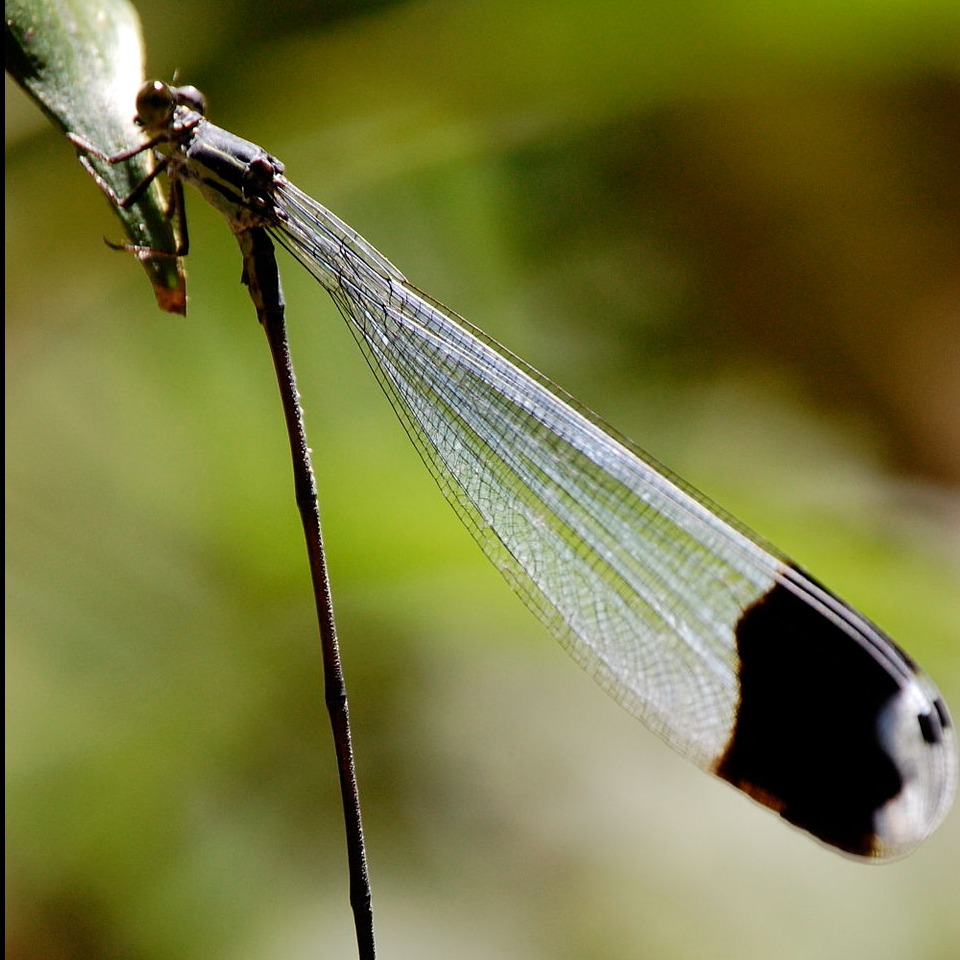
Megaloprepus caerulatus
Helicopter Damselfly
(Drury, 1782)
Added by
Anonymous Curator
Reviewed by
Under Review
Last modified by
Julia Trouin
TaxonomyBiological classification ranks placing this species within the tree of life, from Kingdom down to Genus.
Ecology & StatusHow this species lives: habitat preferences, diet, behavior, population status, and role in its ecosystem.
OriginWhether the species is native (evolved here), endemic (found only here), or introduced by human activity.
Native
Population TrendDirection of change in population size over time: increasing, stable, decreasing, or unknown.
Decreasing
Breeding SeasonTime of year when this species typically reproduces or flowers.
--
Trophic RolePosition in the food chain: producer, herbivore, carnivore, omnivore, decomposer, or parasite.
Insectivore
Recent SightingsWhether this species has been observed in the wild in Costa Rica within recent years.
Yes
Habitat SummaryOverview of the specific ecosystems and environments where this species is found in Costa Rica. Multi-lang
It is an inhabitant strictly restricted to the dense understory of mature, undisturbed primary tropical rainforests, from sea level to mid-elevations in Central and South America. Its life cycle depends absolutely on the existence of old and fallen trees containing natural water-filled tree holes (phytotelmata). If the forest lacks these large tree holes (common only in very old-growth forests), the species cannot reproduce. They avoid direct sunlight and open areas, preferring the high humidity and filtered light rays of the deep forest interior.BehaviourDaily activity patterns, movement, territory use, foraging style, and seasonal behavioral changes. Multi-lang
A diurnal and crepuscular insect that navigates the dark forest understory with extreme slowness and grace, rarely ascending beyond the mid-canopy layer. Males exhibit pronounced territorial behavior. They actively search for large holes in fallen tree trunks containing water (at least 1 or 2 liters). Upon finding a good tree hole, the male fiercely defends it against other invading males through vigorous circular chases and aerial clashes. Females, on the other hand, roam freely through the forest hunting spiders and visit the males' territories only when they are ready to mate and lay their eggs.Social ActivitySocial structure: whether the species is solitary, paired, or colonial; hierarchy and communication. Multi-lang
Completely solitary and extremely belligerent intra-sexually. They only meet briefly for copulation. Males do not tolerate the presence of any other male near their defended breeding pool. If a rival male approaches, both will engage in a 'blade combat' in mid-flight: they rise vertically, repeatedly striking each other with their long wings to intimidate, attempt to mutilate, or chase away the loser in a frantic display of wing clattering. The victor gains mating access to all females visiting that tree.Feeding GuildWhat the species eats, how it forages or hunts, and its role as a consumer in the food web. Multi-lang
Highly specialist carnivore (Araneophagous). Adults feed almost exclusively on spiders, ignoring the vast majority of flies or other insects. They patrol looking for the webs of orb-weavers, linyphiids, and jumping spiders in the understory foliage. Once they consume a rich prey, they use its high protein energy to continue defending their territory or to search for optimal oviposition sites.Trophic Chain DetailsSpecific interactions in local food webs: prey species, predators, competitors, and scavengers. Multi-lang
It is a secondary consumer and highly specialized insectivore. During its lethal larval stage, which lasts about half a year in the tree hole puddle, it is the aquatic apex predator eating everything in its path: nematode worms, dipteran larvae (mosquitoes), tadpoles, and even smaller siblings (cannibalism). As an adult, it acts as a key biological control agent over spider populations (especially of the families Araneidae and Tetragnathidae). They themselves fall prey to agile understory frogs, large wandering huntsman spiders (like the wandering spider) that ambush them while resting, and insectivorous birds like jacamars and motmots.Reproductive BehaviourMating strategies, courtship displays, nesting or spawning behavior, and parental care. Multi-lang
The gravid female enters the territory of the dominant male who holds the highest-quality tree hole. The male clasps the female behind the head using special claspers at the end of his abdomen (forming the mating wheel or 'heart'). After transferring sperm, the male hovers above guarding her (non-contact guarding) while the female rhythmically oviposits by submerging her ovipositor underwater in the tree hole (scattering up to 50 eggs across various pools). The hatching larvae are born ready to hunt and even resort to fratricide; from a dozen eggs in a hole, cannibalism is such that typically only a single, massive individual survives to emerge from the water and transform into the giant adult several months later.Physical Measures
Length (cm)
7.0 - 12.0 cm
Weight (Grams)
0.5 g - 2 g
Lifespan
Sexual MaturityAge at which the individual becomes capable of reproducing for the first time.
6 - 8 Months
Gestation / IncubationDuration from fertilization to birth (mammals) or to hatching (egg-laying species).
14 - 30