AnimaliaIUCN LCApproved Recent Sighting
Lepidophyma flavimaculatum
Yellow-spotted Night Lizard
A. Duméril, 1851
Detailed Texts Multi-lang
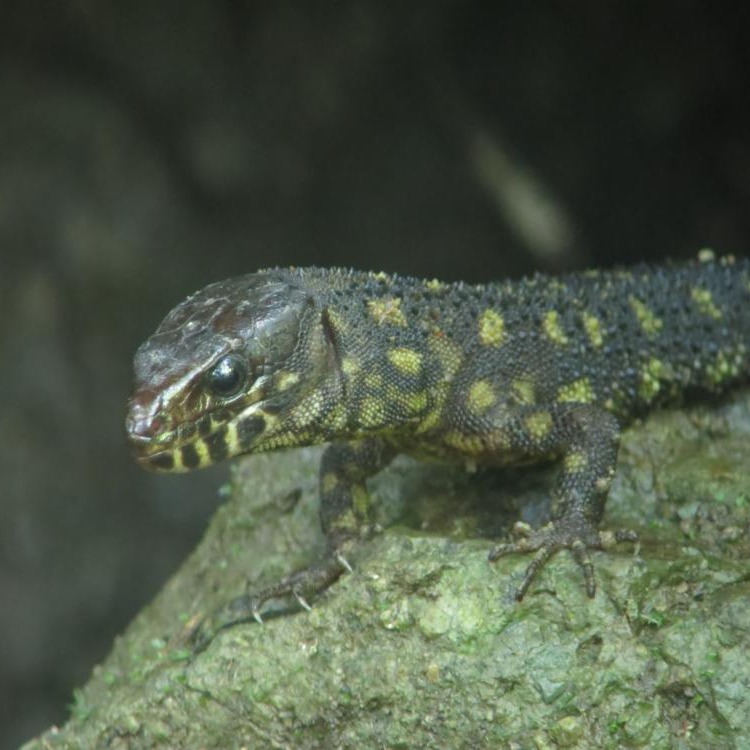
Medium-sized lizard with a characteristic coloration featuring yellowish or whitish spots on a dark background, usually brown or blackish. It has granular scales and a flattened head adapted to its crevice-dwelling life.
Added by
Anonymous Curator
Reviewed by
Julia Trouin
Last modified by
Julia Trouin
Taxonomy
PhylumChordata
ClassReptilia
OrderSquamata
FamilyXantusiidae
GenusLepidophyma
Taxonomic AuthorityA. Duméril, 1851
Ecology & Status
Origin
Native
Population Trend
Stable
Breeding Season
Year Round
Trophic Role
Insectivore
Recent Sightings
Yes
Habitat Summary Multi-lang
Inhabits mainly tropical rainforests, often near fallen logs, rocks, and cavities where it shelters during the day. Prefers environments with high humidity and dense vegetation cover.Behaviour Multi-lang
Mainly nocturnal activity, remaining hidden in crevices during daylight hours.Social Activity Multi-lang
Generally solitary, although several individuals may be found sharing large fallen logs.Feeding Guild Multi-lang
Active foraging during the night looking for prey in leaf litter and on woody substrates.Trophic Chain Details Multi-lang
Opportunistic insectivore, controls populations of small invertebrates in its microhabitat.Reproductive Behaviour Multi-lang
Viviparous reproduction with limited parental care; females gestate the offspring internally.Physical Measures
Length (cm)
7.0 - 12.0 cm
Weight (Grams)
10 g - 25 g
Offspring per cycle2 - 6
Sexual DimorphismYes
Lifespan
Sexual Maturity
1 - 2 Years
Gestation / Incubation
--
Lifespan Estimated
Males--
Females--
Sexual Dimorphism
Males Multi-lang
Usually slightly smaller and have less robust heads than females.
Females Multi-lang
They have more robust bodies and often reach slightly larger sizes due to energy investment in gestation.
Evolutionary Adaptations Multi-lang
Nocturnal and crevice-dwelling habits: Allows avoiding diurnal predators and competing effectively for safe shelters in decaying wood or rocky crevices.
Main Threats Multi-lang
Habitat destruction due to deforestation and land conversion for agricultural use, which fragments its local populations.
Interesting Facts Multi-lang
They are viviparous, meaning they give birth to live young instead of laying eggs, an unusual adaptation common in this genus.