
Costa Rica Species
Dendrobates auratus
AnimaliaHighest rank in taxonomy. Groups all life into domains: Animalia, Plantae, Fungi, etc.IUCN LCInternational Union for Conservation of Nature — the world authority on species extinction risk, using standardized criteria. — Least Concern — widespread and abundant; not at immediate risk of extinction.In ProgressCurrent stage of this record in the editorial review workflow. Recent Sighting

Dendrobates auratus

Green and Black Poison Dart Frog

Girard, 1855

Detailed Texts Multi-lang
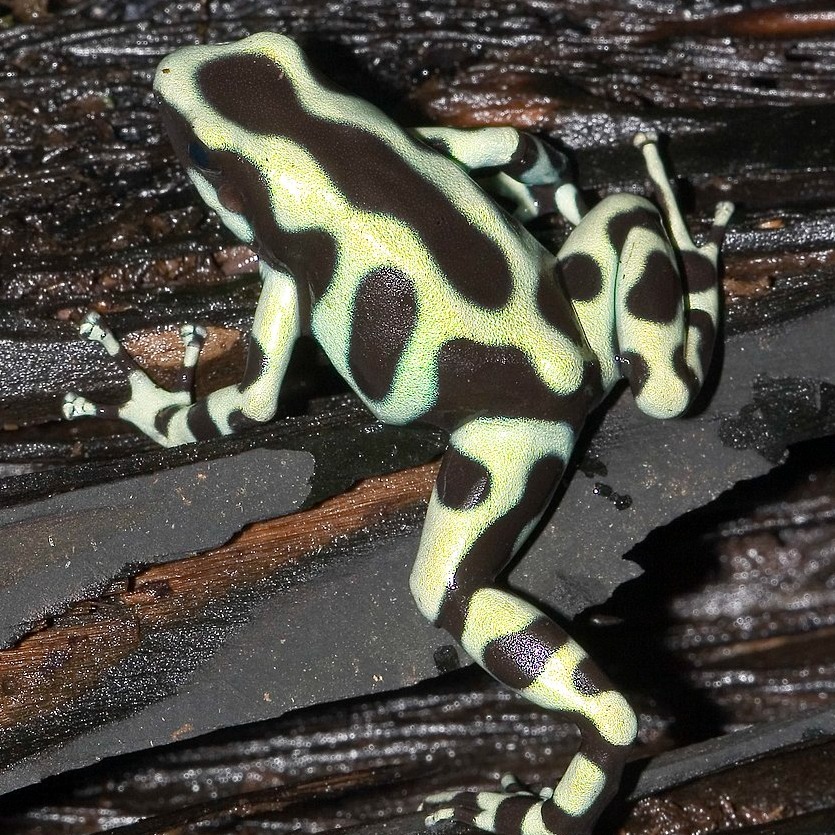
The green and black poison dart frog (Dendrobates auratus) is a small, diurnal amphibian of the Dendrobatidae family, famous for its striking aposematic coloration and potent skin toxins. Highly recognizable by its bright green (sometimes mint, yellow, or bluish) and black mottled patterns, this frog warns predators of its high toxicity. Unlike many amphibians that rely on camouflage, D. auratus moves boldly through the forest floor during the day. Its toxicity is not synthesized internally but sequestered from its specialized diet of alkaloid-rich mites and ants. Endemic to Central America and northwestern South America, it is particularly abundant in the humid lowland rainforests of Costa Rica, both on the Caribbean and Pacific slopes. Despite its lethal defense mechanism in the wild, individuals bred in captivity completely lose their toxicity.

Added by

Anonymous Curator

Reviewed by

Under Review

Last modified by

Julia Trouin

TaxonomyBiological classification ranks placing this species within the tree of life, from Kingdom down to Genus.

PhylumRank below Kingdom. Groups organisms sharing a fundamental body plan (e.g., Chordata = vertebrates and some invertebrates).Chordata
ClassRank below Phylum. Subdivides by structural traits (e.g., Mammalia, Aves, Reptilia, Insecta).Amphibia
OrderRank below Class. Groups related families sharing common ancestry (e.g., Carnivora, Primates).Anura
FamilyRank below Order. Groups closely related genera (e.g., Felidae = cats, Canidae = dogs).Dendrobatidae
GenusRank just above Species. The first word in the two-part binomial scientific name.Dendrobates
Taxonomic AuthorityThe scientist who first formally described and published this species, followed by the year of publication.Girard, 1855
Record Completeness
94%
Coming soon

Ecology & StatusHow this species lives: habitat preferences, diet, behavior, population status, and role in its ecosystem.

OriginWhether the species is native (evolved here), endemic (found only here), or introduced by human activity.

Native

Population TrendDirection of change in population size over time: increasing, stable, decreasing, or unknown.

Decreasing

Breeding SeasonTime of year when this species typically reproduces or flowers.

--

Trophic RolePosition in the food chain: producer, herbivore, carnivore, omnivore, decomposer, or parasite.

Insectivore

Recent SightingsWhether this species has been observed in the wild in Costa Rica within recent years.

Yes

Habitat SummaryOverview of the specific ecosystems and environments where this species is found in Costa Rica. Multi-lang

Inhabits the leaf litter of primary and secondary humid tropical lowland forests, typically from sea level up to 800 meters. They thrive in environments with a closed canopy that maintains high humidity on the forest floor. While primarily terrestrial, they are excellent climbers and frequently ascend trees up to 10 meters or higher into the canopy to seek out bromeliads and tree holes filled with rainwater (phytotelmata) for their tadpoles. They adapt moderately well to disturbed habitats, such as traditional shaded cacao plantations, provided there is sufficient leaf litter and microhabitats holding water.

BehaviourDaily activity patterns, movement, territory use, foraging style, and seasonal behavioral changes. Multi-lang

Strictly diurnal and highly active. It spends its day hopping through the leaf litter, probing for microscopic prey with quick, jerky movements. Thanks to its toxic defense, it shows little fear of most animals and will boldly forage in the open. Males are highly territorial and use a low, buzzing trill to defend their patch of forest from rival males and to attract females. Physical combat between males involves wrestling and pushing matches that can last for hours. During dry periods, they seek refuge under logs or deep in the leaf litter to avoid desiccation, entering a state of reduced activity until the rains return.

Social ActivitySocial structure: whether the species is solitary, paired, or colonial; hierarchy and communication. Multi-lang

Generally solitary outside the breeding season, though several individuals may congregate in prime feeding areas with deep leaf litter. Males establish and fiercely defend small territories on the forest floor, using vocalizations to establish boundaries. If a rival male intrudes, they engage in aggressive physical wrestling, standing on their hind legs and trying to pin each other down. Females are also known to be aggressive toward one another, sometimes destroying the egg clutches of rival females to ensure the male focuses solely on raising her offspring.

Feeding GuildWhat the species eats, how it forages or hunts, and its role as a consumer in the food web. Multi-lang

Insectivore (Myrmecophage/Microphagous). They are visual hunters that rely on an incredibly fast, sticky tongue to capture tiny prey. Their diet is overwhelmingly dominated by ants and mites, which are swallowed whole. They forage actively and continuously throughout the day, requiring a high intake of these tiny prey items to maintain their fast metabolism and replenish their toxic reserves. They do not eat typical large amphibian prey like earthworms or large crickets in the wild.

Trophic Chain DetailsSpecific interactions in local food webs: prey species, predators, competitors, and scavengers. Multi-lang

Acts primarily as a secondary consumer (insectivore). Its highly specialized diet consists mostly of tiny leaf-litter arthropods, particularly formicine ants, oribatid mites, springtails, and small beetles. It is the ingestion of these specific arthropods that provides the alkaloid precursors needed for its skin toxins. Thanks to its lethal defense, adult D. auratus have virtually no natural predators, with the notable exception of the fire-bellied snake (Erythrolamprus epinephelus), which has evolved resistance to the frog's toxins. Eggs and tadpoles lack this high toxicity and are heavily preyed upon by predatory insects, spiders, and other frog species.

Reproductive BehaviourMating strategies, courtship displays, nesting or spawning behavior, and parental care. Multi-lang

Breeding coincides with the rainy season. The male attracts a female with a soft, buzzing call. Courtship involves the female gently stroking the male's back and head. The female lays a small clutch of 4 to 6 eggs on a dark, moist leaf in the litter, which the male then fertilizes. The male is the primary caretaker, guarding the eggs for about 10-14 days and keeping them moist with his urine. Once the eggs hatch, the tadpoles wriggle onto the male's back, held in place by a sticky mucus. He then climbs high into the canopy to deposit each tadpole into a separate small pool of water (like a bromeliad axil or tree hole) to prevent them from cannibalizing each other. The tadpoles feed on algae, detritus, and insect larvae until metamorphosis 10-12 weeks later.

Physical Measures

Length (cm)

2.5 - 4.2 cm

Weight (Grams)

3 g - 6 g

Offspring per cycleTypical number of young (live births, eggs, or seeds) produced by one adult in a single reproductive event or breeding season.4 - 6
Sexual DimorphismObservable physical differences between males and females of the same species (e.g., size, coloration, features).Yes

Lifespan

Sexual MaturityAge at which the individual becomes capable of reproducing for the first time.

1 - 1.5 Years

Gestation / IncubationDuration from fertilization to birth (mammals) or to hatching (egg-laying species).

10 - 14

Lifespan EstimatedExpected duration of life from birth to natural death under wild conditions.
Males5 - 10 Years
Females5 - 10 Years

Sexual DimorphismPhysical differences in size, coloration, or morphology between males and females of this species.

Males Multi-lang

Visually, males are very difficult to distinguish from females. They possess the same vibrant aposematic patterns and colors. On average, adult males are slightly smaller and slimmer than adult females. The most definitive characteristic is behavioral and anatomical: males possess vocal slits in their mouths and a small vocal sac under their throat, allowing them to produce the distinctive buzzing trill used for territorial defense and courtship. Males also tend to have slightly wider toe pads, which aid in climbing when carrying tadpoles.

Females Multi-lang

Adult females are generally slightly larger, more robust, and have a more rounded, pear-shaped body compared to the slimmer males, especially when gravid (carrying eggs). They completely lack vocal slits and a vocal sac, meaning they cannot produce the characteristic buzzing calls of the species. Aside from the slight size difference, their aposematic coloration and patterning are identical to the males, making sexing them in the field without observing calling or reproductive behavior highly challenging.

Evolutionary AdaptationsInherited traits and behaviors that improve the species' survival and reproduction in its specific environment. Multi-lang

Aposematic coloration and toxin sequestration: Their vibrant colors serve as a universal warning. The frog absorbs lipophilic alkaloid toxins (like pumiliotoxins) from its diet of specific ants and oribatid mites, secreting them through skin glands when stressed or attacked.
Specialized diurnal vision: They have highly developed eyesight adapted for hunting tiny, fast-moving insects in the dappled light of the forest floor, a necessity since their warning colors are most effective during the day.
Parental tadpole transport: Males produce a specialized mucus that allows newly hatched tadpoles to adhere to their backs. This enables them to transport them from the terrestrial egg-laying site to arboreal water pools to avoid ground predators.

Main ThreatsDocumented pressures reducing the population: habitat loss, hunting, disease, climate change, and invasive species. Multi-lang

Habitat loss: Deforestation for agriculture, cattle ranching, and urban expansion eliminates the humid microclimates, closed canopy, and leaf litter they strictly depend on to survive and reproduce.
Illegal pet trade: Their stunning colors make them highly sought after in the international exotic pet trade, leading to localized depletion of wild populations through smuggling.
Chytridiomycosis: Like many amphibians globally, they are susceptible to the fungal pathogen Batrachochytrium dendrobatidis (Bd), which attacks their keratinized skin and disrupts osmoregulation, though lowland species generally fare better than highland species.

Interesting FactsSurprising or notable facts that highlight what makes this species unique or ecologically important. Multi-lang

In 1932, over 200 of these frogs from Panama were intentionally introduced to the island of Oahu, Hawaii, in a misguided attempt to control non-native mosquito populations. They successfully established a thriving, non-native population there that still exists today.
The specific epithet 'auratus' means 'golden' in Latin. This seems contradictory for a green and black frog, but it refers to a rare morph found in Panama and Colombia that features a metallic bronze or golden coloration instead of green.
Indigenous tribes of the Chocó region in Colombia are famous for rubbing their blowdarts on the backs of poison dart frogs for hunting. However, they use frogs of the genus Phyllobates (like P. terribilis), which are far more toxic; Dendrobates auratus is generally not toxic enough to be used for hunting large game.