Costa Rica Species
Leucocoprinus birnbaumii
FungiHighest rank in taxonomy. Groups all life into domains: Animalia, Plantae, Fungi, etc.IUCN NEInternational Union for Conservation of Nature — the world authority on species extinction risk, using standardized criteria. — Not Evaluated — not yet assessed against the IUCN Red List criteria.In ProgressCurrent stage of this record in the editorial review workflow. Recent Sighting

Leucocoprinus birnbaumii

Plantpot Dapperling / Flowerpot Parasol

(Corda) Singer, 1962

Detailed Texts Multi-lang
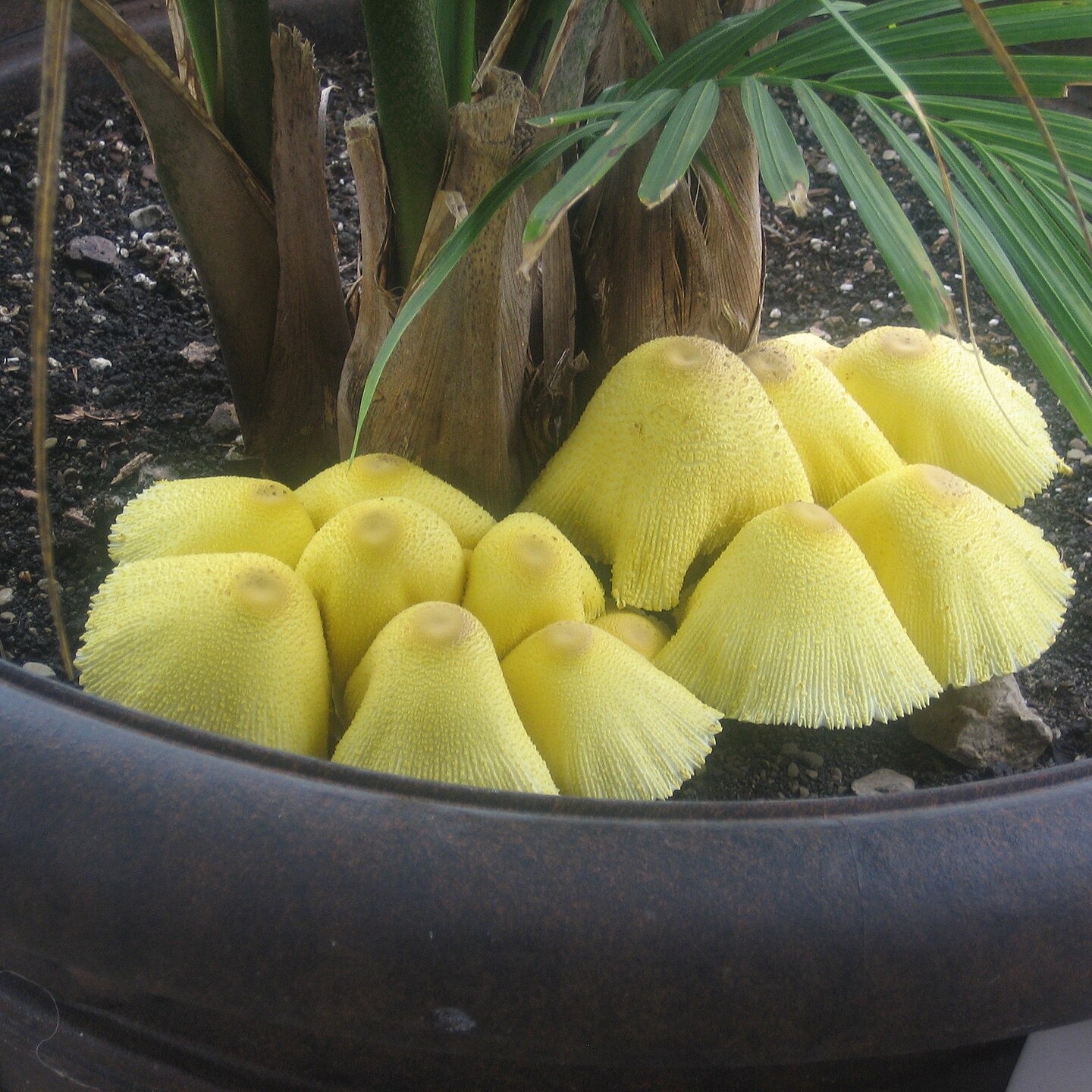
Leucocoprinus birnbaumii is a basidiomycete fungus unmistakable for its bright lemon or sulfur yellow color. The cap is initially oval or bell-shaped, later expanding to a convex form with a diameter of 2 to 5 cm; its surface is covered with small scales or granulations of the same color. The gills are free, thin, and also yellowish. The stalk is slender, hollow, with a slightly bulbous base and features a delicate, fleeting ring on the upper part. It is a saprophytic fungus that feeds on decaying organic matter. While aesthetically attractive, it is important to note that it is toxic if ingested, causing severe gastrointestinal distress, though it poses no danger to the plants it grows with.

Added by

Anonymous Curator

Reviewed by

Under Review

Last modified by

Julia Trouin

TaxonomyBiological classification ranks placing this species within the tree of life, from Kingdom down to Genus.

PhylumRank below Kingdom. Groups organisms sharing a fundamental body plan (e.g., Chordata = vertebrates and some invertebrates).Basidiomycota
ClassRank below Phylum. Subdivides by structural traits (e.g., Mammalia, Aves, Reptilia, Insecta).Agaricomycetes
OrderRank below Class. Groups related families sharing common ancestry (e.g., Carnivora, Primates).Agaricales
FamilyRank below Order. Groups closely related genera (e.g., Felidae = cats, Canidae = dogs).Agaricaceae
GenusRank just above Species. The first word in the two-part binomial scientific name.Leucocoprinus
Taxonomic AuthorityThe scientist who first formally described and published this species, followed by the year of publication.(Corda) Singer, 1962
Record Completeness
93%
Coming soon

Ecology & StatusHow this species lives: habitat preferences, diet, behavior, population status, and role in its ecosystem.

OriginWhether the species is native (evolved here), endemic (found only here), or introduced by human activity.

Native

Population TrendDirection of change in population size over time: increasing, stable, decreasing, or unknown.

Stable

Trophic RolePosition in the food chain: producer, herbivore, carnivore, omnivore, decomposer, or parasite.

--

EdibilityWhether this mushroom is edible, toxic, hallucinogenic, or of unknown safety. Never eat based solely on this data.

--

Cap ShapeShape of the mushroom cap (pileus): convex, flat, umbonate, funnel-shaped, bell-shaped, etc.

--

Hymenium TypeThe spore-bearing surface of a fungus: gills, pores, teeth, ridges, smooth, or wrinkled.

--

Fruiting SeasonTime of year when this species typically reproduces or flowers.

Year Round

Recent SightingsWhether this species has been observed in the wild in Costa Rica within recent years.

Yes

Habitat SummaryOverview of the specific ecosystems and environments where this species is found in Costa Rica. Multi-lang

Originally a species of tropical and subtropical climates, it has been distributed globally through the ornamental plant trade. It naturally inhabits greenhouses, indoor flowerpots, and gardens with warm mulch. It requires substrates rich in organic matter (peat, compost) and stable humidity and temperature conditions. In Costa Rica, it is commonly found both in nature and in moist domestic environments.

SubstrateThe organic material or host organism this fungus colonizes and decomposes. Multi-lang

Information not available in English. Help us expand this record!

BehaviourDaily activity patterns, movement, territory use, foraging style, and seasonal behavioral changes. Multi-lang

It is a nutrient recycler in the flowerpot microenvironment. Its mycelium creates a network in the substrate that improves aeration and mineral availability. Its fruiting bodies usually appear in groups after a generous watering or on days with high relative humidity.

Physical Measures

Length (cm)

3.0 - 8.0 cm

Hymenium StructuresMacro photographs of the spore-bearing surfaces used for mushroom identification.

No hymenium surface images available.

Evolutionary AdaptationsInherited traits and behaviors that improve the species' survival and reproduction in its specific environment. Multi-lang

Thermophily and Adaptation to Artificial Substrate: It has evolved to thrive in high temperatures and nitrogen levels found in compost and commercial potting soils, allowing it to occupy an ecological niche where other forest fungi do not survive.
Fast Life Cycle: The fruiting body can fully develop within days from pre-existing mycelium in the soil, taking advantage of frequent watering to release its spores in indoor environments.

Main ThreatsDocumented pressures reducing the population: habitat loss, hunting, disease, climate change, and invasive species. Multi-lang

Human removal: Due to fears that they might harm plants or their toxicity to pets, the fruiting bodies are often plucked as soon as they appear.

Interesting FactsSurprising or notable facts that highlight what makes this species unique or ecologically important. Multi-lang

Friend of your plants: Contrary to popular belief, this fungus does not harm indoor plants. Being saprophytic, it helps decompose organic matter in the substrate, releasing nutrients that the plant can later absorb.