
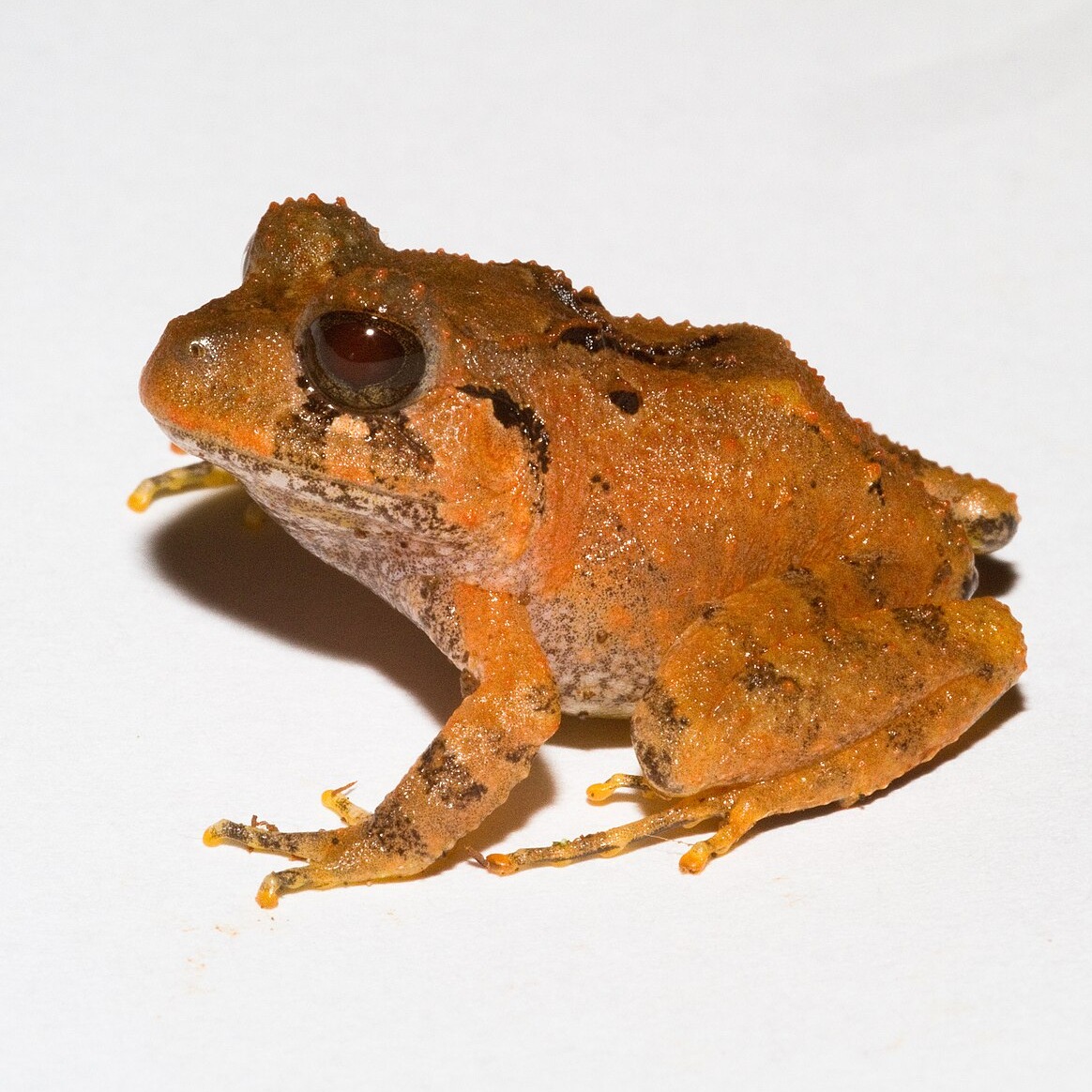
Costa Rica Species
AnimaliaHighest rank in taxonomy. Groups all life into domains: Animalia, Plantae, Fungi, etc.IUCN LCInternational Union for Conservation of Nature — the world authority on species extinction risk, using standardized criteria. — Least Concern — widespread and abundant; not at immediate risk of extinction.ApprovedCurrent stage of this record in the editorial review workflow. Recent Sighting

Craugastor megacephalus

Big-headed Robber Frog

(Günther, 1888)

Detailed Texts Multi-lang
A prominent terrestrial frog characterized by its disproportionately large, wide head, a distinct dark face mask running through the tympanum, and an incredibly cryptic dorsal pattern. Its skin texture varies from smooth to scattered ridges that perfectly mimic rotting forest leaves.

Added by

Anonymous Curator

Reviewed by

Under Review

Other Names (Global)Regional and multilingual names used for this species across different countries and languages.

Rana de hojarasca cabezonaLarge-headed robber frogGroßkopf-Raubfrosch

TaxonomyBiological classification ranks placing this species within the tree of life, from Kingdom down to Genus.

PhylumRank below Kingdom. Groups organisms sharing a fundamental body plan (e.g., Chordata = vertebrates and some invertebrates).Chordata
ClassRank below Phylum. Subdivides by structural traits (e.g., Mammalia, Aves, Reptilia, Insecta).Amphibia
OrderRank below Class. Groups related families sharing common ancestry (e.g., Carnivora, Primates).Anura
FamilyRank below Order. Groups closely related genera (e.g., Felidae = cats, Canidae = dogs).Craugastoridae
GenusRank just above Species. The first word in the two-part binomial scientific name.Craugastor
Taxonomic AuthorityThe scientist who first formally described and published this species, followed by the year of publication.(Günther, 1888)
Record Completeness
94%
Coming soon

Ecology & StatusHow this species lives: habitat preferences, diet, behavior, population status, and role in its ecosystem.

OriginWhether the species is native (evolved here), endemic (found only here), or introduced by human activity.

Native

Population TrendDirection of change in population size over time: increasing, stable, decreasing, or unknown.

Stable

Breeding SeasonTime of year when this species typically reproduces or flowers.

Year Round

Trophic RolePosition in the food chain: producer, herbivore, carnivore, omnivore, decomposer, or parasite.

Carnivore

Recent SightingsWhether this species has been observed in the wild in Costa Rica within recent years.

Yes

Habitat SummaryOverview of the specific ecosystems and environments where this species is found in Costa Rica. Multi-lang

Primarily restricts itself to the damp floor leaf litter layer of humid lowland, premontane, and lower montane tropical rainforests, requiring dense canopy cover and high humidity levels.

BehaviourDaily activity patterns, movement, territory use, foraging style, and seasonal behavioral changes. Multi-lang

Strictly nocturnal. During daytime hours, it blends seamlessly into the leaf litter matrix. At night, it sits quietly on top of damp leaves or slightly elevated root configurations, utilizing an ambush hunting strategy to ambush passing organisms.

Social ActivitySocial structure: whether the species is solitary, paired, or colonial; hierarchy and communication. Multi-lang

Solitary and reclusive. Communication is highly limited; unlike smaller frogs, males of this species rarely call or produce loud vocal advertisements, likely to prevent detection by larger vertebrate predators that share their floor habitat.

Feeding GuildWhat the species eats, how it forages or hunts, and its role as a consumer in the food web. Multi-lang

Terrestrial ambush macro-invertivore.

Trophic Chain DetailsSpecific interactions in local food webs: prey species, predators, competitors, and scavengers. Multi-lang

Acts as an apex invertebrate predator on the forest floor, eating massive beetles, crickets, roaches, land snails, and small lizards. It falls prey to forest snakes, larger opossums, owls, and macro-arachnids.

Reproductive BehaviourMating strategies, courtship displays, nesting or spawning behavior, and parental care. Multi-lang

Terrestrial reproduction occurs directly within hidden, damp spaces under leaf litter or decaying root structures. The female lays large, unpigmented eggs with thick gel envelopes, which hatch directly without an aquatic tadpole phase.

Physical Measures

Length (cm)

4.2 - 8.5 cm

Weight (Grams)

8 g - 45 g

Offspring per cycleTypical number of young (live births, eggs, or seeds) produced by one adult in a single reproductive event or breeding season.20 - 65
Sexual DimorphismObservable physical differences between males and females of the same species (e.g., size, coloration, features).Yes

Lifespan

Sexual MaturityAge at which the individual becomes capable of reproducing for the first time.

12 - 18 Months

Gestation / IncubationDuration from fertilization to birth (mammals) or to hatching (egg-laying species).

35 - 50

Lifespan EstimatedExpected duration of life from birth to natural death under wild conditions.
Males4 - 8 Years
Females5 - 10 Years

Sexual DimorphismPhysical differences in size, coloration, or morphology between males and females of this species.

Males Multi-lang

Males are considerably smaller than females, typically reaching only half of the extreme snout-vent length found in mature females, and possess smaller heads relative to total body length.

Females Multi-lang

Females grow to huge and bulky proportions, exhibiting massive, heavily muscularized jaws and broad skulls designed to facilitate the predation of large floor arthropods and facilitate egg mass carrying capacity.

Evolutionary AdaptationsInherited traits and behaviors that improve the species' survival and reproduction in its specific environment. Multi-lang

Massive gape size and hypertrophied jaw structure, allowing it to easily overpower and swallow exceptionally large macro-invertebrates and small vertebrates relative to its body size.
Direct-development life cycle where embryos undergo complete metamorphosis inside the terrestrial egg capsule, hatching as independent juvenile froglets and eliminating dependencies on standing water pools.

Main ThreatsDocumented pressures reducing the population: habitat loss, hunting, disease, climate change, and invasive species. Multi-lang

Habitat destruction via conversion of primary tropical forests into agricultural fields, banana plantations, and pastures, which removes the critical humid leaf litter layer.
Vulnerability to microclimatic drying caused by canopy thinning and edge effects, which dramatically lowers forest floor humidity below their physiological tolerance levels.

Interesting FactsSurprising or notable facts that highlight what makes this species unique or ecologically important. Multi-lang

Due to its wide mouth and aggressive feeding behavior, large females have been documented consuming not only heavy beetles and scorpions, but also smaller sympatric frog species on the forest floor.