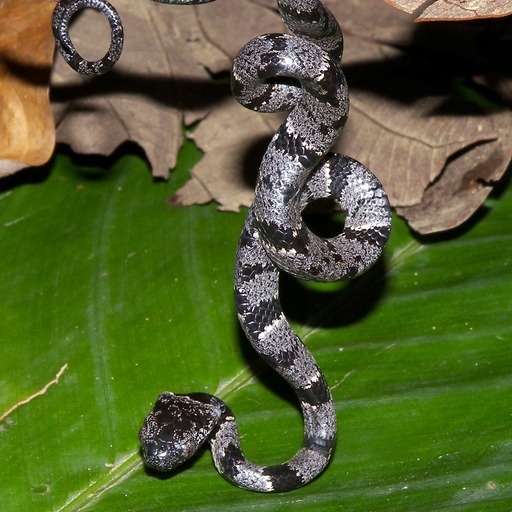
Sibon nebulatus
Cloudy Snail-eater
(Linnaeus, 1758)
Added by
Anonymous Curator
Reviewed by
Under Review
Last modified by
Julia Trouin
TaxonomyBiological classification ranks placing this species within the tree of life, from Kingdom down to Genus.
Ecology & StatusHow this species lives: habitat preferences, diet, behavior, population status, and role in its ecosystem.
OriginWhether the species is native (evolved here), endemic (found only here), or introduced by human activity.
Native
Population TrendDirection of change in population size over time: increasing, stable, decreasing, or unknown.
Stable
Breeding SeasonTime of year when this species typically reproduces or flowers.
Year Round
Trophic RolePosition in the food chain: producer, herbivore, carnivore, omnivore, decomposer, or parasite.
Carnivore
Recent SightingsWhether this species has been observed in the wild in Costa Rica within recent years.
Yes
Habitat SummaryOverview of the specific ecosystems and environments where this species is found in Costa Rica. Multi-lang
Inhabits mainly humid tropical forests, cloud forests, and riparian vegetation areas. It is frequently found in low vegetation or bushes near water sources, where its main prey (mollusks) are most abundant. It is a species tolerant of secondary habitats, occasionally appearing in plantations and areas near human settlements with good vegetation cover.BehaviourDaily activity patterns, movement, territory use, foraging style, and seasonal behavioral changes. Multi-lang
It is a strictly nocturnal reptile. During the day, it usually rests hidden among dense vegetation or under logs, where its mimicry patterns make it almost invisible. At nightfall, it becomes active and begins its slow and methodical patrol through branches and the ground in search of its favorite prey. Its nature is shy and avoids direct contact, preferring evasion over confrontation.Social ActivitySocial structure: whether the species is solitary, paired, or colonial; hierarchy and communication. Multi-lang
It is a solitary animal that does not show group behaviors. Its social interaction is minimal, limited almost exclusively to mating encounters. For most of the time, it maintains a solitary existence patrolling its area of influence in search of food.Feeding GuildWhat the species eats, how it forages or hunts, and its role as a consumer in the food web. Multi-lang
Specialized molluscivore. It feeds almost exclusively on land snails, slugs, and, occasionally, eggs of other mollusks. It uses its specialized teeth to grip the snail's body and extract it precisely from its shell, a process that requires skill and patience.Trophic Chain DetailsSpecific interactions in local food webs: prey species, predators, competitors, and scavengers. Multi-lang
It occupies a specialized place as a consumer of terrestrial mollusks, helping to maintain the balance in snail populations that could affect vegetation or decomposition. It is prey to various nocturnal predators, including small mammals, owls, and other larger predatory snakes that share its stratum.Reproductive BehaviourMating strategies, courtship displays, nesting or spawning behavior, and parental care. Multi-lang
Oviparous species. The female deposits eggs, usually in small numbers (between 2 and 5), in humid and protected places such as under leaf litter, tree cavities, or rock crevices. Incubation is a critical period that depends on stable humidity conditions. Upon birth, the young are exact replicas of the adults and disperse immediately to start their independent life cycle.Physical Measures
Length (cm)
60.0 - 85.0 cm
Weight (Grams)
30 g - 60 g
Lifespan
Sexual MaturityAge at which the individual becomes capable of reproducing for the first time.
1 - 2 Years
Gestation / IncubationDuration from fertilization to birth (mammals) or to hatching (egg-laying species).
40 - 50