
Costa Rica Species
Selasphorus scintilla
AnimaliaHighest rank in taxonomy. Groups all life into domains: Animalia, Plantae, Fungi, etc.IUCN LCInternational Union for Conservation of Nature — the world authority on species extinction risk, using standardized criteria. — Least Concern — widespread and abundant; not at immediate risk of extinction.In ProgressCurrent stage of this record in the editorial review workflow. Recent Sighting

Selasphorus scintilla

Scintillant Hummingbird

(Gould, 1851)

Detailed Texts Multi-lang
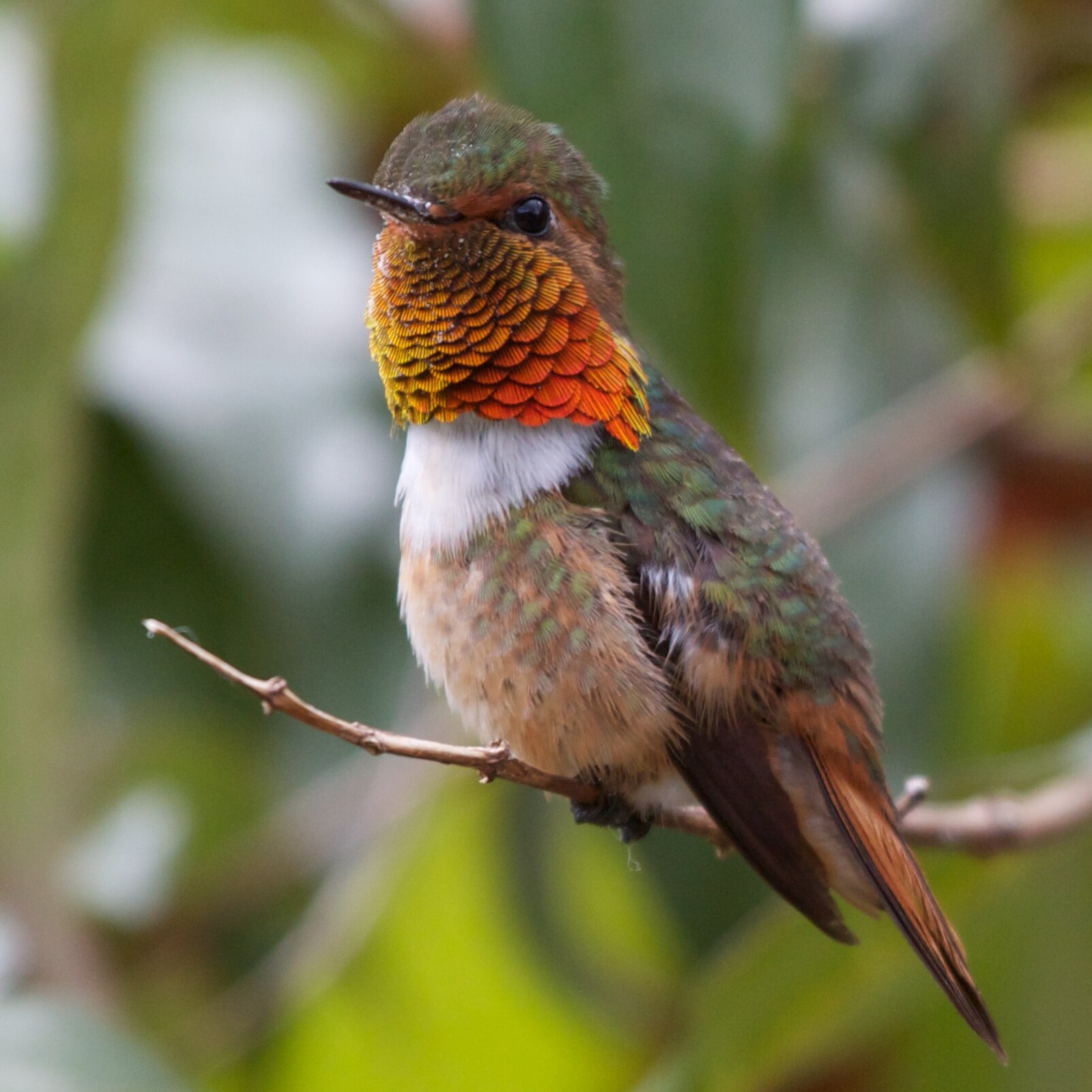
The Scintillant Hummingbird (Selasphorus scintilla) is one of the smallest birds on the planet, measuring a mere 6.5 cm in length and weighing around 2 grams. The male is spectacular despite its size: its back is a bronzy green, its flanks are rufous (orange-chestnut), and its throat (gorget) sports a dazzling metallic orange-red that glows like glowing embers when catching the light. The female shares the green back and rufous tail with a black subterminal band, but lacks the brilliant gorget, presenting instead a pale cinnamon throat with small dark speckles. Its bill is short, straight, and black, perfectly adapted for extracting nectar from small-corolla flowers.

Added by

Anonymous Curator

Reviewed by

Under Review

Last modified by

Julia Trouin

TaxonomyBiological classification ranks placing this species within the tree of life, from Kingdom down to Genus.

PhylumRank below Kingdom. Groups organisms sharing a fundamental body plan (e.g., Chordata = vertebrates and some invertebrates).Chordata
ClassRank below Phylum. Subdivides by structural traits (e.g., Mammalia, Aves, Reptilia, Insecta).Aves
OrderRank below Class. Groups related families sharing common ancestry (e.g., Carnivora, Primates).Apodiformes
FamilyRank below Order. Groups closely related genera (e.g., Felidae = cats, Canidae = dogs).Trochilidae
GenusRank just above Species. The first word in the two-part binomial scientific name.Selasphorus
Taxonomic AuthorityThe scientist who first formally described and published this species, followed by the year of publication.(Gould, 1851)
Record Completeness
85%
Coming soon

Ecology & StatusHow this species lives: habitat preferences, diet, behavior, population status, and role in its ecosystem.

OriginWhether the species is native (evolved here), endemic (found only here), or introduced by human activity.

Native

Population TrendDirection of change in population size over time: increasing, stable, decreasing, or unknown.

Decreasing

Breeding SeasonTime of year when this species typically reproduces or flowers.

Dry Season

Trophic RolePosition in the food chain: producer, herbivore, carnivore, omnivore, decomposer, or parasite.

Herbivore

Recent SightingsWhether this species has been observed in the wild in Costa Rica within recent years.

Yes

Habitat SummaryOverview of the specific ecosystems and environments where this species is found in Costa Rica. Multi-lang

It is a near-endemic resident of the highlands of Costa Rica and western Panama. It inhabits brushy areas, cloud forest edges, shrubby pastures, coffee plantations, and flowery gardens at mid to high elevations, generally between 900 and 2,500 meters above sea level. In Costa Rica, it is very common in the Central Valley and along the Tilarán, Central, and Talamanca mountain ranges, where it is a frequent visitor to urban nectar feeders.

BehaviourDaily activity patterns, movement, territory use, foraging style, and seasonal behavioral changes. Multi-lang

Despite its size, it is a bold and visible hummingbird. Males perch on bare branches or exposed wires, singing to claim their territory. Its song is a rapid series of sharp, dry chips. During courtship, the male ascends abruptly in the air and then performs a vertical 'U' shaped dive in front of the female, fanning its rufous tail and making its throat erupt in an incandescent orange color.

Social ActivitySocial structure: whether the species is solitary, paired, or colonial; hierarchy and communication. Multi-lang

Highly solitary and intensely territorial. They do not form pairs beyond the seconds that copulation lasts and will aggressively expel other hummingbirds from their flower patches.

Feeding GuildWhat the species eats, how it forages or hunts, and its role as a consumer in the food web. Multi-lang

Nectarivore / Stationary territorial forager.

Trophic Chain DetailsSpecific interactions in local food webs: prey species, predators, competitors, and scavengers. Multi-lang

Primary consumer (Nectarivore). It extracts nectar from a wide variety of small-flowered plants, including Salvia, Lantana, and blooming coffee plants. It supplements its diet by catching tiny gnats and insects in flight. Its predators include giant praying mantises and orb-weaver spiders (which can trap them in their webs), small snakes, and domestic cats.

Reproductive BehaviourMating strategies, courtship displays, nesting or spawning behavior, and parental care. Multi-lang

The female performs all the rearing alone. She builds a tiny cup-shaped nest (the size of half a walnut shell) using tree fern scales, spider web silk, and moss, camouflaging it with lichens. The nest is usually 1-4 meters high in a shrub. She lays 2 minuscule eggs (the size of a small coffee bean or a pea). Incubation lasts about 15 to 19 days. The chicks hatch blind and defenseless, and are fed by regurgitation until they leave the nest after about 20-22 days.

Physical Measures

Length (cm)

6.5 - 7.0 cm

Weight (Grams)

1.7 g - 2.2 g

Offspring per cycleTypical number of young (live births, eggs, or seeds) produced by one adult in a single reproductive event or breeding season.2 - 2
Sexual DimorphismObservable physical differences between males and females of the same species (e.g., size, coloration, features).Yes

Lifespan

Sexual MaturityAge at which the individual becomes capable of reproducing for the first time.

10 - 12 Months

Gestation / IncubationDuration from fertilization to birth (mammals) or to hatching (egg-laying species).

15 - 19

Lifespan EstimatedExpected duration of life from birth to natural death under wild conditions.
Males2 - 5 Years
Females2 - 5 Years

Sexual DimorphismPhysical differences in size, coloration, or morphology between males and females of this species.

Males Multi-lang

The male sports a dazzling, glowing metallic coppery orange-red throat patch (gorget).

Females Multi-lang

The female lacks the iridescent throat patch; her underparts are pale buff or cinnamon, with fine dark speckling on the throat.

Evolutionary AdaptationsInherited traits and behaviors that improve the species' survival and reproduction in its specific environment. Multi-lang

Extreme Metabolism and Nocturnal Torpor: Because its volume-to-surface-area ratio is minuscule, it loses body heat rapidly. To survive the cold mountain nights in Costa Rica, it enters a state of lethargy or 'torpor', lowering its body temperature from 40°C to almost ambient temperature, reducing its energy consumption to a bare minimum.
Insect-like Flight (Micro-Maneuverability): Despite its size, its wings beat at an astonishing speed of up to 80 times per second. This extreme anatomy allows it to hover like a miniature helicopter in front of flowers that are too small or delicate to support the weight of large insects or other hummingbirds.

Main ThreatsDocumented pressures reducing the population: habitat loss, hunting, disease, climate change, and invasive species. Multi-lang

Domestic Predators (Cats): Being so small and frequently foraging in low urban gardens (like in the Central Valley), they are highly vulnerable to domestic cats, which hunt them by stalking among the floral shrubs.
Urban Development in the Central Valley: The rapid urban expansion and paving of the Costa Rican highlands have eliminated extensive areas of natural scrub and traditional coffee plantations, fragmenting its habitat.

Interesting FactsSurprising or notable facts that highlight what makes this species unique or ecologically important. Multi-lang

Insect Confusion: Due to its minuscule size and rapid buzzing flight, people frequently confuse the Scintillant Hummingbird with sphinx moths (Sphingidae) or large bees when it forages at dusk.
The Tiny Warrior: Despite weighing the same as a small coin, it has disproportionate aggressiveness. Males will fiercely defend their flower bush against other hummingbirds triple their size.