
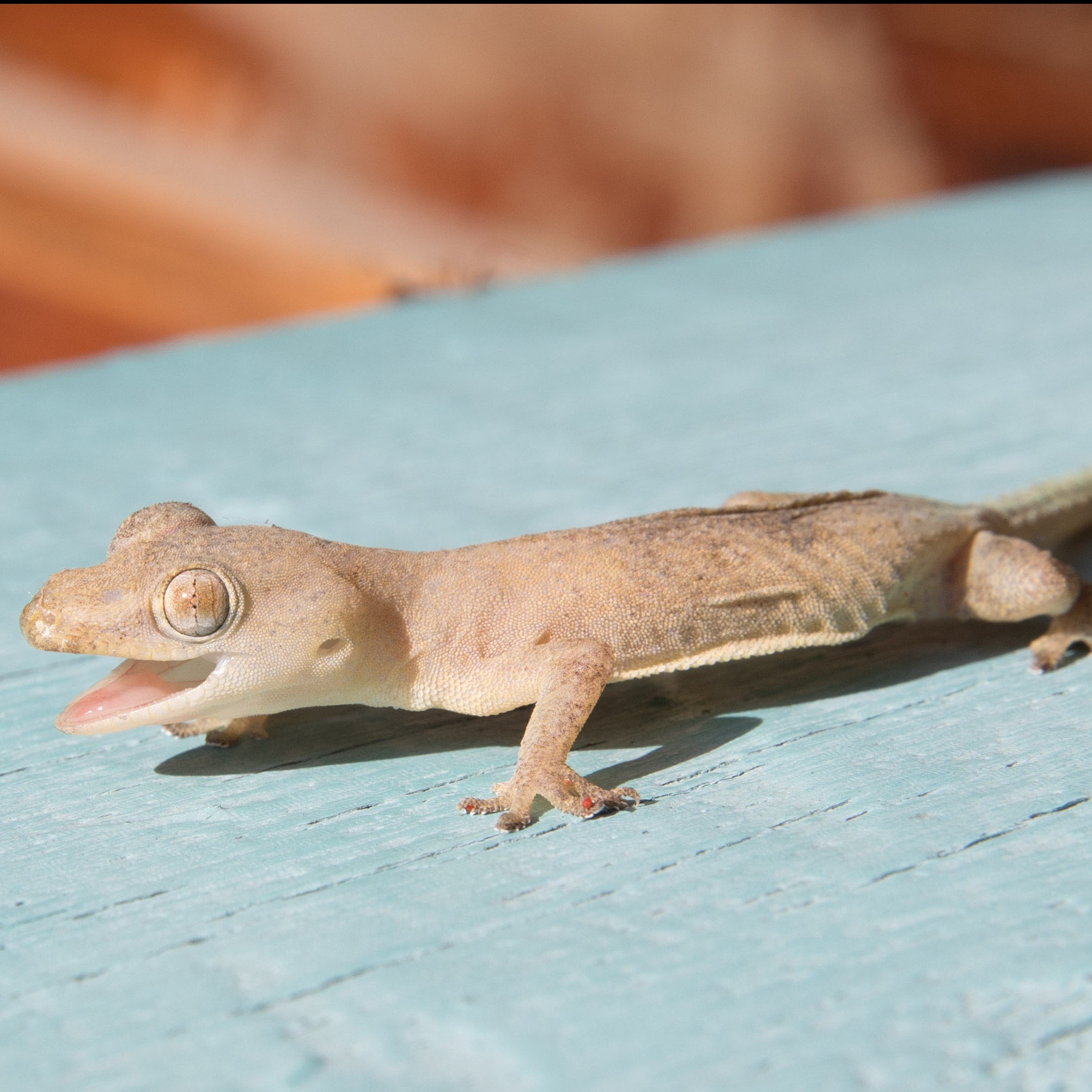
Hemidactylus frenatus
Common House Gecko
Schlegel, 1836
Added by
Anonymous Curator
Reviewed by
Under Review
Last modified by
Julia Trouin
TaxonomyBiological classification ranks placing this species within the tree of life, from Kingdom down to Genus.
Ecology & StatusHow this species lives: habitat preferences, diet, behavior, population status, and role in its ecosystem.
OriginWhether the species is native (evolved here), endemic (found only here), or introduced by human activity.
Introduced
Population TrendDirection of change in population size over time: increasing, stable, decreasing, or unknown.
Increasing
Breeding SeasonTime of year when this species typically reproduces or flowers.
Year Round
Trophic RolePosition in the food chain: producer, herbivore, carnivore, omnivore, decomposer, or parasite.
Insectivore
Recent SightingsWhether this species has been observed in the wild in Costa Rica within recent years.
Yes
Habitat SummaryOverview of the specific ecosystems and environments where this species is found in Costa Rica. Multi-lang
Highly synanthropic species. Although native to Southeast Asia, it has successfully established itself in homes, warehouses, and urban areas throughout the Neotropics. It prefers walls, ceilings, and areas near artificial light sources where insects congregate.BehaviourDaily activity patterns, movement, territory use, foraging style, and seasonal behavioral changes. Multi-lang
Reptile of nocturnal and crepuscular activity, highly active in human environments. It spends the day hidden in cracks and dark areas, coming out at dusk to hunt under artificial lights. It is a very agile animal, capable of making precise jumps and quick movements to escape predators or capture prey.Social ActivitySocial structure: whether the species is solitary, paired, or colonial; hierarchy and communication. Multi-lang
Solitary and territorial animal, although in areas with high food availability (near artificial lights) dense groupings can be observed. Males are aggressive towards other males and actively defend their hunting areas through vocalizations and postural displays.Feeding GuildWhat the species eats, how it forages or hunts, and its role as a consumer in the food web. Multi-lang
Opportunistic insectivore. Its diet consists mainly of small and medium-sized insects, such as moths, mosquitoes, beetles, spiders, and small cockroaches. It uses a stalking hunting style, waiting patiently near light sources before pouncing on the prey with a quick movement.Trophic Chain DetailsSpecific interactions in local food webs: prey species, predators, competitors, and scavengers. Multi-lang
Functions as a regulator of insect populations in urban and peri-urban ecosystems, consuming a large quantity of mosquitoes, moths, and cockroaches. In turn, it is preyed upon by domestic cats, insectivorous birds, large spiders, and snakes, integrating effectively into highly altered trophic webs.Reproductive BehaviourMating strategies, courtship displays, nesting or spawning behavior, and parental care. Multi-lang
Oviparous species. The female generally deposits 2 hard-shelled eggs in protected cracks or under bark. These eggs are very resistant and can hatch after a variable incubation period. The ability to reproduce throughout the year in tropical climates has contributed significantly to its success as an invasive species.Physical Measures
Length (cm)
7.0 - 13.0 cm
Weight (Grams)
3 g - 8 g
Lifespan
Sexual MaturityAge at which the individual becomes capable of reproducing for the first time.
0.5 - 1 Years
Gestation / IncubationDuration from fertilization to birth (mammals) or to hatching (egg-laying species).
40 - 50