
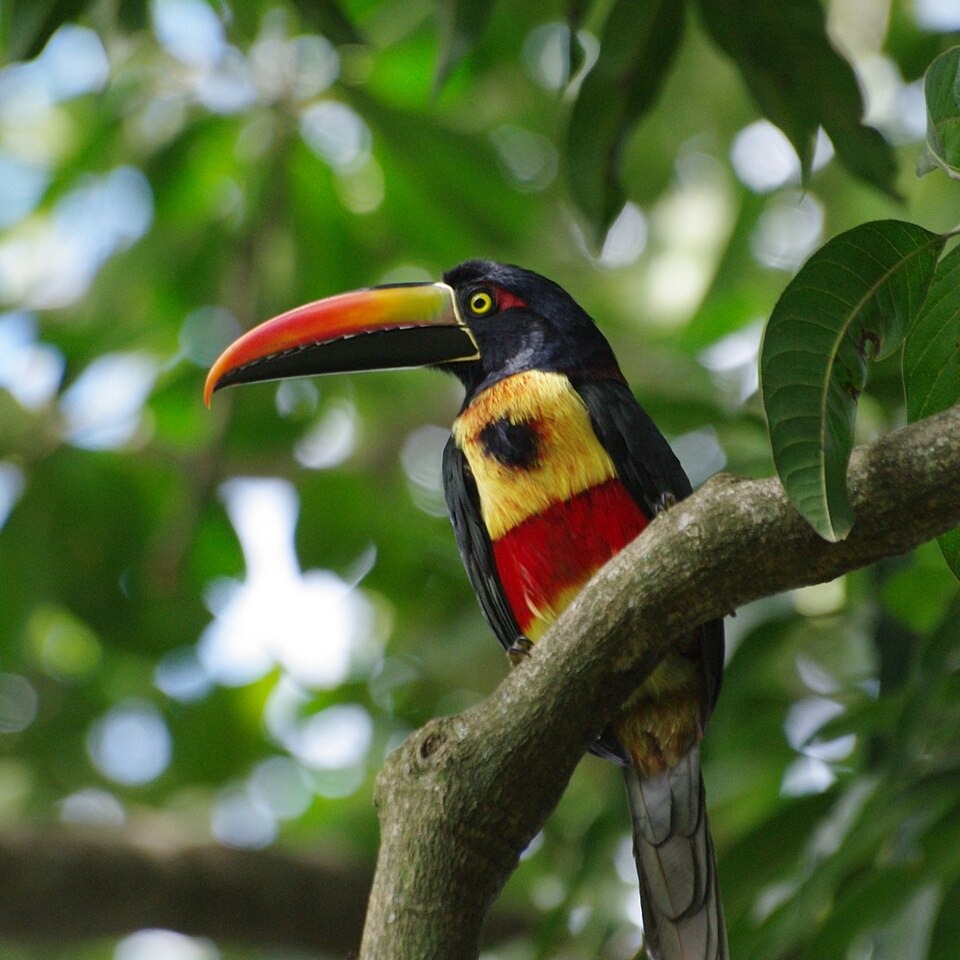
Pteroglossus frantzii
Fiery-billed Aracari
Cabanis, 1861
Added by
Anonymous Curator
Reviewed by
Under Review
Last modified by
Julia Trouin
TaxonomyBiological classification ranks placing this species within the tree of life, from Kingdom down to Genus.
Ecology & StatusHow this species lives: habitat preferences, diet, behavior, population status, and role in its ecosystem.
OriginWhether the species is native (evolved here), endemic (found only here), or introduced by human activity.
Native
Population TrendDirection of change in population size over time: increasing, stable, decreasing, or unknown.
Decreasing
Breeding SeasonTime of year when this species typically reproduces or flowers.
--
Trophic RolePosition in the food chain: producer, herbivore, carnivore, omnivore, decomposer, or parasite.
Frugivore
Recent SightingsWhether this species has been observed in the wild in Costa Rica within recent years.
Yes
Habitat SummaryOverview of the specific ecosystems and environments where this species is found in Costa Rica. Multi-lang
The fiery-billed aracari preferentially inhabits the canopy and subcanopy of lowland and premontane tropical moist and very moist forests, between sea level and 1,700 meters in altitude, although it is most abundant between 0 and 900 meters. It occupies continuous mature forests, advanced secondary forests with canopy connectivity, forest edges, cacao and banana plantations adjacent to native forest, and wooded riparian corridors. It requires the simultaneous presence of productive fruit trees and old trees with cavities for nesting — especially cavities previously excavated by woodpeckers. In Costa Rica it is distributed primarily in the Central and South Pacific, including the Osa Peninsula, Manuel Antonio National Park, Carara Biological Reserve, and the Osa-Talamanca corridor. It is considerably more tolerant of habitat disturbance than the quetzal and can persist in agricultural landscapes with sufficient remnant tree cover.BehaviourDaily activity patterns, movement, territory use, foraging style, and seasonal behavioral changes. Multi-lang
The fiery-billed aracari is diurnal and highly social throughout the year. It lives in family or non-family groups of 3 to 10 individuals that move together through the canopy in search of ripe fruits, communicating constantly through vocalizations while moving. Upon locating a productive tree, the complete group may remain in it for 30 to 90 minutes before continuing the route. Groups have home ranges of 10 to 50 hectares that partially overlap with those of neighboring groups. They are territorially active during the breeding season, when the group defends the nesting cavity from intruders and predators through vocal alarms, bill displays, and aerial pursuits. Outside the breeding season groups are more tolerant of each other. They sleep in compact groups inside tree cavities. Their vocalizations — a series of repetitive sharp chirps — are audible from several hundred meters and are the most reliable indicator of their presence in the canopy.Social ActivitySocial structure: whether the species is solitary, paired, or colonial; hierarchy and communication. Multi-lang
The fiery-billed aracari is one of the toucan species with the greatest recorded social cohesion. It lives in permanent groups of 3 to 10 individuals — averaging 5 — that maintain a stable social structure throughout the year and not only during the breeding season. Group members follow each other from tree to tree during foraging, vocally alert each other to predators, share the nocturnal roosting cavity, and may cooperatively participate in feeding chicks that are not their own ('helpers at the nest' behavior). Intraspecific communication is predominantly vocal, with continuous contact calls during group movement, differentiated alarm calls for aerial and terrestrial threats, and short-range vocalizations during feeding. No rigid dominance hierarchies within groups have been documented.Feeding GuildWhat the species eats, how it forages or hunts, and its role as a consumer in the food web. Multi-lang
Specialized frugivore with insectivorous-carnivorous supplement. Its diet consists primarily of ripe canopy fruits of the families Moraceae (Ficus spp.), Melastomataceae, Arecaceae (especially small understory palms), Burseraceae, Myrtaceae, and Lauraceae. The proportion of Ficus fruits can reach 40% of the diet during periods of low availability of other fruits. During the breeding season it incorporates a higher proportion of animal protein — large insects, small vertebrates, and eggs — to meet the nutritional requirements of the chicks. It captures animal prey directly from foliage or from bark with rapid, precise bill movements. It does not store food.Trophic Chain DetailsSpecific interactions in local food webs: prey species, predators, competitors, and scavengers. Multi-lang
Specialized frugivorous primary consumer and seed disperser of significant importance in the South Pacific forests. It primarily consumes canopy and subcanopy fruits of the families Melastomataceae, Moraceae (especially Ficus spp.), Arecaceae, Burseraceae, Myrtaceae, and Lauraceae. By ingesting whole fruits and regurgitating or defecating intact seeds at distances of up to 300 meters, it acts as a primary seed disperser of palms (Welfia, Iriartea, Socratea), higuerones, and various understory trees. It also consumes insects (especially mantids, orthopterans, and large beetles), small frogs, lizards, and eggs of other birds during the breeding season. Its main predators are the collared forest-falcon (Micrastur semitorquatus), bicolored hawk (Accipiter bicolor), keel-billed toucan (Ramphastos sulfuratus), boa constrictor (Boa constrictor), and Central American squirrel monkey (Saimiri oerstedii) which can predate eggs and chicks in the cavity. The tiger ratsnake (Spilotes pullatus) represents a specialized nest predator in cavities.Reproductive BehaviourMating strategies, courtship displays, nesting or spawning behavior, and parental care. Multi-lang
The fiery-billed aracari's breeding season in Costa Rica extends primarily from February to June, with the peak of nesting activity between March and May. Existing social groups participate cooperatively in reproduction: although only the dominant pair of the group breeds, the other group members — 'helpers' — participate in feeding the chicks and guarding the nest. The nesting cavity is always pre-existing — the aracari does not excavate — and consists of a woodpecker hole or natural cavity in an old tree, at a height of 3 to 25 meters. The interior of the cavity is not lined with nesting material. The clutch normally consists of 2 to 4 white eggs. Both sexes incubate, with turns of 50 to 90 minutes, for 16 to 17 days. Chicks hatch altricial — blind and without down — and are fed by the breeding pair and helpers with an initial diet rich in insects, lizards, and small frogs that gradually incorporates fruits. The nestling period is 40 to 50 days. Young reach full adult plumage at 12–18 months.Physical Measures
Length (cm)
43.0 - 47.0 cm
Weight (Grams)
200 g - 280 g
Lifespan
Sexual MaturityAge at which the individual becomes capable of reproducing for the first time.
1 - 2 Years
Gestation / IncubationDuration from fertilization to birth (mammals) or to hatching (egg-laying species).
16 - 17