
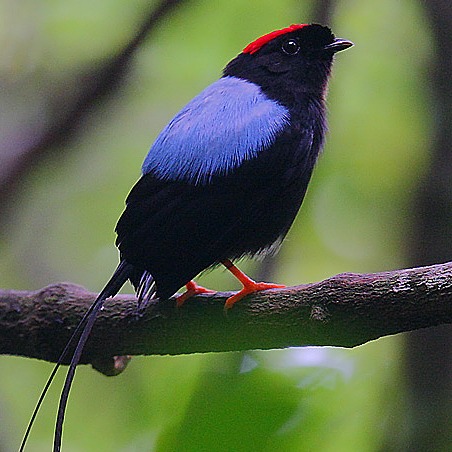
Chiroxiphia linearis
Long-tailed Manakin
(Bonaparte, 1838)
Added by
Anonymous Curator
Reviewed by
Under Review
Last modified by
Julia Trouin
TaxonomyBiological classification ranks placing this species within the tree of life, from Kingdom down to Genus.
Ecology & StatusHow this species lives: habitat preferences, diet, behavior, population status, and role in its ecosystem.
OriginWhether the species is native (evolved here), endemic (found only here), or introduced by human activity.
Native
Population TrendDirection of change in population size over time: increasing, stable, decreasing, or unknown.
Decreasing
Breeding SeasonTime of year when this species typically reproduces or flowers.
--
Trophic RolePosition in the food chain: producer, herbivore, carnivore, omnivore, decomposer, or parasite.
Insectivore
Recent SightingsWhether this species has been observed in the wild in Costa Rica within recent years.
Yes
Habitat SummaryOverview of the specific ecosystems and environments where this species is found in Costa Rica. Multi-lang
It predominantly inhabits the dense understory of tropical dry forests, deciduous forests, secondary scrub, and gallery forests from southern Mexico to northwestern Costa Rica. In Costa Rica, it is an emblematic species of the Guanacaste province and the Nicoya Peninsula, preferring shaded areas and vine tangles near streams where males can establish their display zones (leks).BehaviourDaily activity patterns, movement, territory use, foraging style, and seasonal behavioral changes. Multi-lang
They are understory birds that rarely venture into the canopy. They fly with quick, short buzzing flights through dense shrubby vegetation. Males are territorial regarding their display areas (leks), while females maintain a low, silent profile, moving stealthily to evaluate males and forage.Social ActivitySocial structure: whether the species is solitary, paired, or colonial; hierarchy and communication. Multi-lang
The social system revolves around the lek. Males are not solitary; they depend on a cooperative system of hierarchical male alliances that can last a lifetime. Females, however, are completely solitary outside of the brief copulation event.Feeding GuildWhat the species eats, how it forages or hunts, and its role as a consumer in the food web. Multi-lang
Frugivore and insectivore. Although their diet consists of 80% small fleshy fruits plucked on the wing, they supplement their nutrition by catching small insects and spiders in the foliage, providing vital protein especially during the breeding season.Trophic Chain DetailsSpecific interactions in local food webs: prey species, predators, competitors, and scavengers. Multi-lang
They act predominantly as specialized understory frugivores, functioning as crucial seed dispersers for plant regeneration in the Melastomataceae and Rubiaceae families. They are preyed upon mainly by small arboreal snakes, forest raptors (such as the Double-toothed Kite), and small mammals.Reproductive BehaviourMating strategies, courtship displays, nesting or spawning behavior, and parental care. Multi-lang
Mating is polygynous. After copulation, the male completely disengages. The female assumes all reproductive responsibility: she builds a fragile cup-shaped nest suspended from a low fork over a stream, incubates 2 cream-colored, brown-spotted eggs for 18 to 20 days, and solely feeds the altricial chicks.Physical Measures
Length (cm)
11.0 - 27.0 cm
Weight (Grams)
15 g - 22 g
Lifespan
Sexual MaturityAge at which the individual becomes capable of reproducing for the first time.
1 - 4 Years
Gestation / IncubationDuration from fertilization to birth (mammals) or to hatching (egg-laying species).
18 - 20