
AnimaliaIUCN LCIn Progress Recent Sighting
Chiroxiphia linearis
Long-tailed Manakin
(Bonaparte, 1838)
Detailed Texts Multi-lang
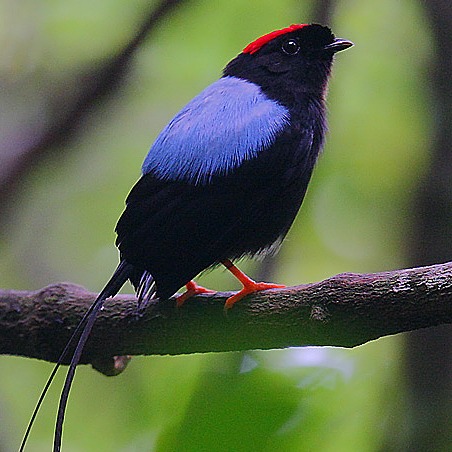
It is a small, plump bird with marked sexual dimorphism. The adult male is unmistakable: his plumage is a deep velvety black that contrasts dramatically with a bright sky-blue mantle on his back and a scarlet-red crest on his crown. His most distinctive feature is the two central tail feathers, which extend like fine black ribbons up to 15 cm beyond his body. The female, conversely, presents cryptic plumage of a uniform olive-green tone, slightly paler on the belly, designed for perfect camouflage in the understory. Both sexes have striking pale orange legs.
Added by
Anonymous Curator
Reviewed by
Under Review
Last modified by
Julia Trouin
Taxonomy
PhylumChordata
ClassAves
OrderPasseriformes
FamilyPipridae
GenusChiroxiphia
Taxonomic Authority(Bonaparte, 1838)
Ecology & Status
Origin
Native
Population Trend
Decreasing
Breeding Season
--
Trophic Role
Insectivore
Recent Sightings
Yes
Habitat Summary Multi-lang
It predominantly inhabits the dense understory of tropical dry forests, deciduous forests, secondary scrub, and gallery forests from southern Mexico to northwestern Costa Rica. In Costa Rica, it is an emblematic species of the Guanacaste province and the Nicoya Peninsula, preferring shaded areas and vine tangles near streams where males can establish their display zones (leks).Behaviour Multi-lang
They are understory birds that rarely venture into the canopy. They fly with quick, short buzzing flights through dense shrubby vegetation. Males are territorial regarding their display areas (leks), while females maintain a low, silent profile, moving stealthily to evaluate males and forage.Social Activity Multi-lang
The social system revolves around the lek. Males are not solitary; they depend on a cooperative system of hierarchical male alliances that can last a lifetime. Females, however, are completely solitary outside of the brief copulation event.Feeding Guild Multi-lang
Frugivore and insectivore. Although their diet consists of 80% small fleshy fruits plucked on the wing, they supplement their nutrition by catching small insects and spiders in the foliage, providing vital protein especially during the breeding season.Trophic Chain Details Multi-lang
They act predominantly as specialized understory frugivores, functioning as crucial seed dispersers for plant regeneration in the Melastomataceae and Rubiaceae families. They are preyed upon mainly by small arboreal snakes, forest raptors (such as the Double-toothed Kite), and small mammals.Reproductive Behaviour Multi-lang
Mating is polygynous. After copulation, the male completely disengages. The female assumes all reproductive responsibility: she builds a fragile cup-shaped nest suspended from a low fork over a stream, incubates 2 cream-colored, brown-spotted eggs for 18 to 20 days, and solely feeds the altricial chicks.Physical Measures
Length (cm)
11.0 - 27.0 cm
Weight (Grams)
15 g - 22 g
Offspring per cycle1 - 2
Sexual DimorphismYes
Lifespan
Sexual Maturity
1 - 4 Years
Gestation / Incubation
18 - 20
Lifespan Estimated
Males10 - 15 Years
Females10 - 15 Years
Sexual Dimorphism
Males Multi-lang
Adult male with deep black plumage, intense red crown, bright blue mantle, and two extremely long central tail feathers. Its evolution has favored aesthetic ostentation to win the female's favor at the lek.
Females Multi-lang
Uniform olive-green plumage, lacking the red crown or bright blue, and a short tail. Evolutionarily designed to blend in with dense vegetation and protect the nest from predators.
Evolutionary Adaptations Multi-lang
Leapfrog Dance Choreography: Males have evolved a hyper-complex behavioral adaptation. Two males (an alpha master and a beta apprentice) perform a synchronized dance on a horizontal branch, alternately jumping over each other in mid-air like a moving wheel, while emitting high-pitched buzzes to impress the female.
Modified Feathers for Sonority: Their wings possess evolutionarily adapted primary feathers that allow them to generate mechanical sounds akin to a whip crack or an insect's buzz during their nuptial flights, adding a physical acoustic element to their vocal song.
Main Threats Multi-lang
Dry Forest Loss: The Mesoamerican tropical dry forest is one of the most threatened ecosystems in the world. Its deforestation for cattle pastures and agriculture critically fragments the biological corridors these manakins require.
Phenological Mismatch due to Climate Change: Unpredictable variations in rainfall affect the seasonal availability of small wild fruits, interfering with the energy required for their prolonged and exhausting courtship displays.
Interesting Facts Multi-lang
The Faithful Apprentice: In the courtship alliance, only the dominant male (alpha) gets to mate with the female. The subordinate male (beta) invests years cooperating in the dance with no immediate reproductive reward, waiting to inherit the display zone (lek) and alpha rank when the master dies.
The Origin of 'Toledo': Its common Spanish name comes directly from its distinctive, loud duet call. When the alpha and beta males vocalize in unison to attract females, it sounds exactly as if they are whistling the word 'To-le-do! To-le-do!'.