Costa Rica Species
Tillandsia usneoides
PlantaeHighest rank in taxonomy. Groups all life into domains: Animalia, Plantae, Fungi, etc.IUCN LCInternational Union for Conservation of Nature — the world authority on species extinction risk, using standardized criteria. — Least Concern — widespread and abundant; not at immediate risk of extinction.In ProgressCurrent stage of this record in the editorial review workflow. Recent Sighting

Tillandsia usneoides

Spanish Moss

(L.) L., 1762

Detailed Texts Multi-lang
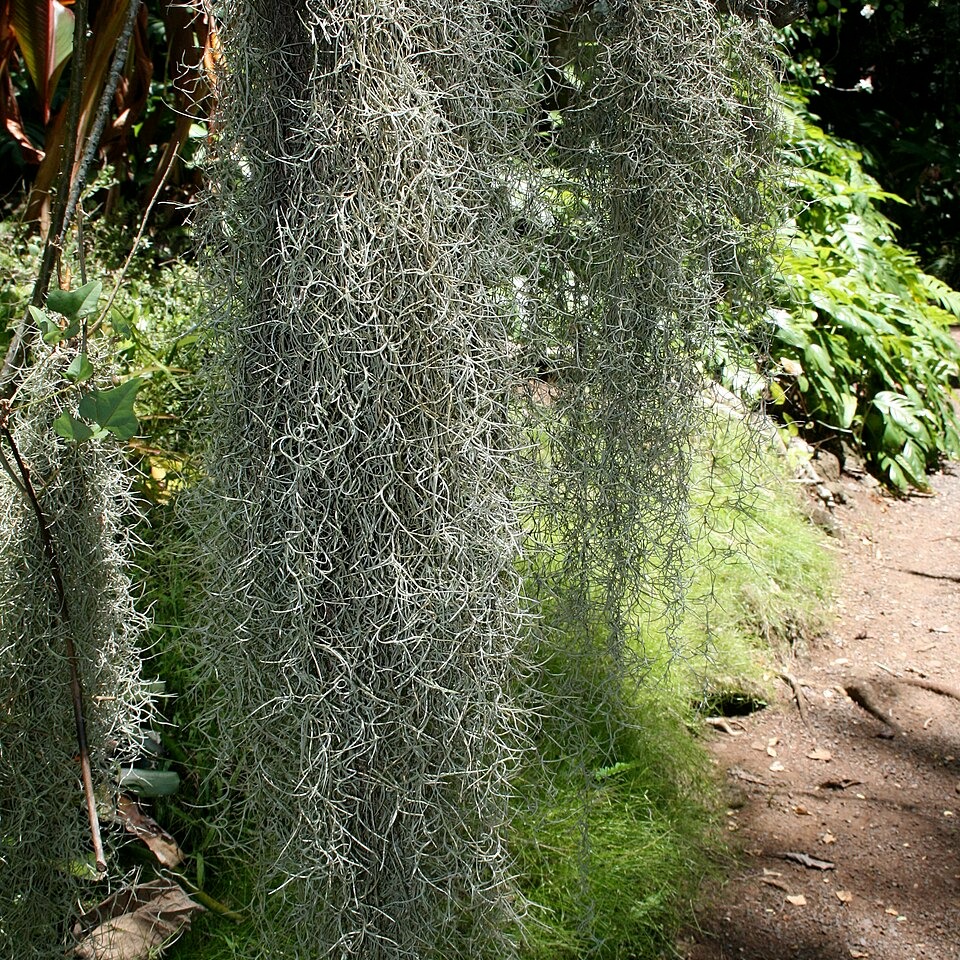
Tillandsia usneoides, popularly known as Spanish moss, is a fascinating epiphytic plant that lacks true roots and grows suspended from tree branches. Although its appearance resembles moss or lichen (hence its specific name usneoides, after the Usnea lichen), it is actually a vascular plant in the bromeliad family. It features slender, branched, and drooping stems that can form curtains up to several meters in length. Its leaves are small, distichous, and densely covered by specialized scales (trichomes) that give it a characteristic silver-gray color. It produces tiny, solitary flowers, usually pale green or bluish, which emanate a soft fragrance at night. Its fruits are slender capsules that release feathery seeds designed to be carried by the wind. It is an architectural species that defines the aesthetics of wet and dry forests, creating ethereal landscapes.

Added by

Anonymous Curator

Reviewed by

Under Review

Last modified by

Julia Trouin

TaxonomyBiological classification ranks placing this species within the tree of life, from Kingdom down to Genus.

PhylumRank below Kingdom. Groups organisms sharing a fundamental body plan (e.g., Chordata = vertebrates and some invertebrates).Tracheophyta
ClassRank below Phylum. Subdivides by structural traits (e.g., Mammalia, Aves, Reptilia, Insecta).Liliopsida
OrderRank below Class. Groups related families sharing common ancestry (e.g., Carnivora, Primates).Poales
FamilyRank below Order. Groups closely related genera (e.g., Felidae = cats, Canidae = dogs).Bromeliaceae
GenusRank just above Species. The first word in the two-part binomial scientific name.Tillandsia
Taxonomic AuthorityThe scientist who first formally described and published this species, followed by the year of publication.(L.) L., 1762
Record Completeness
91%
Coming soon

Ecology & StatusHow this species lives: habitat preferences, diet, behavior, population status, and role in its ecosystem.

OriginWhether the species is native (evolved here), endemic (found only here), or introduced by human activity.

Native

Population TrendDirection of change in population size over time: increasing, stable, decreasing, or unknown.

Stable

Trophic RolePosition in the food chain: producer, herbivore, carnivore, omnivore, decomposer, or parasite.

--

Growth HabitPhysical form and structure of the plant: tree, shrub, herb, vine, epiphyte, aquatic, etc.

--

Leaf TypeLeaf characteristics: deciduous (seasonal shed), evergreen, simple, compound, needle-like, etc.

--

Flowering SeasonTime of year when this species typically reproduces or flowers.

--

Recent SightingsWhether this species has been observed in the wild in Costa Rica within recent years.

Yes

Habitat SummaryOverview of the specific ecosystems and environments where this species is found in Costa Rica. Multi-lang

It is an extremely versatile species that inhabits everything from tropical dry forests to cloud forests and mangroves. It is found from sea level up to 3,300 meters (10,800 feet) in altitude. It requires high ambient humidity or frequent fog but tolerates drought periods thanks to its trichomes. In Costa Rica, it is commonly seen decorating tree branches in the Central Valley, Guanacaste, and the mountainous areas of the Talamanca Range.

Light & Water NeedsSunlight intensity and moisture levels this plant needs to grow and reproduce successfully. Multi-lang

Information not available in English. Help us expand this record!

BehaviourDaily activity patterns, movement, territory use, foraging style, and seasonal behavioral changes. Multi-lang

It is a vital component of the forest ecosystem. Its dense curtains provide shelter and nesting material for numerous birds, bats, and reptiles. It also intercepts fog water, redistributing it to the ground through foliar drip, increasing water availability for other plants. Its reproduction is both sexual and vegetative, with pieces of the plant commonly carried by the wind or birds to colonize new trees.

Toxicity / UsesToxic compounds present and their documented effects on humans or other organisms. Multi-lang

Information not available in English. Help us expand this record!

Physical Measures

Length (cm)

20.0 - 300.0 cm

Reproductive StructuresFlowers, fruits, and seeds — the reproductive organs and their seasonal appearance.

Flower Photos (Max 2)

No image

Fruit Photos (Max 2)

No image

Evolutionary AdaptationsInherited traits and behaviors that improve the species' survival and reproduction in its specific environment. Multi-lang

Absorbent Trichomes: The entire surface of the plant is covered by multicellular scales called trichomes. These act as biological valves: when it rains or is foggy, the trichomes open to absorb water and nutrients directly from the air; when the environment is dry, they close to prevent transpiration, giving the plant its reflective silvery color.
CAM Metabolism: As an adaptation to epiphytic life and drought periods, it uses Crassulacean Acid Metabolism (CAM), opening its stomata only at night to fix CO2, minimizing water loss during the hot day.

Main ThreatsDocumented pressures reducing the population: habitat loss, hunting, disease, climate change, and invasive species. Multi-lang

Air pollution: By obtaining its nutrients directly from the air and rain, Spanish moss is extremely sensitive to heavy metal and sulfur dioxide pollution, acting as a bioindicator of air quality.

Interesting FactsSurprising or notable facts that highlight what makes this species unique or ecologically important. Multi-lang

Neither moss nor Spanish: Despite its name, it is not a moss (it is a flowering plant) and is native to the Americas, not Spain. The name arose from a humorous comparison by French explorers to the beards of Spaniards.