
AnimaliaIUCN ENIn Progress Recent Sighting
Nototriton abscondens
Hiding Moss Salamander
Taylor, 1948
Detailed Texts Multi-lang
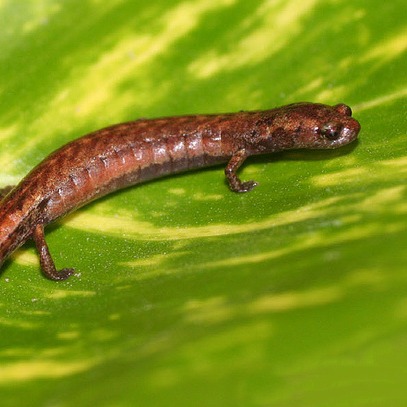
An extremely small amphibian, with a slender body and short limbs. Its skin presents tones that mimic the texture and color of moss, allowing it to remain hidden in plain sight in its microhabitat.
Added by
Anonymous Curator
Reviewed by
Under Review
Last modified by
Julia Trouin
Taxonomy
PhylumChordata
ClassAmphibia
OrderCaudata
FamilyPlethodontidae
GenusNototriton
Taxonomic AuthorityTaylor, 1948
Ecology & Status
Origin
Native
Population Trend
Decreasing
Breeding Season
Year Round
Trophic Role
Insectivore
Recent Sightings
Yes
Habitat Summary Multi-lang
Inhabits exclusively high-elevation cloud forests in Costa Rica, mainly within patches of moss, liverworts, and epiphytic bromeliads.Behaviour Multi-lang
Strictly nocturnal and cryptic habits. It spends the day buried in moss or within bromeliad cavities to avoid desiccation.Social Activity Multi-lang
Completely solitary. Social interactions are minimal and appear to be almost exclusively for reproductive courtship.Feeding Guild Multi-lang
Ambush predator. Remains still on the moss, waiting for a tiny prey to pass nearby before attacking with a quick movement.Trophic Chain Details Multi-lang
Insectivore specialized in very small-sized prey, such as moss mites, small springtails, and eggs of other invertebrates.Reproductive Behaviour Multi-lang
Oviparous; lays very small clutches of eggs on protected substrates. Direct development (no tadpole stage).Physical Measures
Length (cm)
2.5 - 3.5 cm
Weight (Grams)
0.2 g - 0.8 g
Offspring per cycle2 - 6
Sexual DimorphismYes
Lifespan
Sexual Maturity
1 - 2 Years
Gestation / Incubation
2 - 4
Lifespan Estimated
Males2 - 4 Years
Females2 - 4 Years
Sexual Dimorphism
Males Multi-lang
Minimal morphological differences; males with slightly more marked submandibular glands for chemical communication during courtship.
Females Multi-lang
Females slightly larger and more robust to manage egg-laying within the confined spaces of the moss.
Evolutionary Adaptations Multi-lang
Miniaturization: Its tiny size allows it to access microspaces in moss and between leaves, places inaccessible to larger predators.
Main Threats Multi-lang
Habitat loss and rising temperatures: Being a species restricted to high and very humid areas, it is extremely vulnerable to forest fragmentation and climate change.
Interesting Facts Multi-lang
It is a notable example of "microendemism", where a species can have a range of geographic distribution extremely restricted to a few mountain slopes.