
Costa Rica Species
Mazama americana
AnimaliaHighest rank in taxonomy. Groups all life into domains: Animalia, Plantae, Fungi, etc.IUCN DDInternational Union for Conservation of Nature — the world authority on species extinction risk, using standardized criteria. — Data Deficient — not enough data to make a reliable assessment of extinction risk.In ProgressCurrent stage of this record in the editorial review workflow. Recent Sighting

Mazama americana

Red Brocket Deer

(Erxleben, 1777)

Detailed Texts Multi-lang
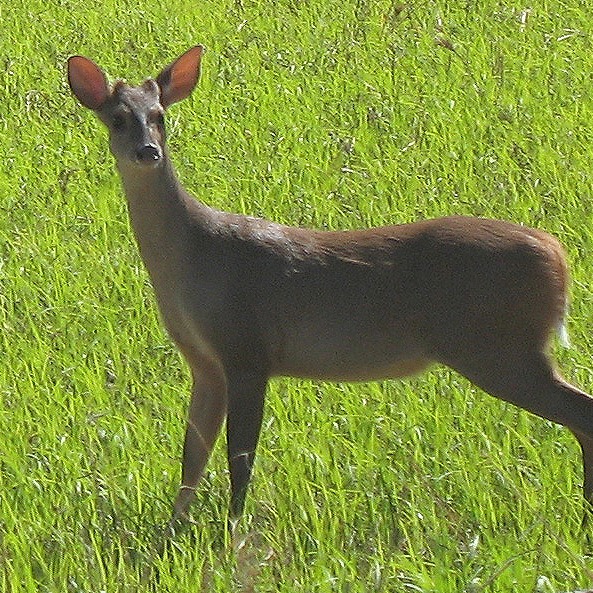
Mazama americana is the largest and most robust deer of the Mazama genus. Its body is remarkably adapted to life in dense undergrowth: it has an arched back and hind legs slightly longer than the front legs, giving it a hunched silhouette that facilitates movement through intricate vegetation. The fur is an intense reddish-brown on the torso, becoming lighter, almost whitish, on the throat, inside of the legs, and the ventral area. Its head is relatively small with short, rounded ears. Males possess simple, short, and pointed antlers (unbranched), which rarely exceed 12 cm, reducing the risk of getting tangled in the brush. Unlike the white-tailed deer, the red brocket is much shyer, has solitary habits, and its presence is usually detected more by its tracks and signs than by direct sightings.

Added by

Anonymous Curator

Reviewed by

Under Review

Last modified by

Julia Trouin

TaxonomyBiological classification ranks placing this species within the tree of life, from Kingdom down to Genus.

PhylumRank below Kingdom. Groups organisms sharing a fundamental body plan (e.g., Chordata = vertebrates and some invertebrates).Chordata
ClassRank below Phylum. Subdivides by structural traits (e.g., Mammalia, Aves, Reptilia, Insecta).Mammalia
OrderRank below Class. Groups related families sharing common ancestry (e.g., Carnivora, Primates).Artiodactyla
FamilyRank below Order. Groups closely related genera (e.g., Felidae = cats, Canidae = dogs).Cervidae
GenusRank just above Species. The first word in the two-part binomial scientific name.Mazama
Taxonomic AuthorityThe scientist who first formally described and published this species, followed by the year of publication.(Erxleben, 1777)
Record Completeness
85%
Coming soon

Ecology & StatusHow this species lives: habitat preferences, diet, behavior, population status, and role in its ecosystem.

OriginWhether the species is native (evolved here), endemic (found only here), or introduced by human activity.

Native

Population TrendDirection of change in population size over time: increasing, stable, decreasing, or unknown.

Decreasing

Breeding SeasonTime of year when this species typically reproduces or flowers.

Year Round

Trophic RolePosition in the food chain: producer, herbivore, carnivore, omnivore, decomposer, or parasite.

Herbivore

Recent SightingsWhether this species has been observed in the wild in Costa Rica within recent years.

Yes

Habitat SummaryOverview of the specific ecosystems and environments where this species is found in Costa Rica. Multi-lang

It is a specialist of primary and mature secondary forests, preferring humid tropical rainforests, gallery forests, and areas with very dense vegetation. It avoids open or deforested areas, as it relies on forest cover to evade predators. In Costa Rica, it is distributed on both slopes, from sea level to 2,500 meters in altitude, found in protected areas such as Corcovado, Tortuguero, and the foothills of the Talamanca Range.

BehaviourDaily activity patterns, movement, territory use, foraging style, and seasonal behavioral changes. Multi-lang

It is a solitary animal, except during mating or when a mother accompanies her young. It is primarily nocturnal and crepuscular, although in areas without hunting pressure, it may show diurnal activity. Its diet is frugivorous-browser, consuming a wide variety of fallen fruits, fungi, flowers, and tender shoots. It plays a crucial role as a seed disperser for canopy trees. When threatened, it often emits a loud snort or thumps the ground with its hind legs before disappearing into the thicket.

Social ActivitySocial structure: whether the species is solitary, paired, or colonial; hierarchy and communication. Multi-lang

Solitary. Males are territorial and defend areas that may overlap with the territories of several females.

Feeding GuildWhat the species eats, how it forages or hunts, and its role as a consumer in the food web. Multi-lang

Frugivore and Browser.

Trophic Chain DetailsSpecific interactions in local food webs: prey species, predators, competitors, and scavengers. Multi-lang

Primary consumer. It is a fundamental prey species for large felines such as the Jaguar (Panthera onca) and the Puma (Puma concolor). Its population health is a direct indicator of forest habitat quality.

Reproductive BehaviourMating strategies, courtship displays, nesting or spawning behavior, and parental care. Multi-lang

It does not have a fixed breeding season in the tropics. After a gestation of about 220 days, a single fawn is born. Fawns have white spots on their fur during the first months to camouflage with the dappled light passing through the foliage (mimicry).

Physical Measures

Length (cm)

100.0 - 140.0 cm

Weight (Grams)

25.00 kg - 45.00 kg

Offspring per cycleTypical number of young (live births, eggs, or seeds) produced by one adult in a single reproductive event or breeding season.1 - 1
Sexual DimorphismObservable physical differences between males and females of the same species (e.g., size, coloration, features).Yes

Lifespan

Sexual MaturityAge at which the individual becomes capable of reproducing for the first time.

12 - 18 Months

Gestation / IncubationDuration from fertilization to birth (mammals) or to hatching (egg-laying species).

215 - 225

Lifespan EstimatedExpected duration of life from birth to natural death under wild conditions.
Males8 - 12 Years
Females8 - 14 Years

Sexual DimorphismPhysical differences in size, coloration, or morphology between males and females of this species.

Males Multi-lang

Possess short, simple antlers. They tend to be slightly more robust.

Females Multi-lang

Lack antlers.

Evolutionary AdaptationsInherited traits and behaviors that improve the species' survival and reproduction in its specific environment. Multi-lang

Wedge Morphology: Its body is lower in the front and higher in the back, allowing it to 'dive' through closed undergrowth with great agility, functioning like a wedge that pushes vegetation aside.
Simple Antlers: Males have spike-like antlers without branches. This is a key evolutionary adaptation to avoid getting caught in lianas and branches while fleeing at high speed.

Main ThreatsDocumented pressures reducing the population: habitat loss, hunting, disease, climate change, and invasive species. Multi-lang

Illegal Hunting: It is one of the most coveted prey for poachers for its meat (bushmeat), which has decimated its populations outside national parks.
Habitat Fragmentation: As a species requiring continuous and dense forests, the creation of pastures and roads exposes it to predators and increases roadkill incidents.

Interesting FactsSurprising or notable facts that highlight what makes this species unique or ecologically important. Multi-lang

Forest Ghosts: They are extremely difficult to see. At the slightest noise, they remain motionless relying on their camouflage or flee silently. Many researchers spend months in the forest without seeing one, relying exclusively on camera traps.
Territorial Marking: They possess large preorbital glands in front of their eyes used to mark branches and logs, communicating their presence to others without the need for vocalization.