
FungiIUCN NEIn Progress Recent Sighting
Trametes versicolor
Turkey Tail
(L.) Lloyd, 1920
Detailed Texts Multi-lang
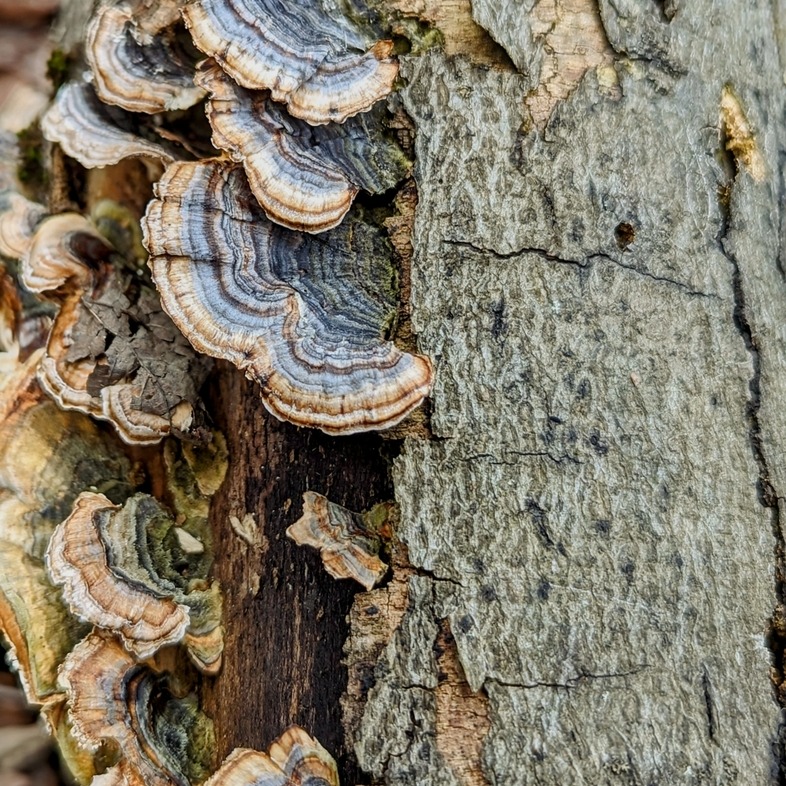
Polypore fungus growing in the form of thin, leathery fans or shelves. Its main feature is the concentric zones of contrasting colors including shades of brown, gray, black, blue, white, and even reddish. The upper surface is finely velvety, while the lower is white or cream with tiny pores.
Added by
Anonymous Curator
Reviewed by
Under Review
Last modified by
Julia Trouin
Other Names (Global)
 Hongo de estantePolíporo versicolor
 Many-zoned polypore
 Yun Zhi
Taxonomy
PhylumBasidiomycota
ClassAgaricomycetes
OrderPolyporales
FamilyPolyporaceae
GenusTrametes
Taxonomic Authority(L.) Lloyd, 1920
Ecology & Status
Origin
Native
Population Trend
Stable
Edibility
--
Cap Shape
--
Hymenium Type
--
Fruiting Season
Year Round
Recent Sightings
Yes
Habitat Summary Multi-lang
One of the most common fungi on the planet. It grows on fallen logs and branches of virtually any type of hardwood and occasionally on conifers. It is found in temperate and tropical forests worldwide.Substrate Multi-lang
Information not available in English. Help us expand this record!Behaviour Multi-lang
Acts as a white-rot decomposer, efficiently degrading wood lignin. Its fruiting bodies are tough and can persist for months, serving as a habitat for various species of mycophagous insects.Physical Measures
Length (cm)
2.0 - 10.0 cm
Hymenium Structures
No hymenium surface images available.
Evolutionary Adaptations Multi-lang
Leathery and persistent fruiting body that resists freezing and thawing cycles.
High genetic variability allowing it to colonize a vast range of tree species in different climates.
Main Threats Multi-lang
Overexploitation in wild areas for commercial use in medicinal supplements.
Forestry practices that systematically remove dead wood, reducing its vital substrate.
Interesting Facts Multi-lang
Contains polysaccharide-K (PSK), a compound studied and used in some countries as a complementary therapy in cancer treatment.
While not toxic, its texture is similar to hard cardboard, so it is generally consumed in infusions or extracts rather than eaten directly.