Costa Rica Species
Chelonia mydas
AnimaliaHighest rank in taxonomy. Groups all life into domains: Animalia, Plantae, Fungi, etc.IUCN ENInternational Union for Conservation of Nature — the world authority on species extinction risk, using standardized criteria. — Endangered — faces a very high risk of extinction if threats are not urgently addressed.In ProgressCurrent stage of this record in the editorial review workflow. Recent Sighting

Chelonia mydas

Green Sea Turtle

Linnaeus, 1758

Detailed Texts Multi-lang
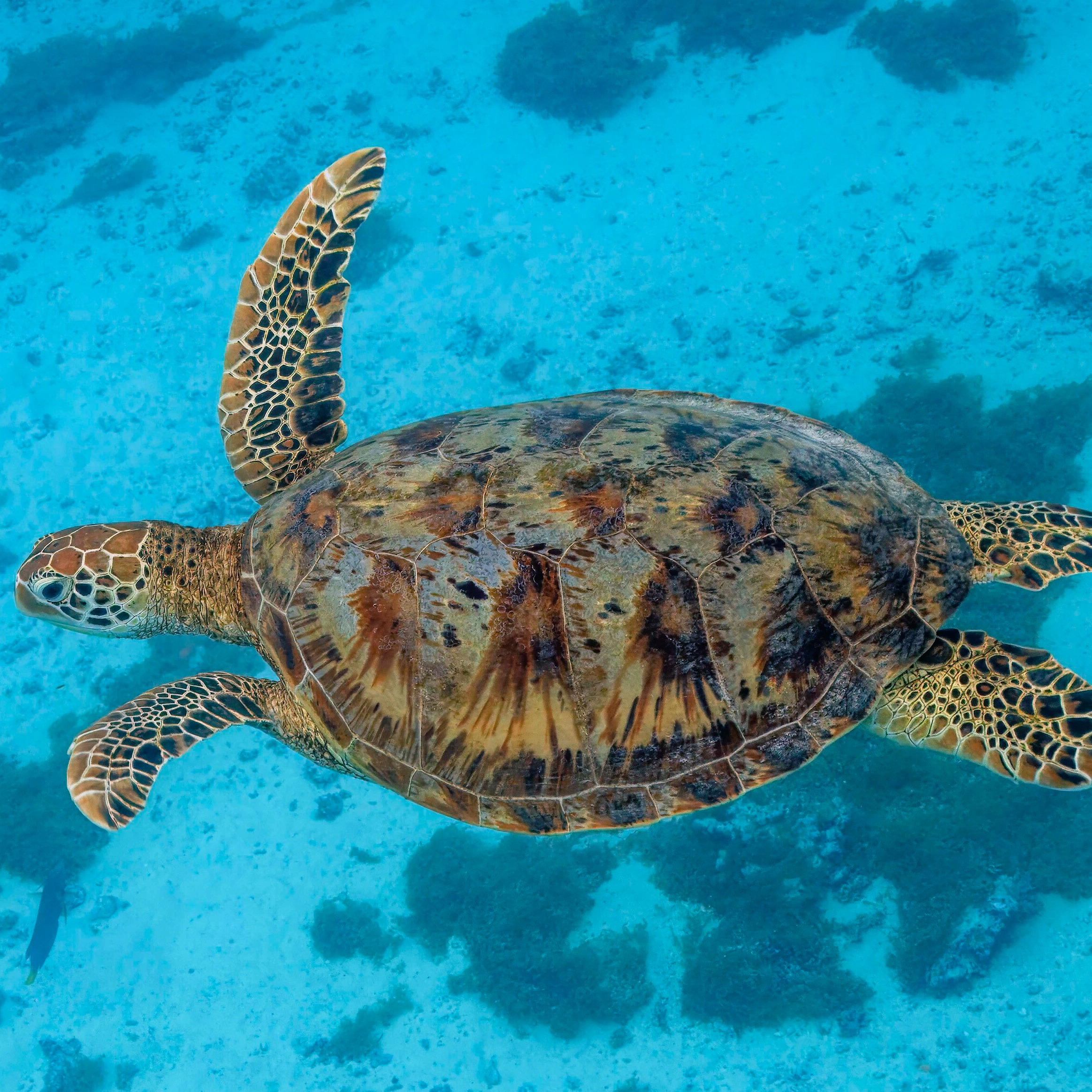
The green sea turtle (Chelonia mydas) is one of the largest sea turtle species in the world and the only one that is predominantly herbivorous as an adult. Its name does not come from the color of its carapace — which is usually brown, olive, or blackish with radiating patterns — but from the greenish hue of its body fat, a result of its strict diet of algae and seagrass. It has a smooth, heart- or teardrop-shaped carapace and a relatively small, unmistakable head with a single pair of prefrontal scales (unlike other species that have two pairs). Its hydrodynamic body and paddle-like flippers make it an exceptional and graceful swimmer. Its distribution is circumglobal in tropical and subtropical waters. In Costa Rica, this species holds monumental importance: Tortuguero National Park on the Caribbean coast is the most important nesting site in the entire Western Hemisphere for the species, while on the Pacific side, a dark morphological variant locally known as the 'black turtle' is found.

Added by

Anonymous Curator

Reviewed by

Under Review

Last modified by

Julia Trouin

TaxonomyBiological classification ranks placing this species within the tree of life, from Kingdom down to Genus.

PhylumRank below Kingdom. Groups organisms sharing a fundamental body plan (e.g., Chordata = vertebrates and some invertebrates).Chordata
ClassRank below Phylum. Subdivides by structural traits (e.g., Mammalia, Aves, Reptilia, Insecta).Reptilia
OrderRank below Class. Groups related families sharing common ancestry (e.g., Carnivora, Primates).Testudines
FamilyRank below Order. Groups closely related genera (e.g., Felidae = cats, Canidae = dogs).Cheloniidae
GenusRank just above Species. The first word in the two-part binomial scientific name.Chelonia
Taxonomic AuthorityThe scientist who first formally described and published this species, followed by the year of publication.Linnaeus, 1758
Record Completeness
94%
Coming soon

Ecology & StatusHow this species lives: habitat preferences, diet, behavior, population status, and role in its ecosystem.

OriginWhether the species is native (evolved here), endemic (found only here), or introduced by human activity.

Native

Population TrendDirection of change in population size over time: increasing, stable, decreasing, or unknown.

Decreasing

Breeding SeasonTime of year when this species typically reproduces or flowers.

--

Trophic RolePosition in the food chain: producer, herbivore, carnivore, omnivore, decomposer, or parasite.

Herbivore

Recent SightingsWhether this species has been observed in the wild in Costa Rica within recent years.

Yes

Habitat SummaryOverview of the specific ecosystems and environments where this species is found in Costa Rica. Multi-lang

Throughout its life, the green sea turtle utilizes three distinct types of habitats. Newborn hatchlings and small juveniles inhabit the open pelagic ocean, drifting in large mats of Sargassum seaweed where they hide and feed. Upon reaching a certain size (approximately 20-30 cm in carapace length), they migrate to shallow benthic coastal habitats, such as bays, estuaries, lagoons, and coral reefs. Here they establish their primary foraging grounds rich in seagrass meadows and algae beds. Finally, adults periodically migrate to tropical sandy beaches for mating and nesting. In Costa Rica, besides nesting massively in Tortuguero, they forage in Pacific coastal waters such as the Golfo Dulce, the Santa Elena Peninsula, and Cocos Island.

BehaviourDaily activity patterns, movement, territory use, foraging style, and seasonal behavioral changes. Multi-lang

It is a highly migratory marine reptile. Their journeys between coastal foraging areas and nesting beaches can span over 2,600 kilometers across open oceans. In daytime seagrass meadows, they can be seen grazing calmly and surfacing to breathe every few minutes. They maintain mutualistic relationships with cleaner fish (such as surgeonfish or remoras) that eat parasites, algae, and barnacles lodged on their carapace, frequently visiting 'cleaning stations' on reefs. They spend their nights sleeping wedged in coral crevices or under rocky ledges to avoid shark attacks.

Social ActivitySocial structure: whether the species is solitary, paired, or colonial; hierarchy and communication. Multi-lang

It is a solitary animal in the immensity of the open ocean, but exhibits massive aggregation behaviors driven by the environment. They concentrate by the hundreds or thousands in coastal areas with abundant food (like seagrass meadows) or in shallow waters off nesting beaches during the breeding season (a floating arribada or flotilla formation). Despite gathering in these multitudes, they do not form structured social hierarchies or cooperate for feeding or defense. The only prolonged contact occurs during the rough mating courtship, where several males may attempt to copulate with the same female simultaneously, competing aggressively among themselves.

Feeding GuildWhat the species eats, how it forages or hunts, and its role as a consumer in the food web. Multi-lang

Strict grazing herbivore (Adults). They spend their days swimming slowly along the coastal bottom, grazing on leaves of marine seagrasses (Thalassia, Halodule, Syringodium) and different species of macroalgae (red and green). Their serrated lower lip works exactly like a scythe to tear off the young upper shoots without destroying the root of the underwater plant, ensuring the sustainability of their own food source.

Trophic Chain DetailsSpecific interactions in local food webs: prey species, predators, competitors, and scavengers. Multi-lang

It undergoes a dramatic ontogenetic diet shift. Upon hatching and living in the open ocean, the babies are carnivorous/omnivorous, feeding on small jellyfish, plankton, fish eggs, and floating crustaceans. As they grow and move to coastal waters, their digestive system (with the help of specialized fermenting bacteria) matures to digest cellulose, and they become nearly strict herbivores. This places them as crucial primary consumers for seagrass ecosystems (Thalassia testudinum). Hatchlings are heavily preyed upon by ghost crabs, seabirds (frigatebirds), coatis, and jaguars on the beach, and by carnivorous fish upon entering the sea. Adults have very few natural predators due to their heavy armor, limited to large tiger sharks (Galeocerdo cuvier), killer whales, and, on some beaches, adult jaguars that hunt them during nesting.

Reproductive BehaviourMating strategies, courtship displays, nesting or spawning behavior, and parental care. Multi-lang

The reproductive process is exhausting. After copulating at sea (where the male clings to the female for hours), the pregnant female waits for nightfall to emerge from the ocean, navigating the crashing waves and high tide. She drags herself fatiguingly up the sand until finding a dry area beyond the high-water mark. With her front flippers, she digs a 'body pit', and then, delicately using her rear flippers, excavates a cylindrical hole about 50 cm deep (egg chamber). She deposits between 100 and 115 round eggs, soft as ping-pong balls. She then camouflages the nest by tossing sand around to confuse predators and, exhausted, returns to the sea leaving tracks that look like tractor tires. A female can repeat this process 3 to 5 times in the same season (at two-week intervals), and then will not nest again for 2 to 4 years.

Physical Measures

Length (cm)

80.0 - 120.0 cm

Weight (Grams)

65.00 kg - 200.00 kg

Offspring per cycleTypical number of young (live births, eggs, or seeds) produced by one adult in a single reproductive event or breeding season.80 - 120
Sexual DimorphismObservable physical differences between males and females of the same species (e.g., size, coloration, features).Yes

Lifespan

Sexual MaturityAge at which the individual becomes capable of reproducing for the first time.

20 - 40 Years

Gestation / IncubationDuration from fertilization to birth (mammals) or to hatching (egg-laying species).

45 - 70

Lifespan EstimatedExpected duration of life from birth to natural death under wild conditions.
Males60 - 80 Years
Females60 - 80 Years

Sexual DimorphismPhysical differences in size, coloration, or morphology between males and females of this species.

Males Multi-lang

Adult males differ clearly from females by two main characteristics developed upon reaching sexual maturity (at 20-30 years of age). The most evident is a massively thickened and elongated tail that extends well beyond the rear edge of the carapace (as it houses the reproductive organs). Additionally, they possess a single curved and considerably enlarged claw on each front flipper; this specialized claw serves to anchor themselves firmly to the leading edge of the female's carapace during the turbulent mating process in the open ocean.

Females Multi-lang

Adult females retain the short, flattened tail typical of immature turtles, which barely protrudes or does not extend at all beyond the posterior edge of the carapace. They lack the large curved mating claws on the front flippers. In general, their carapace tends to be wider and more highly domed than that of the male, a fundamental physiological adaptation that provides them with the internal volume necessary to develop and carry large clutches of over 100 eggs at the same time.

Evolutionary AdaptationsInherited traits and behaviors that improve the species' survival and reproduction in its specific environment. Multi-lang

Serrated jaws adapted for herbivory: Unlike the pointed or crushing jaws of other sea turtles, the lower jaw of the green turtle has a serrated edge and the upper jaw features strong ridges. This structure works like pruning shears, allowing them to efficiently cut and tear seagrasses and scrape encrusted algae off rocks and corals.
Excretory salt glands: By ingesting seawater with their food, they accumulate lethal levels of salt. To survive, they possess specialized glands located behind each eye that actively pump salt out of their bloodstream. This highly concentrated saline solution is expelled through tear ducts, giving the emotional appearance that the turtles are 'crying' when they are nesting on land.
Anaerobic respiration and extreme apnea: Although they breathe air, their lungs and metabolism are highly adapted to diving. During routine foraging dives, they stay underwater for about 5-10 minutes, but when resting on the ocean floor, they can drastically reduce their heart rate (down to one beat every 9 minutes) and hold their breath for up to 5 hours, extracting oxygen from their tissues anaerobically.

Main ThreatsDocumented pressures reducing the population: habitat loss, hunting, disease, climate change, and invasive species. Multi-lang

Poaching and consumption of meat and eggs: Historically, it was the most commercially hunted turtle species in the world for turtle soup. Although they now enjoy international legal protection, the illegal harvesting of eggs for the black market (under the false belief that they are aphrodisiacs) and the clandestine hunting of nesting females for their meat remain severe threats in impoverished areas of Central America.
Incidental catch (Bycatch) and plastic pollution: Thousands of turtles drown annually after becoming accidentally entangled in shrimp trawl nets, longlines, and gillnets. Concurrently, because they visually confuse floating plastic bags with jellyfish, ingesting them causes fatal intestinal blockages, gas accumulation that prevents diving (floater syndrome), and cellular toxicity.
Coastal development and Climate Change: Artificial lighting from hotels and coastal roads disorients newborn hatchlings, guiding them inland instead of to the sea, where they die of dehydration or get run over. Furthermore, a turtle's sex depends on the sand temperature; global warming is causing populations to be born almost exclusively female (feminization of the species), threatening their future reproductive success.

Interesting FactsSurprising or notable facts that highlight what makes this species unique or ecologically important. Multi-lang

Magnetic navigation and natal philopatry: Female green turtles possess the astonishing ability to travel thousands of kilometers in the open ocean to return and lay eggs on the exact same beach where they hatched 20 or 30 years ago. They achieve this feat by imprinting on the 'geomagnetic map' of their natal beach as hatchlings and using the Earth's magnetic fields as an extremely precise biological GPS.
Tortuguero, on Costa Rica's Caribbean coast, is named after these turtles. In the 1950s, the Caribbean population was on the brink of extinction due to indiscriminate hunting for soup. Thanks to the pioneering work of biologist Archie Carr and the establishment of the national park in 1970, the colony went from being decimated to becoming the largest and most successful green turtle nesting colony in the North Atlantic, a rare and inspiring global conservation success.
It is the only sea turtle that 'mows' the seagrass. Just like terrestrial lawns, seagrass beds must be constantly cut back to stay healthy and spread across the ocean floor. By feeding on the upper tips of old leaves, the green turtle stimulates the growth of new leaves that are more nutritious, maintaining a fundamental ecosystem that serves as a nursery for hundreds of fish species.