Costa Rica Species
Ophiocordyceps unilateralis
FungiHighest rank in taxonomy. Groups all life into domains: Animalia, Plantae, Fungi, etc.IUCN NEInternational Union for Conservation of Nature — the world authority on species extinction risk, using standardized criteria. — Not Evaluated — not yet assessed against the IUCN Red List criteria.In ProgressCurrent stage of this record in the editorial review workflow. Recent Sighting

Ophiocordyceps unilateralis

Zombie Fungus

(Tul. & C. Tul.) Petch, 1931

Detailed Texts Multi-lang
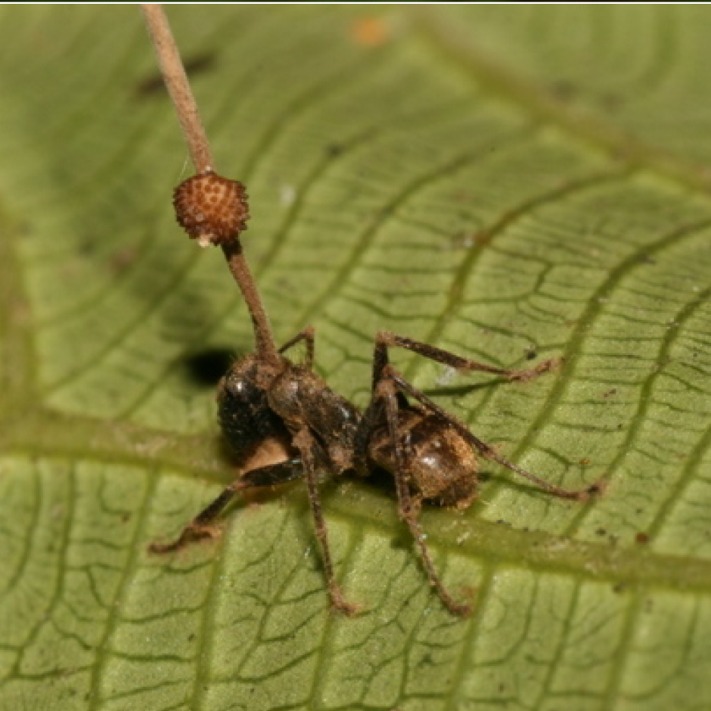
Parasitoid fungus that manifests as a dark stalk (stroma) sprouting from the head of a dead ant. The fruiting body features a globose head where spores are produced. The mycelium internally consumes the host, replacing its tissues while maintaining the integrity of the exoskeleton.

Added by

Anonymous Curator

Reviewed by

Under Review

Last modified by

Julia Trouin

Other Names (Global)Regional and multilingual names used for this species across different countries and languages.

Hongo zombiCordyceps unilateralZombie ant fungusAnt-decapitating fungus

TaxonomyBiological classification ranks placing this species within the tree of life, from Kingdom down to Genus.

PhylumRank below Kingdom. Groups organisms sharing a fundamental body plan (e.g., Chordata = vertebrates and some invertebrates).Ascomycota
ClassRank below Phylum. Subdivides by structural traits (e.g., Mammalia, Aves, Reptilia, Insecta).Sordariomycetes
OrderRank below Class. Groups related families sharing common ancestry (e.g., Carnivora, Primates).Hypocreales
FamilyRank below Order. Groups closely related genera (e.g., Felidae = cats, Canidae = dogs).Ophiocordycetaceae
GenusRank just above Species. The first word in the two-part binomial scientific name.Ophiocordyceps
Taxonomic AuthorityThe scientist who first formally described and published this species, followed by the year of publication.(Tul. & C. Tul.) Petch, 1931
Record Completeness
93%
Coming soon

Ecology & StatusHow this species lives: habitat preferences, diet, behavior, population status, and role in its ecosystem.

OriginWhether the species is native (evolved here), endemic (found only here), or introduced by human activity.

Native

Population TrendDirection of change in population size over time: increasing, stable, decreasing, or unknown.

Stable

Trophic RolePosition in the food chain: producer, herbivore, carnivore, omnivore, decomposer, or parasite.

--

EdibilityWhether this mushroom is edible, toxic, hallucinogenic, or of unknown safety. Never eat based solely on this data.

--

Cap ShapeShape of the mushroom cap (pileus): convex, flat, umbonate, funnel-shaped, bell-shaped, etc.

--

Hymenium TypeThe spore-bearing surface of a fungus: gills, pores, teeth, ridges, smooth, or wrinkled.

--

Fruiting SeasonTime of year when this species typically reproduces or flowers.

Wet Season

Recent SightingsWhether this species has been observed in the wild in Costa Rica within recent years.

Yes

Habitat SummaryOverview of the specific ecosystems and environments where this species is found in Costa Rica. Multi-lang

Found in humid tropical forests worldwide, with high prevalence in Brazil, Thailand, and Central Africa. It prefers areas with constant humidity that favor fungal growth and ant colony activity.

SubstrateThe organic material or host organism this fungus colonizes and decomposes. Multi-lang

Information not available in English. Help us expand this record!

BehaviourDaily activity patterns, movement, territory use, foraging style, and seasonal behavioral changes. Multi-lang

Uses sophisticated chemical manipulation to force the infected ant to leave its colony, climb a plant, and bite a vein on the underside of a leaf at a precise height, where the fungus kills it and fruits.

Physical Measures

Length (cm)

0.5 - 4.0 cm

Hymenium StructuresMacro photographs of the spore-bearing surfaces used for mushroom identification.

No hymenium surface images available.

Evolutionary AdaptationsInherited traits and behaviors that improve the species' survival and reproduction in its specific environment. Multi-lang

Ability to secrete compounds that alter the host's central nervous system without damaging muscle tissue immediately.
Synchronization of the host's 'final spasm' with ideal light and humidity conditions for spore dispersal.

Main ThreatsDocumented pressures reducing the population: habitat loss, hunting, disease, climate change, and invasive species. Multi-lang

Deforestation that eliminates the specific microclimates required for fruiting.
Hyperparasites (other fungi) that attack Cordyceps while it is fruiting on the ant.

Interesting FactsSurprising or notable facts that highlight what makes this species unique or ecologically important. Multi-lang

This fungus was the main inspiration for the concept of the infected in 'The Last of Us' video game and series franchise.
Infected ants usually bite leaves at noon, suggesting the fungus uses circadian rhythms to time its final attack.

External ReferencesScientific publications, field guides, and databases that document this species or area.