
FungiIUCN NEIn Progress Recent Sighting
Ophiocordyceps unilateralis
Zombie Fungus
(Tul. & C. Tul.) Petch, 1931
Detailed Texts Multi-lang
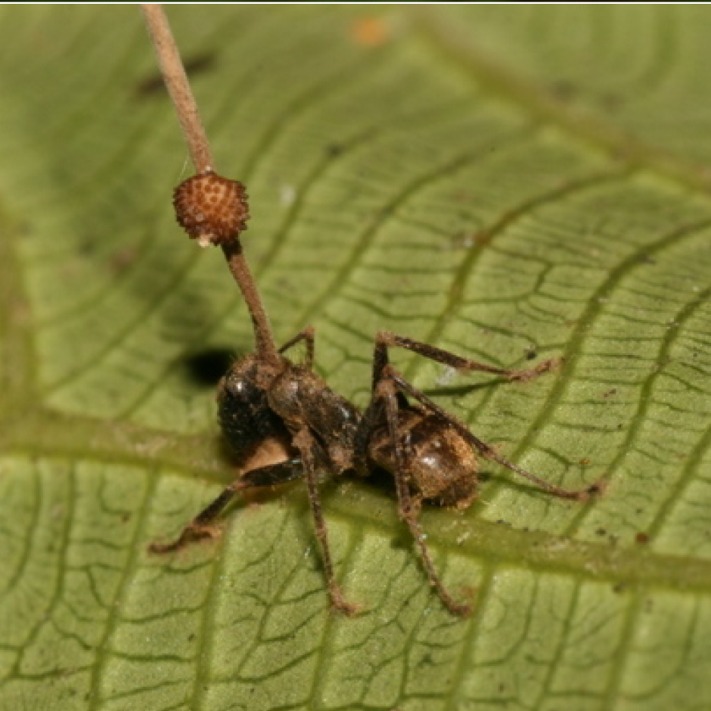
Parasitoid fungus that manifests as a dark stalk (stroma) sprouting from the head of a dead ant. The fruiting body features a globose head where spores are produced. The mycelium internally consumes the host, replacing its tissues while maintaining the integrity of the exoskeleton.
Added by
Anonymous Curator
Reviewed by
Under Review
Last modified by
Julia Trouin
Other Names (Global)
 Hongo zombiCordyceps unilateral
 Zombie ant fungusAnt-decapitating fungus
Taxonomy
PhylumAscomycota
ClassSordariomycetes
OrderHypocreales
FamilyOphiocordycetaceae
GenusOphiocordyceps
Taxonomic Authority(Tul. & C. Tul.) Petch, 1931
Ecology & Status
Origin
Native
Population Trend
Stable
Edibility
--
Cap Shape
--
Hymenium Type
--
Fruiting Season
Wet Season
Recent Sightings
Yes
Habitat Summary Multi-lang
Found in humid tropical forests worldwide, with high prevalence in Brazil, Thailand, and Central Africa. It prefers areas with constant humidity that favor fungal growth and ant colony activity.Substrate Multi-lang
Information not available in English. Help us expand this record!Behaviour Multi-lang
Uses sophisticated chemical manipulation to force the infected ant to leave its colony, climb a plant, and bite a vein on the underside of a leaf at a precise height, where the fungus kills it and fruits.Physical Measures
Length (cm)
0.5 - 4.0 cm
Hymenium Structures
No hymenium surface images available.
Evolutionary Adaptations Multi-lang
Ability to secrete compounds that alter the host's central nervous system without damaging muscle tissue immediately.
Synchronization of the host's 'final spasm' with ideal light and humidity conditions for spore dispersal.
Main Threats Multi-lang
Deforestation that eliminates the specific microclimates required for fruiting.
Hyperparasites (other fungi) that attack Cordyceps while it is fruiting on the ant.
Interesting Facts Multi-lang
This fungus was the main inspiration for the concept of the infected in 'The Last of Us' video game and series franchise.
Infected ants usually bite leaves at noon, suggesting the fungus uses circadian rhythms to time its final attack.