
Costa Rica Species
Falco peregrinus
AnimaliaHighest rank in taxonomy. Groups all life into domains: Animalia, Plantae, Fungi, etc.IUCN LCInternational Union for Conservation of Nature — the world authority on species extinction risk, using standardized criteria. — Least Concern — widespread and abundant; not at immediate risk of extinction.In ProgressCurrent stage of this record in the editorial review workflow. Recent Sighting

Falco peregrinus

Peregrine Falcon

Tunstall, 1771

Detailed Texts Multi-lang
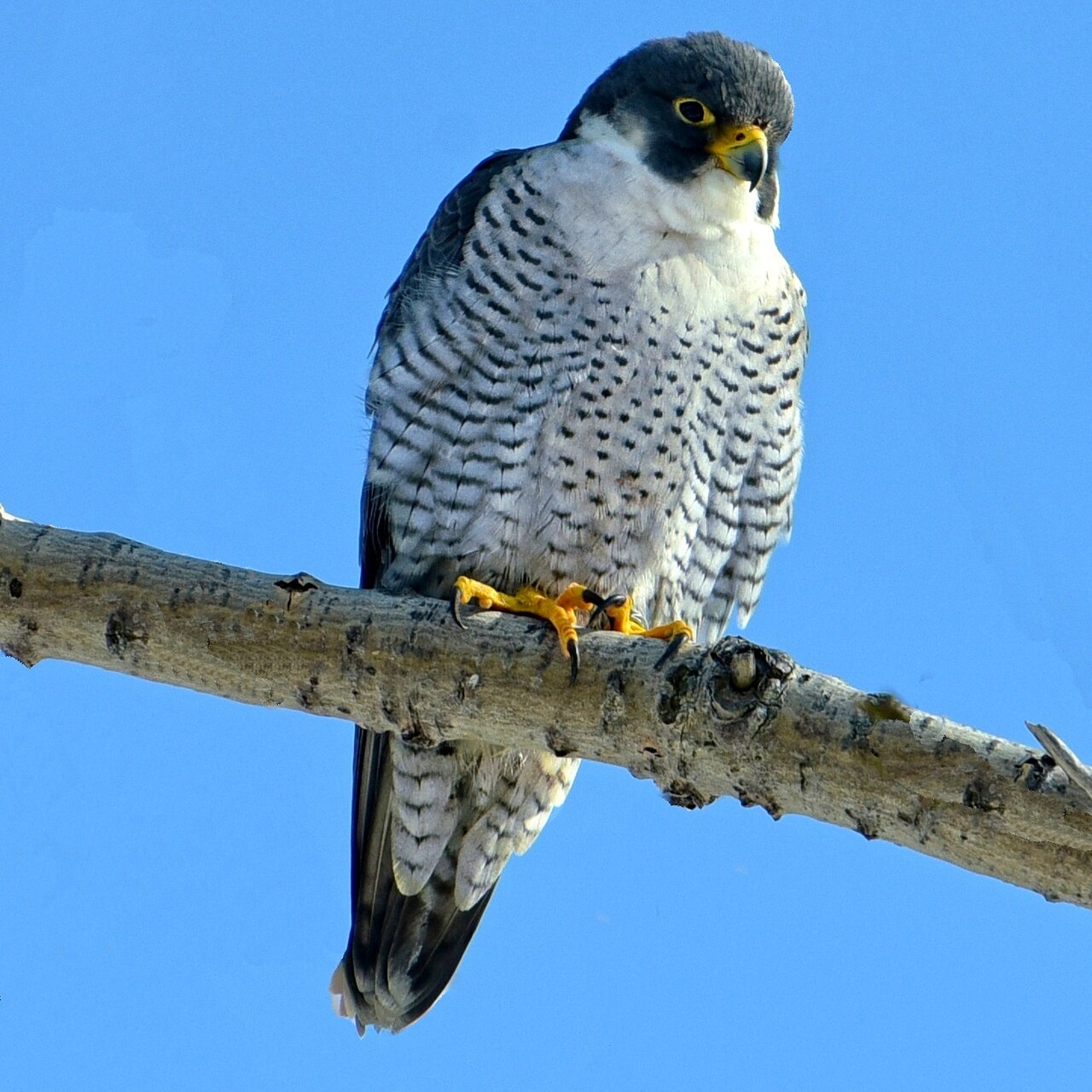
The Peregrine Falcon (Falco peregrinus) is a medium-to-large, powerfully built bird of prey evolutionarily designed for extreme speed. Its back and long, pointed wings are a bluish-gray to slate color, while its chest and belly are white or cream, densely marked with fine dark horizontal barring. Its black head features a distinctive dark mark dropping from the eye (the malar stripe or 'mustache'), giving it the appearance of wearing an aviator's helmet. It has a short, strongly hooked bill with a special notch (the 'tomial tooth') used to sever the neck of its prey. It has large, dark eyes surrounded by a bright yellow orbital ring, matching its short legs which bear extremely sharp talons. It is, without dispute, the fastest animal on Earth.

Added by

Anonymous Curator

Reviewed by

Under Review

Last modified by

Julia Trouin

TaxonomyBiological classification ranks placing this species within the tree of life, from Kingdom down to Genus.

PhylumRank below Kingdom. Groups organisms sharing a fundamental body plan (e.g., Chordata = vertebrates and some invertebrates).Chordata
ClassRank below Phylum. Subdivides by structural traits (e.g., Mammalia, Aves, Reptilia, Insecta).Aves
OrderRank below Class. Groups related families sharing common ancestry (e.g., Carnivora, Primates).Falconiformes
FamilyRank below Order. Groups closely related genera (e.g., Felidae = cats, Canidae = dogs).Falconidae
GenusRank just above Species. The first word in the two-part binomial scientific name.Falco
Taxonomic AuthorityThe scientist who first formally described and published this species, followed by the year of publication.Tunstall, 1771
Record Completeness
83%
Coming soon

Ecology & StatusHow this species lives: habitat preferences, diet, behavior, population status, and role in its ecosystem.

OriginWhether the species is native (evolved here), endemic (found only here), or introduced by human activity.

Native

Population TrendDirection of change in population size over time: increasing, stable, decreasing, or unknown.

Stable

Breeding SeasonTime of year when this species typically reproduces or flowers.

--

Trophic RolePosition in the food chain: producer, herbivore, carnivore, omnivore, decomposer, or parasite.

Carnivore

Recent SightingsWhether this species has been observed in the wild in Costa Rica within recent years.

Yes

Habitat SummaryOverview of the specific ecosystems and environments where this species is found in Costa Rica. Multi-lang

It is a truly cosmopolitan species, present on every continent except Antarctica. It occupies everything from tundras to mountains, coasts, and deserts. In Costa Rica, it is a highly widespread wintering migrant (September to May). It prefers open spaces where it can execute its stoops: wetlands, estuaries, beaches, savannas, and agricultural areas. Furthermore, it has spectacularly adapted to urban habitats, using the tall skyscrapers and communication towers of cities like San José as if they were its natural cliffs.

BehaviourDaily activity patterns, movement, territory use, foraging style, and seasonal behavioral changes. Multi-lang

They are almost exclusive aerial pursuit hunters; they rarely hunt prey on the ground or in branches. They patrol from immense heights (out of human sight) or from prominent vantage points. Upon detecting a bird, they position themselves above it, fold their wings, and drop like a ballistic missile. They do not grab the prey with open talons; rather, they strike it with talons clenched into a fist at such a tremendous speed that the impact instantly kills or stuns the victim in mid-air. After the strike, they catch it in the air as it falls.

Social ActivitySocial structure: whether the species is solitary, paired, or colonial; hierarchy and communication. Multi-lang

Strongly solitary outside the breeding season, especially during their long migratory journeys. They are fiercely territorial and defend the airspace around their nests against any intruder (including eagles or planes).

Feeding GuildWhat the species eats, how it forages or hunts, and its role as a consumer in the food web. Multi-lang

Carnivore / Ornithophage (Aerial).

Trophic Chain DetailsSpecific interactions in local food webs: prey species, predators, competitors, and scavengers. Multi-lang

Apex aerial predator (Ornithophage). Its diet is composed almost 99% of other birds caught in flight (from small swallows and bats, to ducks, shorebirds, parrots, and pigeons). As a fast superpredator, adults have no real natural predators, although Great Horned Owls or large eagles can be a sporadic threat at night or to their nests.

Reproductive BehaviourMating strategies, courtship displays, nesting or spawning behavior, and parental care. Multi-lang

They breed in North America, Europe, and southern regions, but not in Central America. They are monogamous and often mate for life. They do not build a stick nest; they simply scrape a slight depression in the gravel on the ledges of high rocky cliffs or large skyscrapers. The female typically lays 3 to 4 heavily mottled eggs. Incubation is 29 to 33 days and is shared, although the female does the majority, while the male (the 'tiercel') is the main food provider.

Physical Measures

Length (cm)

34.0 - 58.0 cm

Weight (Grams)

330 g - 1.50 kg

Offspring per cycleTypical number of young (live births, eggs, or seeds) produced by one adult in a single reproductive event or breeding season.2 - 5
Sexual DimorphismObservable physical differences between males and females of the same species (e.g., size, coloration, features).Yes

Lifespan

Sexual MaturityAge at which the individual becomes capable of reproducing for the first time.

12 - 36 Months

Gestation / IncubationDuration from fertilization to birth (mammals) or to hatching (egg-laying species).

29 - 33

Lifespan EstimatedExpected duration of life from birth to natural death under wild conditions.
Males10 - 20 Years
Females10 - 20 Years

Sexual DimorphismPhysical differences in size, coloration, or morphology between males and females of this species.

Males Multi-lang

Identical in coloration to the female. However, in falconry and English they are called 'tiercels' because they are exactly one-third (30%) smaller and lighter than females.

Females Multi-lang

Same plumage as males, but they are immensely bulkier, more powerful, and heavier. Historically, the term 'Falcon' was strictly reserved to refer to the large female hunter.

Evolutionary AdaptationsInherited traits and behaviors that improve the species' survival and reproduction in its specific environment. Multi-lang

The Terminal Velocity Stoop: It hunts by diving from immense heights, adopting an aerodynamic teardrop shape. To withstand the extreme pressures and not break apart upon reaching speeds over 350 km/h, its feathers are unusually stiff and its pectoral musculature is immense.
Nasal Baffles (High-Speed Breathing): At over 300 km/h, air pressure would burst a normal bird's lungs. The peregrine possesses a small cone-shaped bone in the center of its nostrils (nasal baffles) that breaks and deflects the air shockwave, allowing it to breathe normally during the stoop.

Main ThreatsDocumented pressures reducing the population: habitat loss, hunting, disease, climate change, and invasive species. Multi-lang

Collisions with Human Structures: Given that they use skyscrapers and urban areas to nest and hunt, they have a high mortality rate from hitting mirrored glass windows, vehicles, or electrical wires at high speeds.
Secondary Poisoning (Avicides): Domestic pigeons are their main urban prey. If pigeons are poisoned by city pest control programs, the falcons suffer from lethal secondary poisoning.

Interesting FactsSurprising or notable facts that highlight what makes this species unique or ecologically important. Multi-lang

The King of Speed: It is the fastest animal in existence. It has been documented in research with skydivers and altimeters that, during a stoop, they can exceed 389 km/h (242 mph).
A Conservation Success (The Return from DDT): In the mid-20th century, the species almost went extinct in the Northern Hemisphere due to the pesticide DDT, which caused their eggshells to become so thin they broke when incubated. Following the chemical's ban, their recovery has been one of the world's greatest conservation successes.