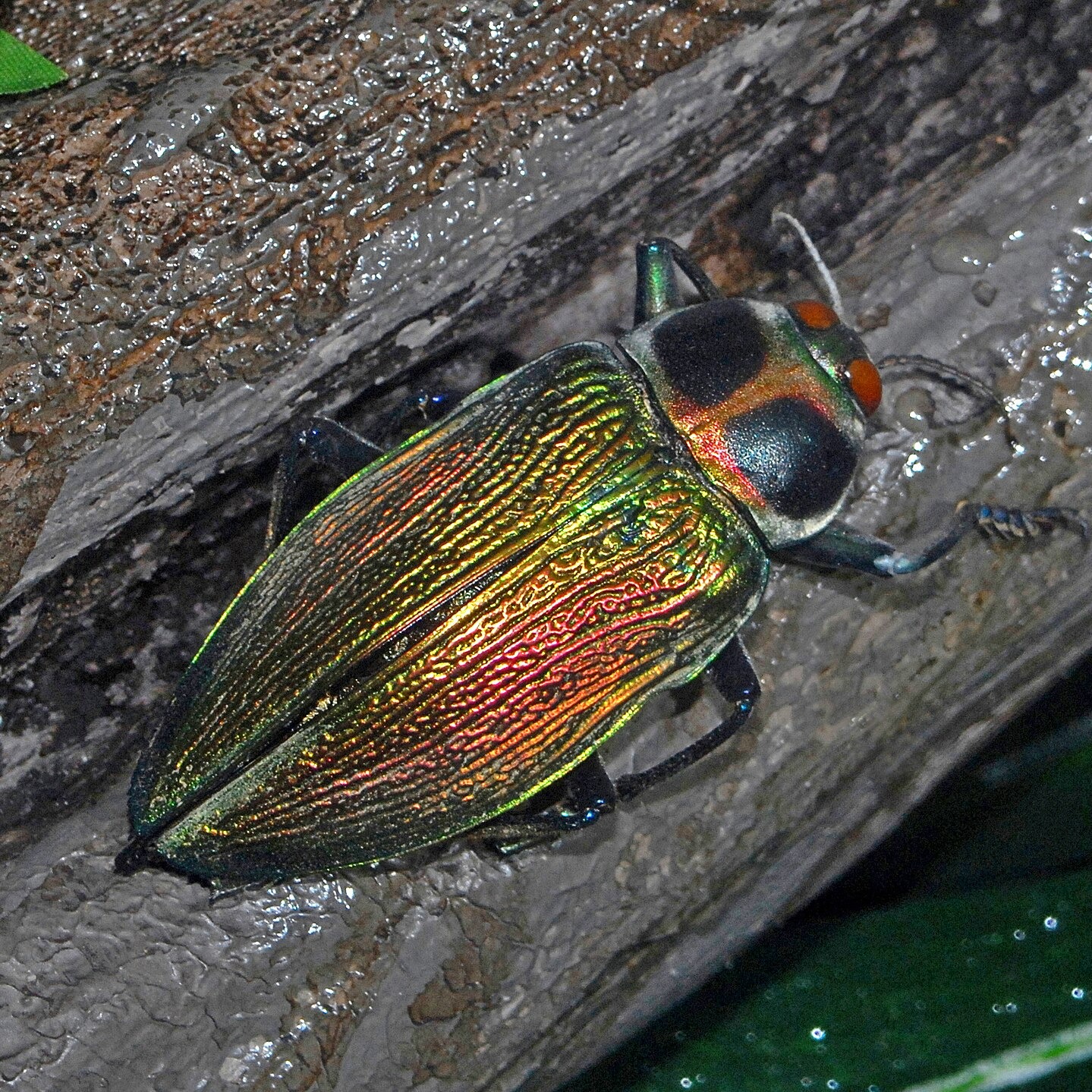
Euchroma gigantea
Giant Metallic Ceiba Borer
Linnaeus, 1758
Added by
Anonymous Curator
Reviewed by
Under Review
Last modified by
Julia Trouin
TaxonomyBiological classification ranks placing this species within the tree of life, from Kingdom down to Genus.
Ecology & StatusHow this species lives: habitat preferences, diet, behavior, population status, and role in its ecosystem.
OriginWhether the species is native (evolved here), endemic (found only here), or introduced by human activity.
Native
Population TrendDirection of change in population size over time: increasing, stable, decreasing, or unknown.
Stable
Breeding SeasonTime of year when this species typically reproduces or flowers.
Year Round
Trophic RolePosition in the food chain: producer, herbivore, carnivore, omnivore, decomposer, or parasite.
Herbivore
Recent SightingsWhether this species has been observed in the wild in Costa Rica within recent years.
Yes
Habitat SummaryOverview of the specific ecosystems and environments where this species is found in Costa Rica. Multi-lang
It inhabits mainly lowland humid tropical forests, with a special affinity for trees of the Malvaceae family, particularly Ceibas (Ceiba pentandra). It is widely distributed from southern Mexico throughout Central America to northern South America, preferring the tree canopy and trunks exposed to the sun.BehaviourDaily activity patterns, movement, territory use, foraging style, and seasonal behavioral changes. Multi-lang
It is a diurnal beetle, highly active under direct sunlight. Adults spend much of the day perched on tree trunks where they feed, exhibiting territorial behaviors. Its flight is powerful and noisy, moving rapidly between treetops. Communication between individuals is mainly carried out through visual signals and vibrations transmitted through the wood of the trunks.Social ActivitySocial structure: whether the species is solitary, paired, or colonial; hierarchy and communication. Multi-lang
Generally solitary, except during mating season. Adults may congregate briefly in specific trees that offer an abundance of sap or suitable oviposition sites. They do not form colonies or complex social structures.Feeding GuildWhat the species eats, how it forages or hunts, and its role as a consumer in the food web. Multi-lang
Frugivorous/Xylophagous: Larvae are xylophagous, feeding on the internal wood of trees. Adults consume tree sap, flower nectar, and occasionally soft tissues of fallen fruits.Trophic Chain DetailsSpecific interactions in local food webs: prey species, predators, competitors, and scavengers. Multi-lang
As larvae, they act as primary wood decomposers (xylophagous), transforming dead or weakened woody matter into usable nutrients. As adults, they are accidental pollinators when visiting flowers and bark. They are prey to various species of insectivorous birds, arboreal reptiles, and small mammals such as monkeys, which take advantage of their large size as an important source of protein.Reproductive BehaviourMating strategies, courtship displays, nesting or spawning behavior, and parental care. Multi-lang
Complex mating: Males compete aggressively through displays of strength and flight. After mating, the female uses her powerful mandibles to pierce the bark of healthy or damaged trees and deposit her eggs deep into the woody tissue. The larvae go through several stages of development (instars) feeding on wood for months or even years before pupating inside the trunk. The pupal stage lasts several weeks, with the adult emerging through a circular hole.Physical Measures
Length (cm)
5.0 - 7.5 cm
Weight (Grams)
10 g - 25 g
Lifespan
Sexual MaturityAge at which the individual becomes capable of reproducing for the first time.
1 - 2 Years
Gestation / IncubationDuration from fertilization to birth (mammals) or to hatching (egg-laying species).
1 - 3