
AnimaliaIUCN LCIn Progress Recent Sighting
Smilisca phaeota
Masked Tree Frog
Cope, 1862
Detailed Texts Multi-lang
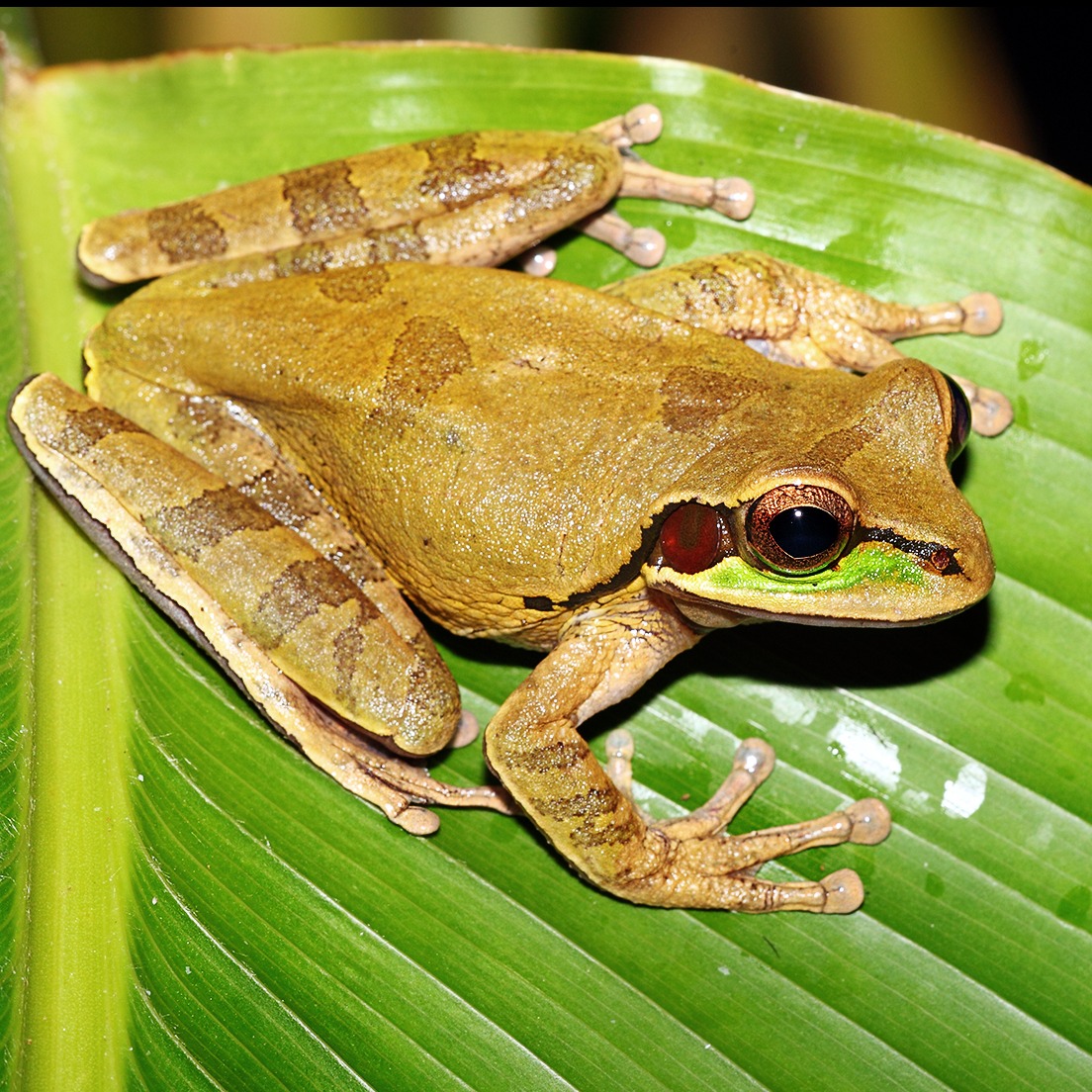
A medium-sized frog with smooth skin. Its most notable feature is a dark stripe that traverses the cephalic region, hiding the eye and extending towards the flanks. Its dorsum varies from brown to olive green tones, allowing for excellent mimicry with the forest environment.
Added by
Anonymous Curator
Reviewed by
Under Review
Last modified by
Julia Trouin
Taxonomy
PhylumChordata
ClassAmphibia
OrderAnura
FamilyHylidae
GenusSmilisca
Taxonomic AuthorityCope, 1862
Ecology & Status
Origin
Native
Population Trend
Stable
Breeding Season
Year Round
Trophic Role
Insectivore
Recent Sightings
Yes
Habitat Summary Multi-lang
Inhabits mainly the understory of humid jungles, lowland forests, and disturbed areas near water bodies. It is an arboreal species usually found in low vegetation or near temporary ponds.Behaviour Multi-lang
Nocturnal and active species. It moves with great dexterity among the low foliage and branches, using its adhesive disks to hold firmly to the leaves even in heavy rain conditions.Social Activity Multi-lang
Solitary, except during the breeding season. Males are quite territorial and establish calling sites near temporary ponds to attract females.Feeding Guild Multi-lang
Ambush predator. Remains motionless waiting for potential prey to approach, then captures it with a quick and precise movement of its protractile tongue.Trophic Chain Details Multi-lang
Generalist insectivore. It captures a wide variety of arboreal invertebrates, especially small flying insects and arachnids, detecting them through subtle movements in the vegetation.Reproductive Behaviour Multi-lang
Oviparous. Deposits egg masses in temporary water bodies or ponds. Larval development is aquatic and relatively fast, adapted to the temporality of its breeding sites.Physical Measures
Length (cm)
4.5 - 6.5 cm
Weight (Grams)
10 g - 30 g
Offspring per cycle100 - 500
Sexual DimorphismYes
Lifespan
Sexual Maturity
1 - 2 Years
Gestation / Incubation
1 - 2
Lifespan Estimated
Males3 - 5 Years
Females3 - 5 Years
Sexual Dimorphism
Males Multi-lang
Males are slightly smaller, with a distinctive and developed subgular vocal sac, vital for the power and frequency of its territorial calls.
Females Multi-lang
Females are larger and have a more voluminous body structure, necessary for the development of the egg clutch before the breeding season.
Evolutionary Adaptations Multi-lang
Facial Mimicry: The dark mask breaks the silhouette of its eye, a key evolutionary trait to go unnoticed by visual predators while resting on trunks.
Main Threats Multi-lang
Forest fragmentation: Being a species that depends on stratified vegetation near water sources, local deforestation severely impacts its dispersal capacity.
Interesting Facts Multi-lang
Vocal Behavior: Males emit a call reminiscent of a short and deep bark, which allows them to coordinate complex reproductive choruses during the wettest nights.