
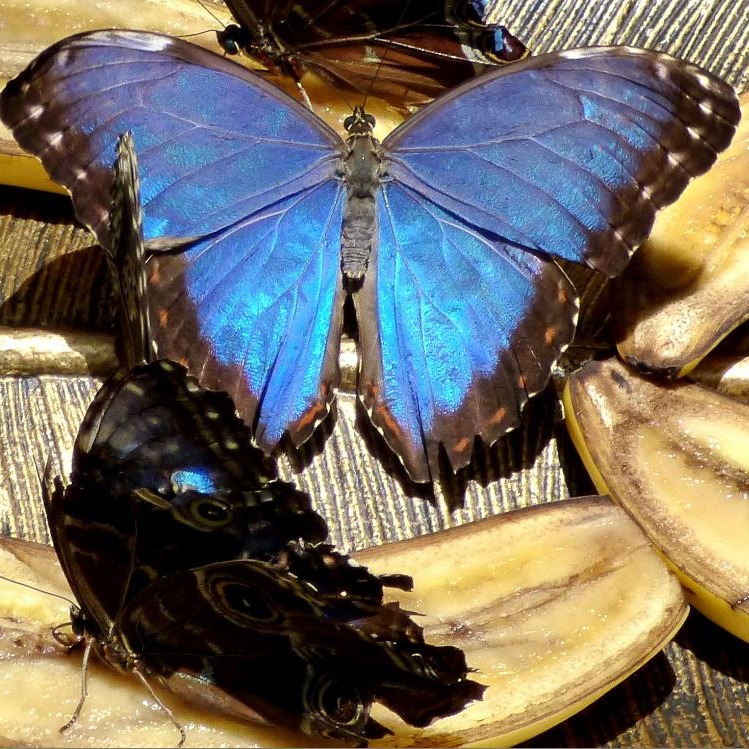
Morpho peleides
Blue Morpho Butterfly
Kollar, 1850
Added by
Anonymous Curator
Reviewed by
Under Review
Last modified by
Julia Trouin
TaxonomyBiological classification ranks placing this species within the tree of life, from Kingdom down to Genus.
Ecology & StatusHow this species lives: habitat preferences, diet, behavior, population status, and role in its ecosystem.
OriginWhether the species is native (evolved here), endemic (found only here), or introduced by human activity.
Native
Population TrendDirection of change in population size over time: increasing, stable, decreasing, or unknown.
Stable
Breeding SeasonTime of year when this species typically reproduces or flowers.
Year Round
Trophic RolePosition in the food chain: producer, herbivore, carnivore, omnivore, decomposer, or parasite.
Frugivore
Recent SightingsWhether this species has been observed in the wild in Costa Rica within recent years.
Yes
Habitat SummaryOverview of the specific ecosystems and environments where this species is found in Costa Rica. Multi-lang
Morpho butterflies inhabit the canopy and edges of primary and secondary rainforests and cloud forests, from sea level up to 1,400 meters in altitude. Although they spend most of their time fluttering in the high layers of the forest, adults frequently descend to understory clearings, forest trails, or streams, especially on sunny mornings to forage (fermenting fruit on the ground) or bask in the sun. In Costa Rica, they can be observed in almost any humid forested area, but they are particularly conspicuous along sunny trails or flying majestically across forest clearings.BehaviourDaily activity patterns, movement, territory use, foraging style, and seasonal behavioral changes. Multi-lang
It is a diurnal and highly active insect. Males are exceptionally territorial and tirelessly patrol along trails, streams, or forest edges (known as 'patrolling' behavior), following the same routes every day in search of females. They have an erratic, slow, and 'bouncy' flight style, designed to create the optical illusion of the blue flash. Upon finding decaying fruit on the ground, they feed in peaceful groups, often sharing with other butterfly species, bees, or birds, fervently concentrating on absorbing the fermented sugars.Social ActivitySocial structure: whether the species is solitary, paired, or colonial; hierarchy and communication. Multi-lang
Outside of shared congregations at rotting fruit patches, Morphos are mostly solitary. Males exhibit pronounced individual territorial behavior. They spend hours actively defending a stretch of trail, a forested ravine, or a clearing they consider their own, fiercely chasing away other, smaller male Morphos or even other butterfly species through lightning-fast aerial pursuits, in an attempt to secure exclusivity over any females crossing that territory.Feeding GuildWhat the species eats, how it forages or hunts, and its role as a consumer in the food web. Multi-lang
Suctorial frugivore (adults). They do not visit flowers like other butterflies, as they are unable to digest pure sucrose-rich floral nectar or solid pollen. Their proboscis is perfectly designed to be inserted into cracks of overripe fruit, sucking up broths rich in yeast and simple sugars derived from natural fermentation (which often gets them slightly inebriated, making them slow to escape).Trophic Chain DetailsSpecific interactions in local food webs: prey species, predators, competitors, and scavengers. Multi-lang
It undergoes a complete change in its trophic chain due to its metamorphosis. As a caterpillar, it is a primary consumer herbivore, eagerly devouring tender leaves of poisonous legumes from which it sequesters chemical defenses to become distasteful (caterpillars are preyed upon by wasps, parasitoid flies, and cuckoo birds). As an adult, it is a 'frugivore' (fluid feeder); its jaws fuse to form the proboscis (a straw-like tube) with which they suck liquids. Adults drink the sweet, fermented juices of rotting fallen fruit (bananas, mangoes, guavas), tree sap exudate, and, surprisingly, absorb dissolved mineral salts from damp mud or even decomposing dead animals.Reproductive BehaviourMating strategies, courtship displays, nesting or spawning behavior, and parental care. Multi-lang
Fertilized adult females actively seek specific leguminous understory plants, such as mucuna or Machaerium vines. They land on the young leaves and individually lay pale green, dome-shaped eggs on the top or bottom of the leaf. Hatching results in a ravenous little caterpillar that will go through several molting stages (instars), growing into a large, colorful caterpillar covered in irritating hairs. Once ready, the caterpillar secretes a silk button, hangs upside down in a 'J' shape, and transforms into a plump, oval, transparent jade-green chrysalis. This pupal stage beautifully mimics a fruit or thick leaf, lasting a couple of weeks before the large blue adult butterfly emerges.Physical Measures
Length (cm)
12.0 - 16.0 cm
Weight (Grams)
1 g - 3 g
Lifespan
Sexual MaturityAge at which the individual becomes capable of reproducing for the first time.
3 - 4 Months
Gestation / IncubationDuration from fertilization to birth (mammals) or to hatching (egg-laying species).
7 - 14