
Costa Rica Species
Eupherusa eximia
AnimaliaHighest rank in taxonomy. Groups all life into domains: Animalia, Plantae, Fungi, etc.IUCN LCInternational Union for Conservation of Nature — the world authority on species extinction risk, using standardized criteria. — Least Concern — widespread and abundant; not at immediate risk of extinction.In ProgressCurrent stage of this record in the editorial review workflow. Recent Sighting

Eupherusa eximia

Stripe-tailed Hummingbird

(De Lattre & Bourcier, 1846)

Detailed Texts Multi-lang
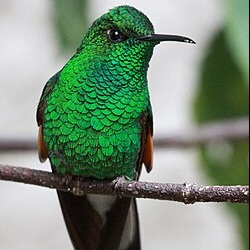
The Stripe-tailed Hummingbird (Eupherusa eximia) is a medium-sized bird with an unmistakable chromatic design. The adult male sports an overall plumage of emerald green with a strong metallic sheen. However, its two most diagnostic features are best seen when it spreads its wings and tail: it possesses large patches of rufous (reddish-chestnut) on the secondary wing feathers that flash vibrantly in mid-flight, and a dark tail whose lateral feathers have thick white edges, giving it the 'striped' or zebra-like appearance that gives it its name. Its bill is straight, entirely black, and of moderate length. Females are similar in the wings and tail, but their underparts are a light grayish tone mottled with green on the flanks.

Added by

Anonymous Curator

Reviewed by

Under Review

Last modified by

Julia Trouin

TaxonomyBiological classification ranks placing this species within the tree of life, from Kingdom down to Genus.

PhylumRank below Kingdom. Groups organisms sharing a fundamental body plan (e.g., Chordata = vertebrates and some invertebrates).Chordata
ClassRank below Phylum. Subdivides by structural traits (e.g., Mammalia, Aves, Reptilia, Insecta).Aves
OrderRank below Class. Groups related families sharing common ancestry (e.g., Carnivora, Primates).Apodiformes
FamilyRank below Order. Groups closely related genera (e.g., Felidae = cats, Canidae = dogs).Trochilidae
GenusRank just above Species. The first word in the two-part binomial scientific name.Eupherusa
Taxonomic AuthorityThe scientist who first formally described and published this species, followed by the year of publication.(De Lattre & Bourcier, 1846)
Record Completeness
85%
Coming soon

Ecology & StatusHow this species lives: habitat preferences, diet, behavior, population status, and role in its ecosystem.

OriginWhether the species is native (evolved here), endemic (found only here), or introduced by human activity.

Native

Population TrendDirection of change in population size over time: increasing, stable, decreasing, or unknown.

Stable

Breeding SeasonTime of year when this species typically reproduces or flowers.

Dry Season

Trophic RolePosition in the food chain: producer, herbivore, carnivore, omnivore, decomposer, or parasite.

Herbivore

Recent SightingsWhether this species has been observed in the wild in Costa Rica within recent years.

Yes

Habitat SummaryOverview of the specific ecosystems and environments where this species is found in Costa Rica. Multi-lang

It is a typical species of middle elevations (premontane and lower montane forests). It prefers cloud forest edges, clearings with flowering shrubs, shaded borders, and dense secondary growth. It generally moves in the understory or the middle strata of the vegetation, where moisture and mist abound. In Costa Rica, it is very common between 300 and 1,500 meters above sea level, inhabiting mainly the Caribbean slope and the main mountain ranges (Tilarán, Central, and Talamanca).

BehaviourDaily activity patterns, movement, territory use, foraging style, and seasonal behavioral changes. Multi-lang

It is a bird of frenetic activity and moderate to high territoriality. Unlike hermit hummingbirds, the stripe-tailed hummingbird usually settles in dense flower patches which it defends vocally and physically from other males and species. When feeling threatened or excited, it fans out its tail, showing the contrasting pattern of black and white stripes, while whispering a high, metallic song.

Social ActivitySocial structure: whether the species is solitary, paired, or colonial; hierarchy and communication. Multi-lang

Generally solitary and aggressive towards other hummingbirds that enter their feeding territory. They do not form flocks, and pair bonds last only the time necessary for copulation.

Feeding GuildWhat the species eats, how it forages or hunts, and its role as a consumer in the food web. Multi-lang

Nectarivore / Mid-story territorial forager.

Trophic Chain DetailsSpecific interactions in local food webs: prey species, predators, competitors, and scavengers. Multi-lang

Primary consumer (Nectarivore). Its main diet consists of nectar from tubular flowers, frequenting plants of the genera Inga, Besleria, and Salvia, as well as multiple epiphytes and bromeliads in the mid-canopy. It supplements its diet by catching small dipterans and wasps in mid-air (hawking) to obtain proteins. It is occasionally preyed upon by small mountain owls, arboreal tarantulas, and bush snakes.

Reproductive BehaviourMating strategies, courtship displays, nesting or spawning behavior, and parental care. Multi-lang

As in most trochilids, the female performs all the reproductive work alone. She builds a compact cup-shaped nest using moss, tree fern scales, and fine spider webs, commonly located at a height of between 1.5 and 4 meters on shrubs at the forest edge. She lays 2 small white eggs. Incubation takes about 15 to 16 days. The female feeds the altricial chicks by regurgitating predigested nectar and insects, until they leave the nest about three weeks later.

Physical Measures

Length (cm)

9.0 - 10.0 cm

Weight (Grams)

4 g - 4.5 g

Offspring per cycleTypical number of young (live births, eggs, or seeds) produced by one adult in a single reproductive event or breeding season.2 - 2
Sexual DimorphismObservable physical differences between males and females of the same species (e.g., size, coloration, features).Yes

Lifespan

Sexual MaturityAge at which the individual becomes capable of reproducing for the first time.

10 - 12 Months

Gestation / IncubationDuration from fertilization to birth (mammals) or to hatching (egg-laying species).

15 - 16

Lifespan EstimatedExpected duration of life from birth to natural death under wild conditions.
Males3 - 5 Years
Females3 - 5 Years

Sexual DimorphismPhysical differences in size, coloration, or morphology between males and females of this species.

Males Multi-lang

The male features completely glowing emerald green underparts.

Females Multi-lang

Females lack the bright green chest; instead, their underparts are white or pale grayish, heavily mottled with green along the flanks.

Evolutionary AdaptationsInherited traits and behaviors that improve the species' survival and reproduction in its specific environment. Multi-lang

Flight Signals (Rufous Flashes): The notable rufous patches on its wings are no accident; they act as powerful visual signals in the gloom of the cloud forest. In flight, the repetitive flashing of this warm color serves both to demarcate its territory against rival males and for courtship.
Montane Morphology (Stabilizing Tail): Its strongly graduated and broad tail provides exceptional stability to perform prolonged hovering flights in front of hanging flowers that are mechanically complex to access and common in montane forests, balancing skillfully despite the constant mountain wind.

Main ThreatsDocumented pressures reducing the population: habitat loss, hunting, disease, climate change, and invasive species. Multi-lang

Climate Change (Forced Altitudinal Migration): As a species dependent on humid montane ecosystems, global warming is raising the baseline of cloud forests, pushing the species to increasingly higher altitudes and reducing the total size of its available habitat.
Habitat Loss due to Agriculture: The deforestation of mountain slopes for planting coffee, cattle pastures, and other agricultural crops disconnects the biological corridors necessary for genetic exchange.

Interesting FactsSurprising or notable facts that highlight what makes this species unique or ecologically important. Multi-lang

Mist Bathers: Taking advantage of their cloud forest environment, these birds often bathe by brushing against large leaves (like those of banana or heliconia plants) that are soaked by mist or morning dew, fluttering over them without needing to submerge in puddles.
Taxonomic Confusion: For many years, some of its subspecies were confused with completely distinct species due to variations in the extent of the rufous color on their wings and the amount of white on their tail depending on the altitude at which they lived.