
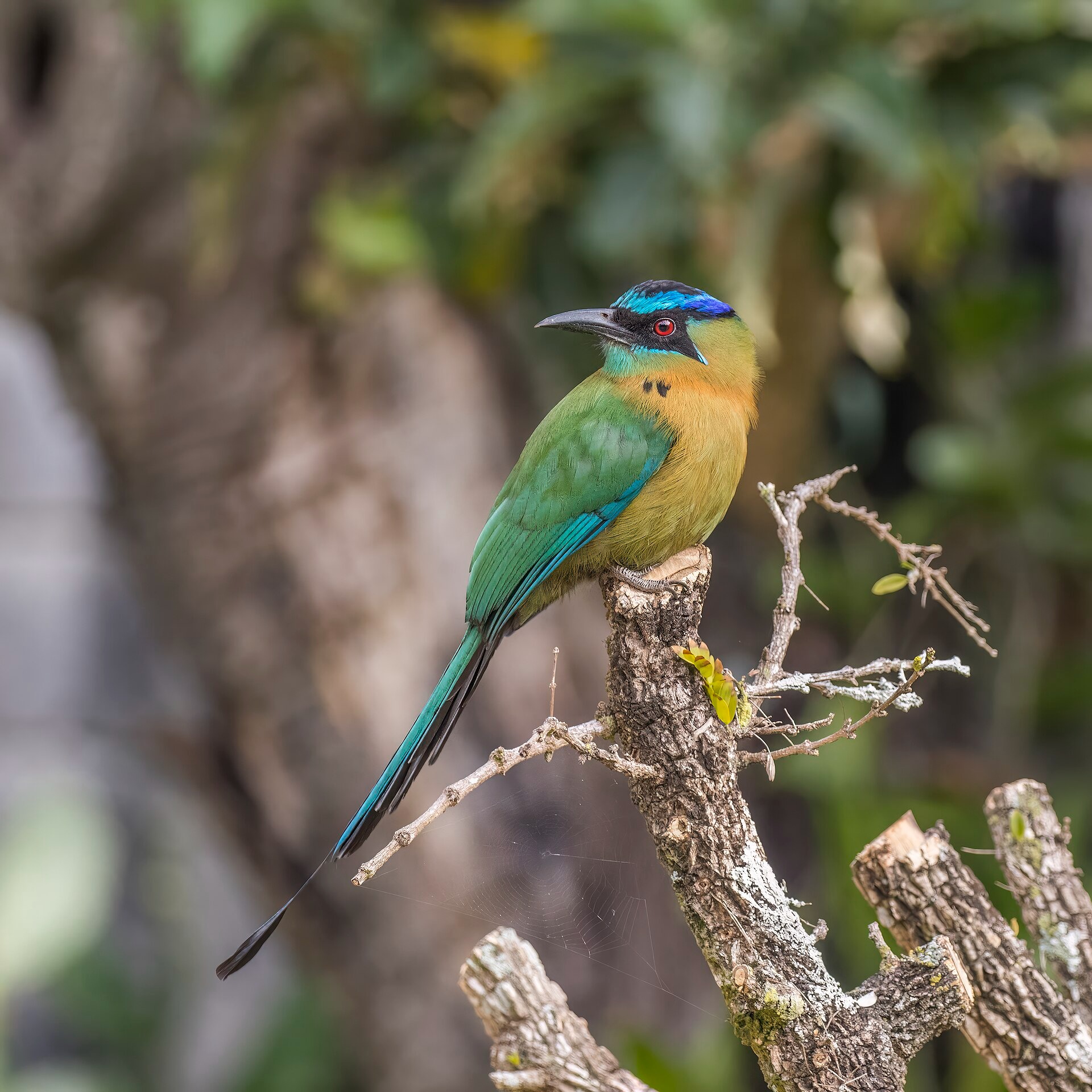
Momotus lessonii
Lesson's Motmot
Lesson, 1842
Added by
Anonymous Curator
Reviewed by
Under Review
Last modified by
Julia Trouin
TaxonomyBiological classification ranks placing this species within the tree of life, from Kingdom down to Genus.
Ecology & StatusHow this species lives: habitat preferences, diet, behavior, population status, and role in its ecosystem.
OriginWhether the species is native (evolved here), endemic (found only here), or introduced by human activity.
Native
Population TrendDirection of change in population size over time: increasing, stable, decreasing, or unknown.
Stable
Breeding SeasonTime of year when this species typically reproduces or flowers.
--
Trophic RolePosition in the food chain: producer, herbivore, carnivore, omnivore, decomposer, or parasite.
Omnivore
Recent SightingsWhether this species has been observed in the wild in Costa Rica within recent years.
Yes
Habitat SummaryOverview of the specific ecosystems and environments where this species is found in Costa Rica. Multi-lang
Lesson's motmot inhabits a wide variety of forested and semi-open environments, being one of the most ecologically plastic birds in Central America. It occupies the interior and edges of lowland and premontane tropical moist and dry forests, advanced secondary forests, shade coffee plantations, cacao groves, wooded gardens, urban parks, edges of rural roads with forested vegetation, and wooded riversides. It is markedly terrestrial in its foraging behavior, spending much of its time perched motionless on low understory branches at 1–6 meters height from which it observes and captures prey on the ground. It can be found from sea level to 2,400 meters in altitude. In Costa Rica it is one of the most widely distributed and frequently observed birds in the country, present in virtually all ecosystems including gardens and green areas of the Greater Metropolitan Area.BehaviourDaily activity patterns, movement, territory use, foraging style, and seasonal behavioral changes. Multi-lang
Lesson's motmot is primarily diurnal with greatest activity in the early morning hours and at dusk. Its foraging strategy consists of remaining motionless for extended periods on a low perch — 1 to 6 meters above ground — from which it observes the ground and surrounding vegetation with continuously moving eyes, then launching in a short flight and returning to the same or a nearby perch with captured prey. This 'sentinel perching' behavior allows it to efficiently exploit the understory without expending energy on active searching. It moves its tail in a rhythmic pendulum while at rest. It is territorial during the breeding season, defending the area around the nesting tunnel through vocalizations — a deep, hoarse, guttural song — and pursuits of intruders. Outside the breeding season it is less territorial and can tolerate other individuals in areas of high food density. It spends nights in dense understory vegetation.Social ActivitySocial structure: whether the species is solitary, paired, or colonial; hierarchy and communication. Multi-lang
Lesson's motmot is primarily solitary or found in stable pairs throughout the year. Pairs maintain long-lasting monogamous bonds and are seen together regularly outside the breeding season during foraging and rest. Pair communication includes duet vocalizations where both individuals sing simultaneously in different registers, mutual preening (allopreening) behavior, and male-to-female food transfer as part of courtship. Territorial defense during reproduction is carried out primarily by the male through territorial song from prominent perches at dawn. Encounters with intruding individuals result in brief aerial pursuits and alarm vocalizations. They do not form mixed flocks with other species but can tolerate the presence of other birds in the same food-resource tree.Feeding GuildWhat the species eats, how it forages or hunts, and its role as a consumer in the food web. Multi-lang
Omnivorous insectivore-carnivore with frugivorous supplement. It forages primarily through the 'sentinel perching' method: it remains motionless on a low perch and launches in short descending flights toward the ground or low vegetation to capture prey. Animal prey includes large insects (beetles, crickets, mantids, grasshoppers), lizards of various species, small frogs, small snakes, centipedes, large spiders, and occasionally eggs and nestlings of other birds. Fruits, especially Ficus spp. and Cecropia spp., constitute 15 to 30% of the diet depending on the season. Large prey are repeatedly struck against the branch before swallowing. It does not store food.Trophic Chain DetailsSpecific interactions in local food webs: prey species, predators, competitors, and scavengers. Multi-lang
Omnivorous secondary consumer with a broad diet spanning live prey and fruits. It primarily consumes large arthropods (beetles, orthopterans, mantids, centipedes, large spiders), lizards (especially Anolis spp. and Norops spp.), small frogs, small snakes, land snails, eggs of other birds, and ripe fruits — especially Ficus spp., Cecropia spp., and Heliconia spp. It acts as a secondary seed disperser of various understory plant species. Its main predators are the short-tailed hawk (Buteo brachyurus), collared forest-falcon (Micrastur semitorquatus), boa constrictor (Boa constrictor), margay (Leopardus wiedii), and raccoons (Procyon lotor). Eggs and chicks in the nesting tunnel are vulnerable to the tiger ratsnake (Spilotes pullatus), hognosed pitviper (Porthidium nasutum), and small burrowing mammals such as opossums (Didelphis marsupialis).Reproductive BehaviourMating strategies, courtship displays, nesting or spawning behavior, and parental care. Multi-lang
The breeding season in Costa Rica extends primarily from March to June. Courtship includes intense dawn duet vocalizations, allopreening between the pair, and food transfer from male to female. Both sexes excavate the nesting tunnel collaboratively over 3 to 6 weeks, using the bill to remove soil and feet to dislodge it. The tunnel measures between 30 and 150 cm in length and ends in a spherical chamber 15 to 20 cm in diameter that is not lined with nesting material. The clutch consists of 3 to 4 rounded white eggs. Both sexes incubate, with turns of several hours during the day and the male generally incubating at night, for 17 to 22 days. Chicks hatch altricial — blind, without down, and with reddish skin — and are fed by both parents with insects, lizards, and small frogs until approximately 24 to 32 days, when they leave the tunnel. Young reach full adult plumage including the tail rackets at 10–12 months.Physical Measures
Length (cm)
38.0 - 48.0 cm
Weight (Grams)
90 g - 140 g
Lifespan
Sexual MaturityAge at which the individual becomes capable of reproducing for the first time.
1 - 2 Years
Gestation / IncubationDuration from fertilization to birth (mammals) or to hatching (egg-laying species).
17 - 22