Costa Rica Species
Porphyrio martinicus
AnimaliaHighest rank in taxonomy. Groups all life into domains: Animalia, Plantae, Fungi, etc.IUCN LCInternational Union for Conservation of Nature — the world authority on species extinction risk, using standardized criteria. — Least Concern — widespread and abundant; not at immediate risk of extinction.In ProgressCurrent stage of this record in the editorial review workflow. Recent Sighting

Porphyrio martinicus

Purple Gallinule

(Linnaeus, 1766)

Detailed Texts Multi-lang
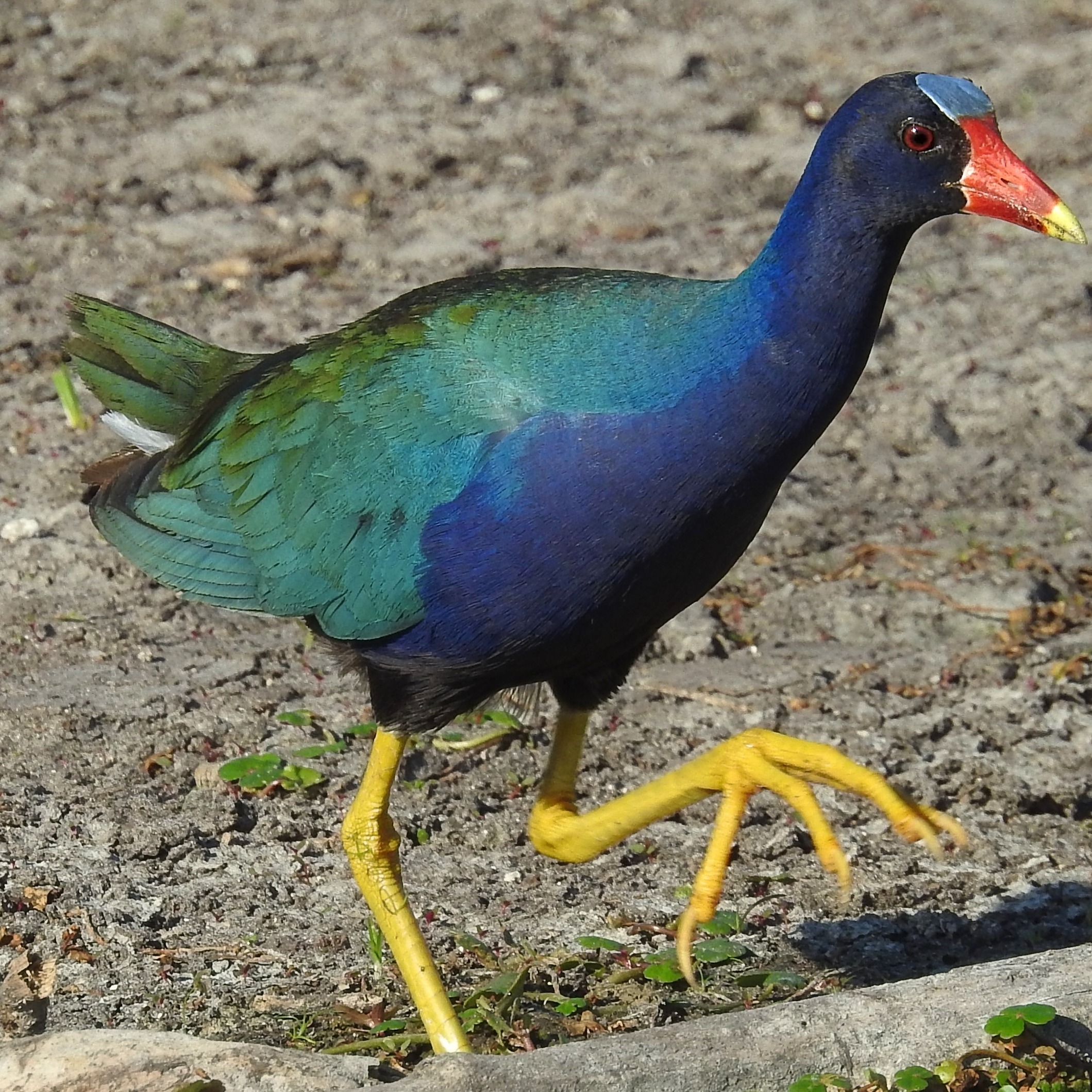
The Purple Gallinule (Porphyrio martinicus) is a medium-sized rallid with the most vibrant, tropical coloration of its entire family. It looks like a living jewel: its head and underparts are an intense purplish-blue, while its back and wings shine with bronze-green and metallic emerald tones. Its face features a pale blue (light blue) fleshy frontal shield, followed by a conical bright red bill with a yellow tip. Its legs are exceptionally long and a bright sulfur-yellow color. When it walks or swims, it nervously flicks its short tail upward, flashing a patch of pure white undertail coverts. Unlike coots, its long toes do not have lobes or webbing.

Added by

Anonymous Curator

Reviewed by

Under Review

Last modified by

Julia Trouin

TaxonomyBiological classification ranks placing this species within the tree of life, from Kingdom down to Genus.

PhylumRank below Kingdom. Groups organisms sharing a fundamental body plan (e.g., Chordata = vertebrates and some invertebrates).Chordata
ClassRank below Phylum. Subdivides by structural traits (e.g., Mammalia, Aves, Reptilia, Insecta).Aves
OrderRank below Class. Groups related families sharing common ancestry (e.g., Carnivora, Primates).Gruiformes
FamilyRank below Order. Groups closely related genera (e.g., Felidae = cats, Canidae = dogs).Rallidae
GenusRank just above Species. The first word in the two-part binomial scientific name.Porphyrio
Taxonomic AuthorityThe scientist who first formally described and published this species, followed by the year of publication.(Linnaeus, 1766)
Record Completeness
95%
Coming soon

Ecology & StatusHow this species lives: habitat preferences, diet, behavior, population status, and role in its ecosystem.

OriginWhether the species is native (evolved here), endemic (found only here), or introduced by human activity.

Native

Population TrendDirection of change in population size over time: increasing, stable, decreasing, or unknown.

Decreasing

Breeding SeasonTime of year when this species typically reproduces or flowers.

Wet Season

Trophic RolePosition in the food chain: producer, herbivore, carnivore, omnivore, decomposer, or parasite.

Omnivore

Recent SightingsWhether this species has been observed in the wild in Costa Rica within recent years.

Yes

Habitat SummaryOverview of the specific ecosystems and environments where this species is found in Costa Rica. Multi-lang

It is a bird inseparably linked to densely vegetated freshwater wetlands. It inhabits swamps, marshes, shallow lagoons, rice paddies, and river margins, always preferring water bodies covered by a floating carpet of plants (like water hyacinth or lilies) and bordered by tall reeds and shrubs. In Costa Rica, it is commonly found in the lowlands and protected wetlands of both slopes, such as Palo Verde, Caño Negro, and Tortuguero.

BehaviourDaily activity patterns, movement, territory use, foraging style, and seasonal behavioral changes. Multi-lang

It is a very active bird during the day. It spends hours walking methodically over floating vegetation or climbing among the reeds looking for food. With each step it takes, it rhythmically bobs its head and flicks its tail up and down, sending white flashes that likely serve to communicate with other gallinules. If frightened, it prefers to run into the thickets rather than fly, often climbing rapidly into thick bushes.

Social ActivitySocial structure: whether the species is solitary, paired, or colonial; hierarchy and communication. Multi-lang

They are generally seen in pairs or small family groups, foraging noisily. They are very territorial during the breeding season and will aggressively chase other rallids out of their territory.

Feeding GuildWhat the species eats, how it forages or hunts, and its role as a consumer in the food web. Multi-lang

Omnivore / Ground and climbing forager.

Trophic Chain DetailsSpecific interactions in local food webs: prey species, predators, competitors, and scavengers. Multi-lang

Opportunistic omnivore. Its diet is very varied: it includes lotus and grass seeds, aquatic leaves, flowers, insects, frogs, spiders, worms, and even small fish and eggs of other birds. They are preyed upon mainly by caimans, large snakes, raccoons, and birds of prey like the snail kite and falcons.

Reproductive BehaviourMating strategies, courtship displays, nesting or spawning behavior, and parental care. Multi-lang

They are seasonally monogamous. They build a cup-shaped nest woven with reeds and grasses, usually well hidden in emergent vegetation or in low bushes over the water (1-2 meters high). The female lays 3 to 10 pale pink eggs with brown spots. Incubation is shared and lasts 22 to 25 days. The chicks are semi-precocial; they hatch covered in black down and leave the nest within a few days, although they continue to be fed and protected by both parents, and occasionally even by older siblings (nest helpers).

Physical Measures

Length (cm)

26.0 - 37.0 cm

Weight (Grams)

140 g - 300 g

Offspring per cycleTypical number of young (live births, eggs, or seeds) produced by one adult in a single reproductive event or breeding season.3 - 10
Sexual DimorphismObservable physical differences between males and females of the same species (e.g., size, coloration, features).No

Lifespan

Sexual MaturityAge at which the individual becomes capable of reproducing for the first time.

12 - 24 Months

Gestation / IncubationDuration from fertilization to birth (mammals) or to hatching (egg-laying species).

22 - 25

Lifespan EstimatedExpected duration of life from birth to natural death under wild conditions.
Males5 - 10 Years
Females5 - 10 Years

Evolutionary AdaptationsInherited traits and behaviors that improve the species' survival and reproduction in its specific environment. Multi-lang

Snowshoe Toes and Climbing: Its toes are ridiculously long in relation to its body. This distributes its weight to walk without sinking on fragile lily pads (like jacanas), but it also gives it exceptional grip to climb with almost acrobatic agility up the tall stalks of reeds and swamp shrubs.
Foot Manipulation (The Swamp Parrot): They have a rare ability among waterbirds. They are capable of grabbing stalks, large seeds, or flowers with one foot, bringing the food up to their bill, and biting it while balancing on the other leg, exactly as a parrot would do.

Main ThreatsDocumented pressures reducing the population: habitat loss, hunting, disease, climate change, and invasive species. Multi-lang

Wetland Drainage: Its survival is entirely dependent on shallow swamps. The conversion of lands for agriculture or residential development completely eradicates local populations.
Chemical Pollution: Living in areas that often receive agricultural runoff (like rice paddies and sugarcane), they are exposed to high levels of pesticides and herbicides.

Interesting FactsSurprising or notable facts that highlight what makes this species unique or ecologically important. Multi-lang

Oceanic Vagrants: Despite looking like clumsy birds that fly little and low (with their legs dangling), they are exceptionally strong migrants. They are famous for suddenly appearing (vagrancy) in places as far away as Europe, South Africa, and Atlantic islands after being blown off course by storms.
Reflected Light: The metallic green and bronze sheen of its back is not a pigment, but structural coloration. Depending on the angle at which sunlight hits its feathers, the bird's back can look anywhere from emerald green to almost black.