
Costa Rica Species
Habia fuscicauda
AnimaliaHighest rank in taxonomy. Groups all life into domains: Animalia, Plantae, Fungi, etc.IUCN LCInternational Union for Conservation of Nature — the world authority on species extinction risk, using standardized criteria. — Least Concern — widespread and abundant; not at immediate risk of extinction.In ProgressCurrent stage of this record in the editorial review workflow. Recent Sighting

Habia fuscicauda

Red-throated Ant-Tanager

Cabanis, 1861

Detailed Texts Multi-lang
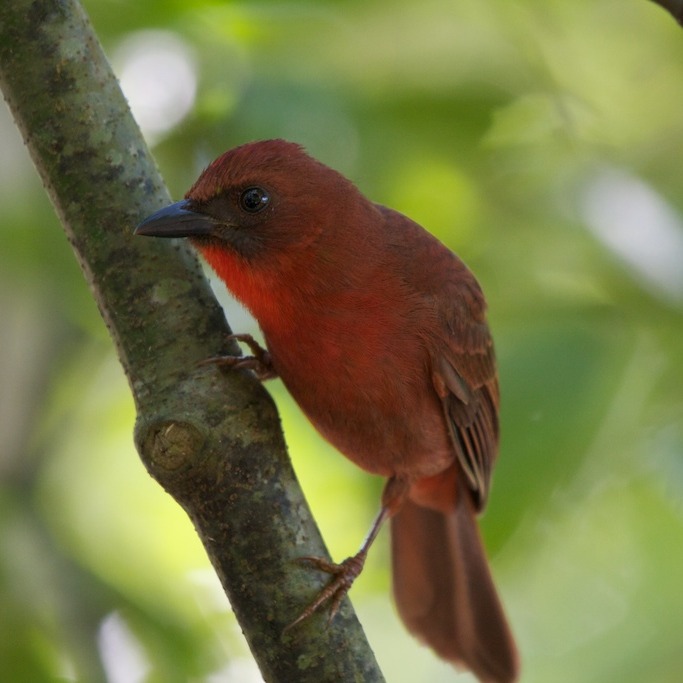
It is a robust, medium-sized passerine with a strong, slightly curved, blackish bill. It displays marked sexual dimorphism in its coloration. The adult male features a dark reddish-brown or sooty-gray body plumage with a generalized reddish wash, highlighted by a brilliant scarlet-red throat and an erectile crest of the same tone, usually concealed unless alarmed. The female possesses a much duller plumage, predominantly olive-brown or brownish, with a pale ochre-yellow throat and lacks the red crest. Both sexes have strong grayish-brown legs and dark eyes, adapted for moving within the dense forest gloom.

Added by

Anonymous Curator

Reviewed by

Under Review

Last modified by

Julia Trouin

TaxonomyBiological classification ranks placing this species within the tree of life, from Kingdom down to Genus.

PhylumRank below Kingdom. Groups organisms sharing a fundamental body plan (e.g., Chordata = vertebrates and some invertebrates).Chordata
ClassRank below Phylum. Subdivides by structural traits (e.g., Mammalia, Aves, Reptilia, Insecta).Aves
OrderRank below Class. Groups related families sharing common ancestry (e.g., Carnivora, Primates).Passeriformes
FamilyRank below Order. Groups closely related genera (e.g., Felidae = cats, Canidae = dogs).Mitrospingidae
GenusRank just above Species. The first word in the two-part binomial scientific name.Habia
Taxonomic AuthorityThe scientist who first formally described and published this species, followed by the year of publication.Cabanis, 1861
Record Completeness
94%
Coming soon

Ecology & StatusHow this species lives: habitat preferences, diet, behavior, population status, and role in its ecosystem.

OriginWhether the species is native (evolved here), endemic (found only here), or introduced by human activity.

Native

Population TrendDirection of change in population size over time: increasing, stable, decreasing, or unknown.

Stable

Breeding SeasonTime of year when this species typically reproduces or flowers.

--

Trophic RolePosition in the food chain: producer, herbivore, carnivore, omnivore, decomposer, or parasite.

Insectivore

Recent SightingsWhether this species has been observed in the wild in Costa Rica within recent years.

Yes

Habitat SummaryOverview of the specific ecosystems and environments where this species is found in Costa Rica. Multi-lang

It primarily inhabits dense understory, riparian thickets, secondary forest edges, and abandoned cacao plantations in the humid lowlands of the Atlantic slope of the Neotropics, ranging from southeastern Mexico to northwestern Colombia. In Costa Rica, it is a highly characteristic species of the northern and Caribbean plains, distributing mainly from sea level up to 600 meters in altitude, avoiding the interior of excessively tall primary forests and preferring areas with dense tangles of vegetation.

BehaviourDaily activity patterns, movement, territory use, foraging style, and seasonal behavioral changes. Multi-lang

It is one of the loudest, most conspicuous, and active birds of the Neotropical understory. It travels in noisy family groups that maintain constant contact through low, harsh notes. They actively follow army ant swarms, perching on low vertical branches just above the advancing front of the ants, making sudden acrobatic sallies to snap up prey on the ground or low foliage.

Social ActivitySocial structure: whether the species is solitary, paired, or colonial; hierarchy and communication. Multi-lang

It possesses a complex cooperative social structure. The family group aggressively defends a permanent territory year-round. When they encounter an ant column, they allow other exogenous species to join the periphery of the banquet, but the ant-tanager always maintains priority access to the center of the advancing front due to its larger size and aggressiveness.

Feeding GuildWhat the species eats, how it forages or hunts, and its role as a consumer in the food web. Multi-lang

Understory insectivore and frugivore. It consumes large quantities of arthropods such as grasshoppers, forest cockroaches, beetles, spiders, caterpillars, and centipedes. It regularly and significantly supplements its diet with small berries from understory shrubs of the Melastomataceae and Rubiaceae families.

Trophic Chain DetailsSpecific interactions in local food webs: prey species, predators, competitors, and scavengers. Multi-lang

It acts as a dominant secondary consumer in the forest's lower stratum. Its diet is highly linked to large arthropods flushed out by ants. In turn, due to its size and ground/low habits, it is a potential prey item for arboreal snakes (Spilotes pullatus), small carnivorous mammals, and forest falcons (such as Micrastur semitorquatus).

Reproductive BehaviourMating strategies, courtship displays, nesting or spawning behavior, and parental care. Multi-lang

It displays cooperative breeding. The nest is built exclusively by the female and is a bulky, untidy open cup made of thin twigs, dry leaves, fern fragments, and gnarled rootlets, usually lined with dark plant fibers and placed between 1 and 3 meters high in the fork of a dense shrub or thorny palm. She generally lays 2 or 3 greenish-white or grayish eggs with abundant brown and lilac speckles. Incubation lasts 12 to 14 days and is performed solely by the female. Nestlings are fed not only by the breeding pair but also by the helper members of the family group, remaining in the nest for 10 to 13 days until they fledge.

Physical Measures

Length (cm)

17.0 - 19.0 cm

Weight (Grams)

34 g - 48 g

Offspring per cycleTypical number of young (live births, eggs, or seeds) produced by one adult in a single reproductive event or breeding season.2 - 3
Sexual DimorphismObservable physical differences between males and females of the same species (e.g., size, coloration, features).Yes

Lifespan

Sexual MaturityAge at which the individual becomes capable of reproducing for the first time.

1 Years

Gestation / IncubationDuration from fertilization to birth (mammals) or to hatching (egg-laying species).

12 - 14

Lifespan EstimatedExpected duration of life from birth to natural death under wild conditions.
Males5 - 8 Years
Females5 - 8 Years

Sexual DimorphismPhysical differences in size, coloration, or morphology between males and females of this species.

Males Multi-lang

Adult male with breeding plumage of a dark or dull reddish-brown tone on the back, tail, and wings. It presents a dark red crown that conceals a brilliant and intense scarlet central crest. The throat exhibits a very striking and well-defined bright red color that contrasts with the darker breast.

Females Multi-lang

Plumage completely olivaceous or dull brownish on the entire back, evolutionarily adapted for camouflage within the foliage. It completely lacks any trace of the red crest. Its throat is an ochre, yellowish-buff, or dull pale yellow tone, remarkably less contrasting and striking than that of the male.

Evolutionary AdaptationsInherited traits and behaviors that improve the species' survival and reproduction in its specific environment. Multi-lang

Obligate Association with Army Ants: It has developed a highly specialized foraging strategy where it follows army ant columns (such as Eciton burchellii) not to feed on the ants, but to capture the insects that jump desperately trying to escape them.
Sentinel Alarm Calls: It possesses a repertoire of loud, harsh vocalizations that act as warning signals for the entire accompanying group of birds when hawks or other understory predators are nearby.

Main ThreatsDocumented pressures reducing the population: habitat loss, hunting, disease, climate change, and invasive species. Multi-lang

Understory Loss due to Cattle Ranching: The clearing of forest understory to introduce pastures completely eliminates the dense shrubs and vegetative tangles on which this species strictly depends.
Disruption of Ant Columns: Severe habitat fragmentation reduces populations of nomadic army ants; without these legions, the tanager loses its primary mechanism for efficient food procurement.

Interesting FactsSurprising or notable facts that highlight what makes this species unique or ecologically important. Multi-lang

Family Group Dynamics: They live in permanent social groups of 3 to 8 individuals consisting of a breeding pair and their offspring from previous years, who act as helpers at the nest.
Nuclear Flock Species: Their loud and confident presence attracts other species of understory insectivorous birds, making them the organizational leaders of mixed-species flocks in the jungle.