
Costa Rica Species
PlantaeHighest rank in taxonomy. Groups all life into domains: Animalia, Plantae, Fungi, etc.IUCN LCInternational Union for Conservation of Nature — the world authority on species extinction risk, using standardized criteria. — Least Concern — widespread and abundant; not at immediate risk of extinction.ApprovedCurrent stage of this record in the editorial review workflow. Recent Sighting

Brassavola nodosa

Lady of the Night

(L.) Lindl., 1831

Detailed Texts Multi-lang
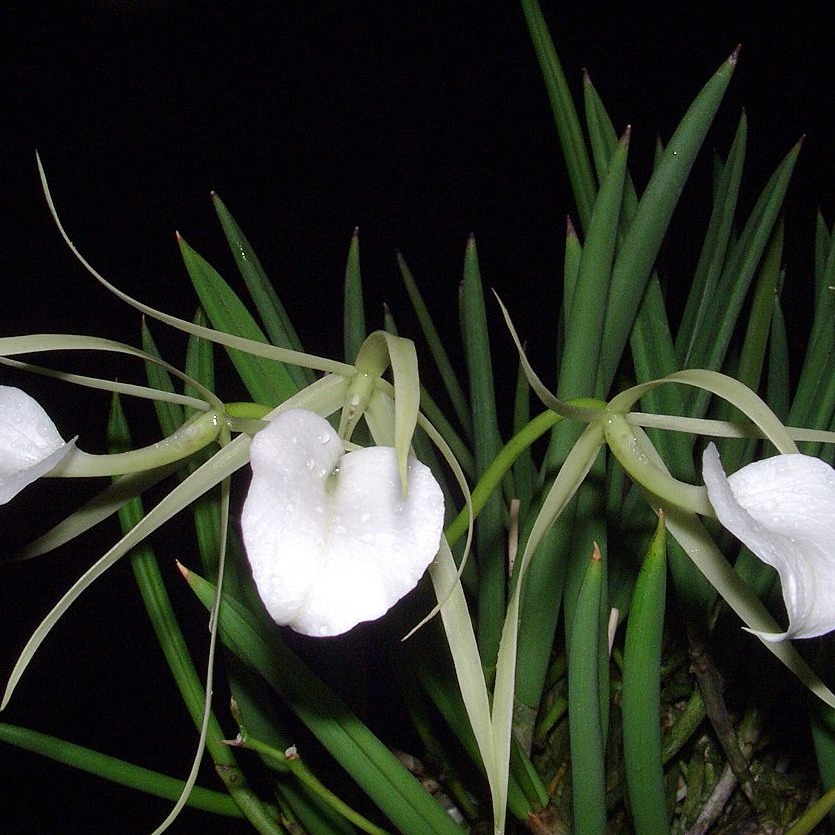
A highly resilient, tough-textured, small-to-medium sized epiphytic or lithophytic orchid renowned for its distinctively rugged, stark botanical profile. It lacks prominent fleshy bulbs, instead developing short, slender, cylindrical pseudobulbs that blend seamlessly into solitary, upright, deeply channeled, semi-terete, and hyper-succulent leaves that resemble stiff, fleshy spikes. The inflorescences emerge directly from the leaf base, producing clusters of one to six highly elegant blossoms. These long-lasting flowers possess thin, narrow, pale green to yellowish-white sepals and petals that frame a massive, showy, pristine-white, heart-shaped or spade-shaped labellum (lip) that sometimes exhibits tiny purple freckles deep inside the tube.

Added by

Anonymous Curator

Reviewed by

Under Review

Other Names (Global)Regional and multilingual names used for this species across different countries and languages.

Lady of the NightDama de nocheQueen of the NightLittle Stars Orchid

TaxonomyBiological classification ranks placing this species within the tree of life, from Kingdom down to Genus.

PhylumRank below Kingdom. Groups organisms sharing a fundamental body plan (e.g., Chordata = vertebrates and some invertebrates).Tracheophyta
ClassRank below Phylum. Subdivides by structural traits (e.g., Mammalia, Aves, Reptilia, Insecta).Magnoliopsida
OrderRank below Class. Groups related families sharing common ancestry (e.g., Carnivora, Primates).Asparagales
FamilyRank below Order. Groups closely related genera (e.g., Felidae = cats, Canidae = dogs).Orchidaceae
GenusRank just above Species. The first word in the two-part binomial scientific name.Brassavola
Taxonomic AuthorityThe scientist who first formally described and published this species, followed by the year of publication.(L.) Lindl., 1831
Record Completeness
93%
Coming soon

Ecology & StatusHow this species lives: habitat preferences, diet, behavior, population status, and role in its ecosystem.

OriginWhether the species is native (evolved here), endemic (found only here), or introduced by human activity.

Native

Population TrendDirection of change in population size over time: increasing, stable, decreasing, or unknown.

Stable

Trophic RolePosition in the food chain: producer, herbivore, carnivore, omnivore, decomposer, or parasite.

Herbivore

Growth HabitPhysical form and structure of the plant: tree, shrub, herb, vine, epiphyte, aquatic, etc.

--

Leaf TypeLeaf characteristics: deciduous (seasonal shed), evergreen, simple, compound, needle-like, etc.

--

Flowering SeasonTime of year when this species typically reproduces or flowers.

Year Round

Recent SightingsWhether this species has been observed in the wild in Costa Rica within recent years.

Yes

Habitat SummaryOverview of the specific ecosystems and environments where this species is found in Costa Rica. Multi-lang

Native across a broad tropical range from Mexico, throughout Central America, into northern South America (Colombia, Venezuela), and across portions of the Caribbean. It thrives in high-stress, exposed environments, functioning as a low-altitude specialist from sea level up to 500 meters. It is frequently found colonizing the harsh, sun-baked bark of coastal mangroves, windswept trees in dry lowland deciduous forests, and bare coralline limestone cliffs right along the ocean surf, showing incredible tolerance to high salt spray and intense, direct sunlight.

Light & Water NeedsSunlight intensity and moisture levels this plant needs to grow and reproduce successfully. Multi-lang

Information not available in English. Help us expand this record!

BehaviourDaily activity patterns, movement, territory use, foraging style, and seasonal behavioral changes. Multi-lang

Establishes dense, localized colonial clusters on exposed branches and coastal rocks. It operates on a strict diurnal clock, maintaining total metabolic silence during high heat before initiating intensive physiological activity at twilight. The synchronous opening of its broad white lips provides highly visible nocturnal landing platforms along coastal corridors, creating focal points for specialized night-flying insects while its tight root masses accumulate salt-tolerant organic debris.

Toxicity / UsesToxic compounds present and their documented effects on humans or other organisms. Multi-lang

Information not available in English. Help us expand this record!

Physical Measures

Length (cm)

15.0 - 45.0 cm

Reproductive StructuresFlowers, fruits, and seeds — the reproductive organs and their seasonal appearance.

Flower Photos (Max 2)

No image

Fruit Photos (Max 2)

No image

Evolutionary AdaptationsInherited traits and behaviors that improve the species' survival and reproduction in its specific environment. Multi-lang

Employs heavy, thickened, pencil-like semi-terete leaves with an extremely thick waxy cuticle to limit moisture transpiration and conserve water reserves within severe, wind-swept, and sun-baked coastal microclimates.
Exhibits exceptional halotolerance, possessing specialized root physiology capable of absorbing atmospheric humidity and rain while blocking the systemic uptake of toxic sodium ions from coastal salt spray.

Main ThreatsDocumented pressures reducing the population: habitat loss, hunting, disease, climate change, and invasive species. Multi-lang

Rapid degradation of coastal ecosystems driven by beachfront tourist infrastructure expansion, aquaculture pond clearing, and the direct destruction of vulnerable mangrove swamp margins.
Heavy localized poaching of wild specimens to supply domestic nurseries and roadside stalls, fueled by its historical fame for intense nighttime perfume and ease of backyard cultivation.

Interesting FactsSurprising or notable facts that highlight what makes this species unique or ecologically important. Multi-lang

The orchid is completely odorless by day, but precisely at dusk, it begins releasing an incredibly potent, sweet scent resembling citrus, gardenia, and warm clove to navigate nocturnal pollinators to its location.
Unlike most orchids that require deep shade, Brassavola nodosa routinely grows completely exposed to direct tropical sun on bare rock, turning its bright green leaves a heavily speckled crimson-red to protect itself from radiation.