
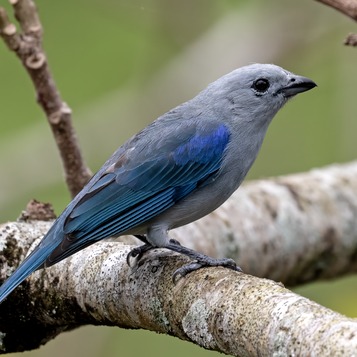
Thraupis episcopus
Blue-gray Tanager
(Linnaeus, 1766)
Added by
Anonymous Curator
Reviewed by
Under Review
Last modified by
Julia Trouin
TaxonomyBiological classification ranks placing this species within the tree of life, from Kingdom down to Genus.
Ecology & StatusHow this species lives: habitat preferences, diet, behavior, population status, and role in its ecosystem.
OriginWhether the species is native (evolved here), endemic (found only here), or introduced by human activity.
Native
Population TrendDirection of change in population size over time: increasing, stable, decreasing, or unknown.
Increasing
Breeding SeasonTime of year when this species typically reproduces or flowers.
--
Trophic RolePosition in the food chain: producer, herbivore, carnivore, omnivore, decomposer, or parasite.
Frugivore
Recent SightingsWhether this species has been observed in the wild in Costa Rica within recent years.
Yes
Habitat SummaryOverview of the specific ecosystems and environments where this species is found in Costa Rica. Multi-lang
The blue-gray tanager is one of the most generalist and ubiquitous birds of tropical America, capable of occupying almost any environment with moderate tree or shrub cover. It inhabits forest edges, open secondary forests, urban and suburban gardens, parks, shade coffee plantations, fruit tree plantations, wooded riversides, savannas with scattered trees, orchards, mangroves with tree cover, and virtually any environment with fruit availability and elevated perches. It avoids the interior of dense primary forests, where it is replaced by more specialized tanagers, and open treeless grasslands. It is omnipresent in the Greater Metropolitan Area of San José and all urban centers of Costa Rica, where the presence of ornamental fruit trees in parks, gardens, and avenues guarantees year-round food resources. It is recorded from sea level to 2,000 meters in altitude, more abundant between 0 and 1,500 meters on both slopes. It is one of the most frequent birds at fruit feeders in urban gardens and the most visibly human-tolerant of all tanager species in the country.BehaviourDaily activity patterns, movement, territory use, foraging style, and seasonal behavioral changes. Multi-lang
The blue-gray tanager is diurnal, vocal, and conspicuous, being one of the most visible birds in the Costa Rican urban landscape throughout the year. It lives in permanent pairs that maintain territories of 0.5 to 2 hectares in gardens, parks, and forest edges. Pairs move together virtually year-round, foraging in the same trees and sleeping on nearby perches. The male's song — a series of sharp, metallic notes, less complex than the clay-colored thrush's but equally persistent — is heard mainly at dawn and during the hottest hours. When detecting a predator or a same-species intruder, it produces a series of short, repetitive staccato notes that serve as alarms to the rest of the garden bird community. It regularly visits fruit feeders placed in gardens, where it can become completely trusting and approach within less than a meter of the observer. In areas with high blue-gray tanager density — such as urban parks of San José and Heredia — pairs tolerate the presence of other pairs a few meters away outside the breeding season, and territorial boundaries are actively renegotiated at the beginning of each season.Social ActivitySocial structure: whether the species is solitary, paired, or colonial; hierarchy and communication. Multi-lang
The blue-gray tanager lives in stable, permanent monogamous pairs that are the fundamental social unit of the species throughout the year. Pairs move together practically all the time, vocalize in mutual response, and collaboratively defend the territory against other pairs of the same species. Outside the breeding season, several pairs may coincide in the same fruit tree without active conflicts, establishing a tacit access hierarchy based on the proximity of the tree to the center of each pair's territory. The blue-gray tanager does not form mixed flocks with other species, but can be regularly seen in the same foraging zone as tanagers of other genera (Ramphocelus, Euphonia) with which it shares resources without frequent agonistic interactions. At urban fruit feeders, the blue-gray tanager is usually the dominant species over other smaller tanagers, though it cedes preferential access to the great kiskadee (Pitangus sulphuratus) when present.Feeding GuildWhat the species eats, how it forages or hunts, and its role as a consumer in the food web. Multi-lang
Generalist frugivorous-omnivore with nectarivorous and insectivorous supplement. It forages primarily in the canopy and subcanopy at 3-20 meters height, taking fruits directly from branches with rapid, precise bill movements. It consumes soft fruits up to 1.5 cm in diameter that it can swallow whole, and larger fruits that it pecks repeatedly to extract pulp. It accesses nectar from tubular flowers through legitimate visits — inserting the bill through the floral opening — or through robbing by piercing the flower base. It captures small insects and arthropods directly from foliage or the ground. The proportion of each component varies seasonally: fruits dominate the diet year-round, nectar increases in the dry season when ripe fruits are scarce, and insects increase during the breeding season to meet the protein requirements of chicks. It does not store food.Trophic Chain DetailsSpecific interactions in local food webs: prey species, predators, competitors, and scavengers. Multi-lang
Frugivorous-omnivorous primary consumer and seed disperser of moderate importance in edge and urban ecosystems. Its diet consists primarily of soft ripe fruits of multiple species (Ficus spp., Cecropia spp., Trema micrantha, Solanum spp., Bursera spp., Miconia spp., Rubus spp., Piper spp.), nectar from tubular flowers (Heliconia spp., Costus spp., Calliandra spp.) obtained legitimately or through robbing by piercing the flower base, and small insects and arthropods captured from foliage or the ground. By defecating intact seeds of the fruit species it consumes, it acts as a secondary disperser of various edge and understory plants. Its main predators are the broad-winged hawk (Buteo platypterus), sharp-shinned hawk (Accipiter striatus), bat falcon (Falco rufigularis), arboreal snakes such as Leptophis ahaetulla and Imantodes cenchoa, domestic cats, and black rats (Rattus rattus). Eggs and chicks are also preyed upon by magpie-jays (Cyanocorax spp.) in zones where these are present.Reproductive BehaviourMating strategies, courtship displays, nesting or spawning behavior, and parental care. Multi-lang
The breeding season in Costa Rica extends primarily from February to July, with the peak of nesting in March-May, coinciding with the onset of the rainy season and increased insect availability. Courtship includes pair duet vocalizations, male pursuits of the female through vegetation, and food transfer — the male offers fruits to the female as a pair-affiliation gesture — behavior that can also be observed outside the courtship season as pair bond reaffirmation. The female builds the nest practically alone over 5 to 8 days. The nest is an open, moderately sized cup built with plant fibers, fine roots, dry leaves, and diverse plant material, placed in a branch fork at 3-15 meters height, generally in a garden or park tree. Unlike the great kiskadee's globular nest, the blue-gray tanager's nest is open and more vulnerable to rain and predators. The clutch consists of 2 to 3 whitish or pale green eggs with brownish and reddish spots. Only the female incubates for 13 to 14 days. Chicks hatch altricial and are fed by both parents — primarily insects in the early stages, with fruits progressively incorporated — for 15 to 18 days. A pair can produce up to two clutches per season. Juveniles reach full adult plumage at 3-4 months and sexual maturity at one year of age.Physical Measures
Length (cm)
16.0 - 18.0 cm
Weight (Grams)
28 g - 40 g
Lifespan
Sexual MaturityAge at which the individual becomes capable of reproducing for the first time.
1 Years
Gestation / IncubationDuration from fertilization to birth (mammals) or to hatching (egg-laying species).
13 - 14