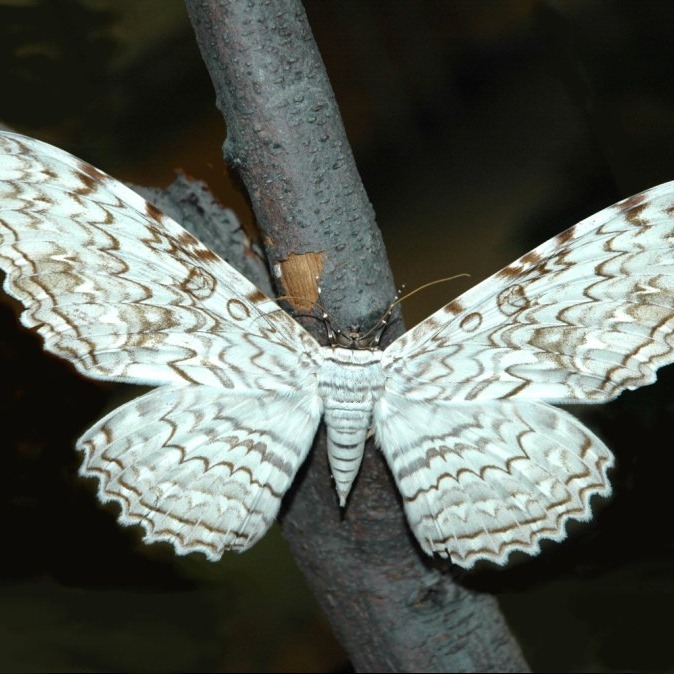
Thysania agrippina
White witch moth
Cramer, 1776
Added by
Anonymous Curator
Reviewed by
Julia Trouin
Last modified by
Julia Trouin
TaxonomyBiological classification ranks placing this species within the tree of life, from Kingdom down to Genus.
Ecology & StatusHow this species lives: habitat preferences, diet, behavior, population status, and role in its ecosystem.
OriginWhether the species is native (evolved here), endemic (found only here), or introduced by human activity.
Native
Population TrendDirection of change in population size over time: increasing, stable, decreasing, or unknown.
Stable
Breeding SeasonTime of year when this species typically reproduces or flowers.
Year Round
Trophic RolePosition in the food chain: producer, herbivore, carnivore, omnivore, decomposer, or parasite.
Herbivore
Recent SightingsWhether this species has been observed in the wild in Costa Rica within recent years.
Yes
Habitat SummaryOverview of the specific ecosystems and environments where this species is found in Costa Rica. Multi-lang
Inhabits tropical rainforests in Mexico, Central America, and much of South America, preferring dense forest environments.BehaviourDaily activity patterns, movement, territory use, foraging style, and seasonal behavioral changes. Multi-lang
Nocturnal moth, strongly attracted to artificial light sources.Social ActivitySocial structure: whether the species is solitary, paired, or colonial; hierarchy and communication. Multi-lang
Generally solitary behavior.Feeding GuildWhat the species eats, how it forages or hunts, and its role as a consumer in the food web. Multi-lang
Active foraging for nectar at night.Trophic Chain DetailsSpecific interactions in local food webs: prey species, predators, competitors, and scavengers. Multi-lang
Larvae feeding mainly on legume species (Fabaceae).Reproductive BehaviourMating strategies, courtship displays, nesting or spawning behavior, and parental care. Multi-lang
Typical Erebidae life cycle with complete metamorphosis.Physical Measures
Length (cm)
15.0 - 30.0 cm
Lifespan
Sexual MaturityAge at which the individual becomes capable of reproducing for the first time.
--
Gestation / IncubationDuration from fertilization to birth (mammals) or to hatching (egg-laying species).
14 - 21