
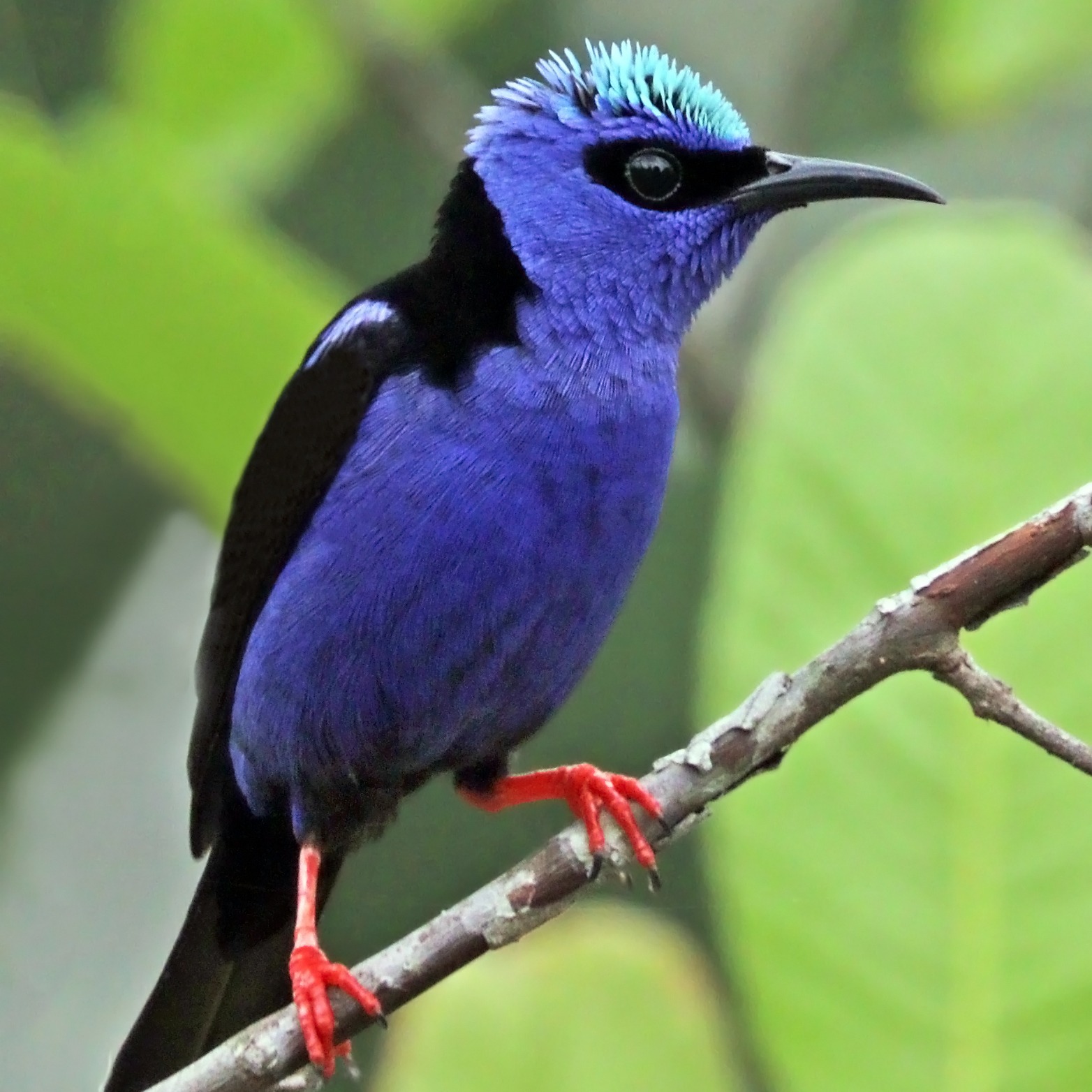
Cyanerpes cyaneus
Red-legged Honeycreeper
(Linnaeus, 1766)
Added by
Anonymous Curator
Reviewed by
Under Review
Last modified by
Julia Trouin
TaxonomyBiological classification ranks placing this species within the tree of life, from Kingdom down to Genus.
Ecology & StatusHow this species lives: habitat preferences, diet, behavior, population status, and role in its ecosystem.
OriginWhether the species is native (evolved here), endemic (found only here), or introduced by human activity.
Native
Population TrendDirection of change in population size over time: increasing, stable, decreasing, or unknown.
Stable
Breeding SeasonTime of year when this species typically reproduces or flowers.
--
Trophic RolePosition in the food chain: producer, herbivore, carnivore, omnivore, decomposer, or parasite.
Omnivore
Recent SightingsWhether this species has been observed in the wild in Costa Rica within recent years.
Yes
Habitat SummaryOverview of the specific ecosystems and environments where this species is found in Costa Rica. Multi-lang
It is widely distributed from southern Mexico, through Central America, to the Amazon basin, Colombia, and Trinidad. In Costa Rica, it is a common and abundant species in the lowlands and foothills of both slopes (Pacific and Caribbean), distributing from sea level to approximately 1,200 meters in altitude. It primarily occupies the canopy and edges of humid forests, maturing secondary forests, cocoa and coffee plantations with native shade trees, as well as wooded clearings and suburban gardens with lush vegetation.BehaviourDaily activity patterns, movement, territory use, foraging style, and seasonal behavioral changes. Multi-lang
It is a diurnal bird, extremely dynamic and social. It rarely remains still, moving with quick hops and acrobatic pirouettes among canopy inflorescences, frequently hanging upside down to reach nectar. Outside the breeding season, it forms coordinated groups of its own species or joins large mixed flocks alongside other tanagers, green honeycreepers, and euphonias. They constantly communicate using short, sharp, nasal calls that sound like 'tsip' or 'sre', maintaining group cohesion as they move through the treetops.Social ActivitySocial structure: whether the species is solitary, paired, or colonial; hierarchy and communication. Multi-lang
It is a markedly gregarious bird during most of the year, moving in family groups of 6 to 15 individuals. It shows excellent intraspecific and interspecific social tolerance, freely associating in trees with abundant flowering. During breeding, pairs subtly separate to nest, but they do not defend extensive territories, being able to tolerate nests of other honeycreepers relatively close by if food is abundant.Feeding GuildWhat the species eats, how it forages or hunts, and its role as a consumer in the food web. Multi-lang
Omnivore specialized in nectar, fruit juices, and small arthropods. Nectar constitutes the base of its liquid energy, supplemented by small berries swallowed whole and pulp from larger fruits (such as Cecropia). It daily consumes a significant amount of small flying insects, aphids, and spiders actively collected through leaf acrobatics.Trophic Chain DetailsSpecific interactions in local food webs: prey species, predators, competitors, and scavengers. Multi-lang
It acts as a highly efficient primary and secondary consumer in the upper forest levels. It plays a vital ecological role as a pollinator of trees from the Inga, Erythrina, and Calliandra genera, carrying pollen on its forehead. It is also an important disperser of small seeds from mistletoes and Ficus. It shares food resources with hummingbirds and the Green Honeycreeper. It is attractive prey for small diurnal raptors such as the Bat Falcon (Falco albigularis), the Double-toothed Kite, and arboreal snakes of the genus Oxybelis.Reproductive BehaviourMating strategies, courtship displays, nesting or spawning behavior, and parental care. Multi-lang
It is a monogamous species. The female is exclusively responsible for constructing the nest, which is small, thin, shallow, and fragile-looking, woven with fine fungal fibers, rootlets, and dry leaves, usually suspended in the fork of a slender branch at heights between 3 and 10 meters above the ground. She invariably lays 2 grayish-white or pale blue eggs with mottled dark spots. The female incubates alone for a period of 12 to 13 days, while the male keeps watch nearby and feeds her regularly via regurgitation. Both parents feed the chicks a diet rich in soft insects and nectar during the 14 to 15 days it takes for them to fledge.Physical Measures
Length (cm)
11.5 - 12.5 cm
Weight (Grams)
11 g - 15 g
Lifespan
Sexual MaturityAge at which the individual becomes capable of reproducing for the first time.
1 Years
Gestation / IncubationDuration from fertilization to birth (mammals) or to hatching (egg-laying species).
12 - 13