AnimaliaIUCN LCIn Progress Recent Sighting
Cyanerpes cyaneus
Red-legged Honeycreeper
(Linnaeus, 1766)
Detailed Texts Multi-lang
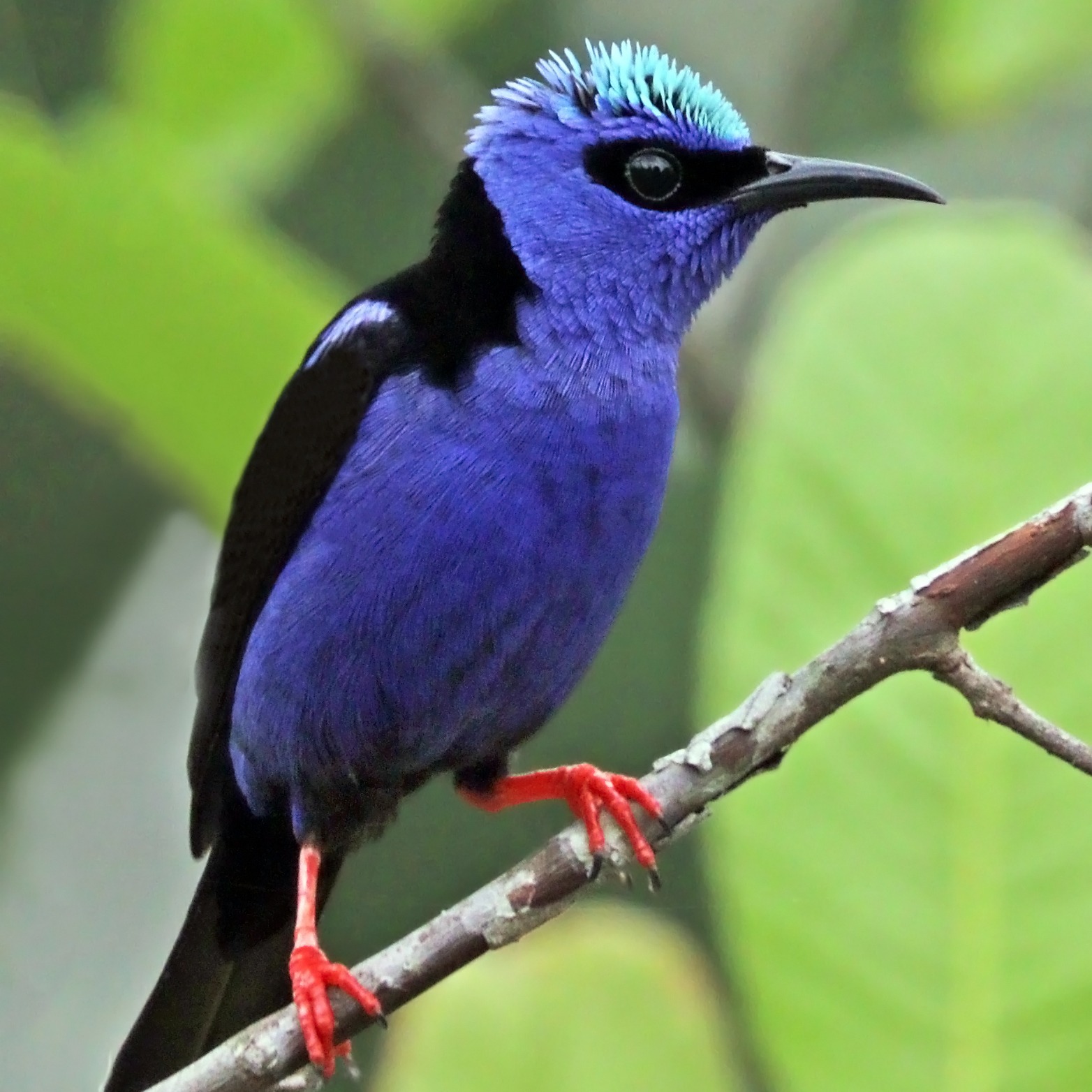
It is a small, highly elegant bird with a stylized silhouette, famous for the astonishing chromatic contrast of its plumage. It exhibits pronounced seasonal sexual dimorphism. The male in breeding plumage displays a deep violet-blue color across most of the body, crowned by a brilliant turquoise or sky-blue cap on top of the head. It features a jet-black mask surrounding the eyes that extends to the upper back, while the wings and tail are intense black. When opening its wings in flight, it reveals a dazzling lemon-yellow color on the underside of the feathers. Its most distinctive feature is its short but bright carmine or coral-red legs. The bill is black, long, slender, and noticeably decurved.
Added by
Anonymous Curator
Reviewed by
Under Review
Last modified by
Julia Trouin
Taxonomy
PhylumChordata
ClassAves
OrderPasseriformes
FamilyThraupidae
GenusCyanerpes
Taxonomic Authority(Linnaeus, 1766)
Ecology & Status
Origin
Native
Population Trend
Stable
Breeding Season
--
Trophic Role
Omnivore
Recent Sightings
Yes
Habitat Summary Multi-lang
It is widely distributed from southern Mexico, through Central America, to the Amazon basin, Colombia, and Trinidad. In Costa Rica, it is a common and abundant species in the lowlands and foothills of both slopes (Pacific and Caribbean), distributing from sea level to approximately 1,200 meters in altitude. It primarily occupies the canopy and edges of humid forests, maturing secondary forests, cocoa and coffee plantations with native shade trees, as well as wooded clearings and suburban gardens with lush vegetation.Behaviour Multi-lang
It is a diurnal bird, extremely dynamic and social. It rarely remains still, moving with quick hops and acrobatic pirouettes among canopy inflorescences, frequently hanging upside down to reach nectar. Outside the breeding season, it forms coordinated groups of its own species or joins large mixed flocks alongside other tanagers, green honeycreepers, and euphonias. They constantly communicate using short, sharp, nasal calls that sound like 'tsip' or 'sre', maintaining group cohesion as they move through the treetops.Social Activity Multi-lang
It is a markedly gregarious bird during most of the year, moving in family groups of 6 to 15 individuals. It shows excellent intraspecific and interspecific social tolerance, freely associating in trees with abundant flowering. During breeding, pairs subtly separate to nest, but they do not defend extensive territories, being able to tolerate nests of other honeycreepers relatively close by if food is abundant.Feeding Guild Multi-lang
Omnivore specialized in nectar, fruit juices, and small arthropods. Nectar constitutes the base of its liquid energy, supplemented by small berries swallowed whole and pulp from larger fruits (such as Cecropia). It daily consumes a significant amount of small flying insects, aphids, and spiders actively collected through leaf acrobatics.Trophic Chain Details Multi-lang
It acts as a highly efficient primary and secondary consumer in the upper forest levels. It plays a vital ecological role as a pollinator of trees from the Inga, Erythrina, and Calliandra genera, carrying pollen on its forehead. It is also an important disperser of small seeds from mistletoes and Ficus. It shares food resources with hummingbirds and the Green Honeycreeper. It is attractive prey for small diurnal raptors such as the Bat Falcon (Falco albigularis), the Double-toothed Kite, and arboreal snakes of the genus Oxybelis.Reproductive Behaviour Multi-lang
It is a monogamous species. The female is exclusively responsible for constructing the nest, which is small, thin, shallow, and fragile-looking, woven with fine fungal fibers, rootlets, and dry leaves, usually suspended in the fork of a slender branch at heights between 3 and 10 meters above the ground. She invariably lays 2 grayish-white or pale blue eggs with mottled dark spots. The female incubates alone for a period of 12 to 13 days, while the male keeps watch nearby and feeds her regularly via regurgitation. Both parents feed the chicks a diet rich in soft insects and nectar during the 14 to 15 days it takes for them to fledge.Physical Measures
Length (cm)
11.5 - 12.5 cm
Weight (Grams)
11 g - 15 g
Offspring per cycle2 - 2
Sexual DimorphismYes
Lifespan
Sexual Maturity
1 Years
Gestation / Incubation
12 - 13
Lifespan Estimated
Males5 - 9 Years
Females5 - 9 Years
Sexual Dimorphism
Males Multi-lang
The adult male in breeding plumage possesses a dazzling electric violet-blue body, with a brilliant turquoise-blue crown on top of the head. Its upper back, wings, tail, and the facial mask covering the eyes are of a deep, intense black. The legs are a highly conspicuous bright coral or carmine red.
Females Multi-lang
The adult female features a completely different and cryptic plumage, with the upperparts being a dull lime or olive green. Her underparts are a pale yellowish-green or buffy, finely streaked with dark green on the breast and flanks. Her legs are a dull reddish, brownish-maroon, or dull pinkish, never the bright red of the male.
Evolutionary Adaptations Multi-lang
Dynamic Decurved Bill: Its elongated and finely curved bill functions as a precision probe, allowing it to insert deeply into the corollas of tubular flowers and bromeliads to extract nectar without tearing the petals.
Male Eclipse Plumage: Outside the breeding season, the male undergoes a drastic molt into a predominantly green 'eclipse' plumage, similar to the female but retaining the black wings, which reduces its visibility to predators when it does not need to attract a mate.
Main Threats Multi-lang
Lowland Deforestation: The conversion of biodiverse tropical forests into extensive pastures or agro-industrial monocultures eliminates the essential native trees from which it extracts nectar and berries.
Wild Bird Trade: Due to the dazzling colors of the male, it is occasionally illegally captured for the exotic pet market, suffering high mortality rates in captivity due to its highly specialized diet.
Interesting Facts Multi-lang
Attraction to Water: They have an absolute fascination with moving water. It is one of the species that descends with the greatest enthusiasm to bathe in forest puddles or shallow streams, splashing energetically.
Yellow Wing Displays: The bright yellow underneath their wings is only visible during flight or in territorial displays. Males flash their wings open suddenly in front of rivals as a visual flash warning signal.