
Costa Rica Species
Pecari tajacu
AnimaliaHighest rank in taxonomy. Groups all life into domains: Animalia, Plantae, Fungi, etc.IUCN LCInternational Union for Conservation of Nature — the world authority on species extinction risk, using standardized criteria. — Least Concern — widespread and abundant; not at immediate risk of extinction.In ProgressCurrent stage of this record in the editorial review workflow. Recent Sighting

Pecari tajacu

Collared Peccary

(Linnaeus, 1758)

Detailed Texts Multi-lang
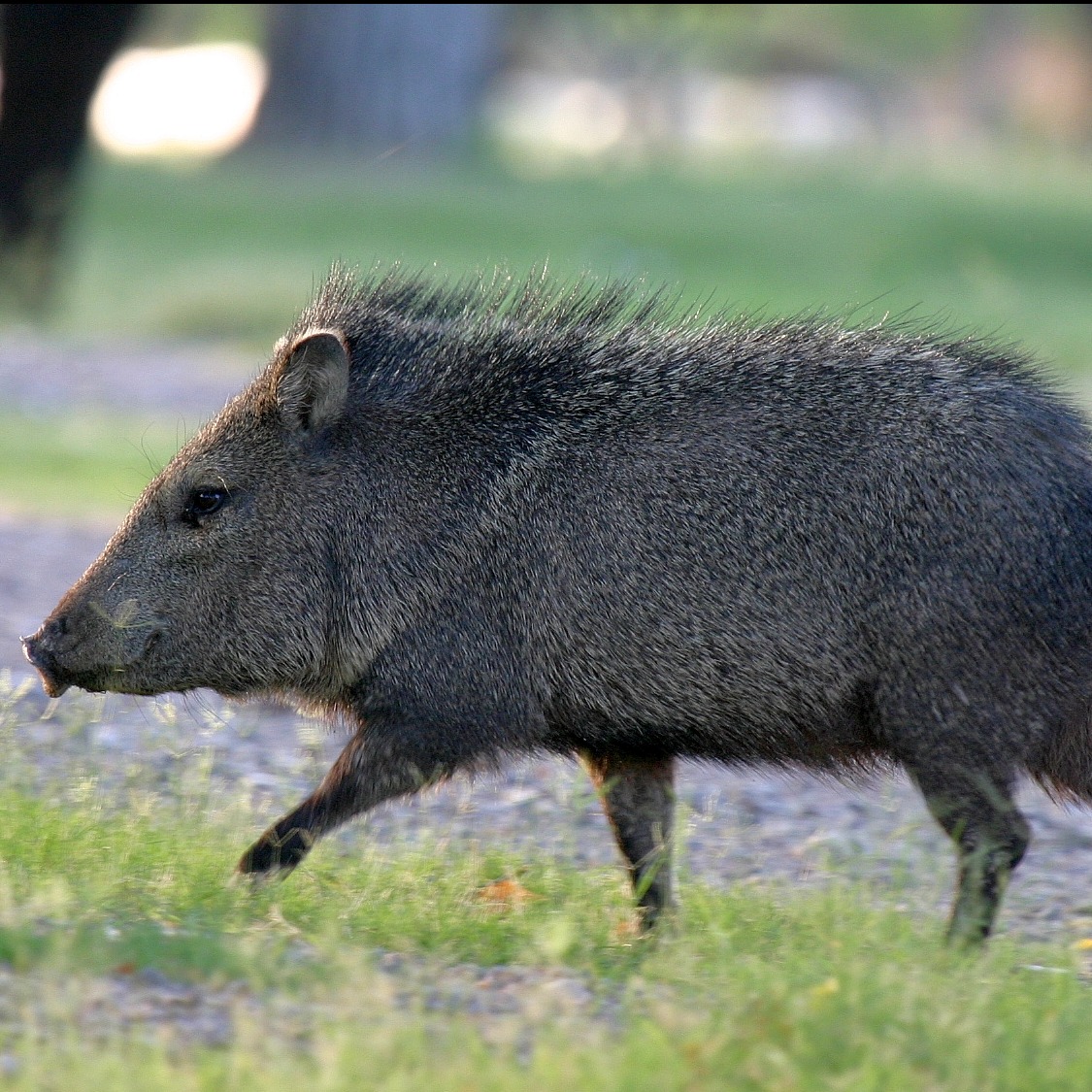
The collared peccary (Pecari tajacu) is the smaller of the two peccaries present in Central America and the most adaptable of all living tayassuids, belonging to the family Tayassuidae. It has a robust, compact body covered in thick, bristly fur ranging from dark gray to black, with a diagonal band of yellowish-white or cream running from the shoulder to the chest — the 'collar' that gives it its common name. The snout is elongated, mobile, and cartilaginous, adapted for digging. It has short but sharp canine tusks and a well-developed dorsal scent gland located on the back approximately 20 cm from the base of the tail. Unlike the white-lipped peccary (Tayassu pecari), it lives in much smaller groups, tolerates more disturbed habitats, and has an extraordinarily wide geographic distribution: from the southwestern United States to northern Argentina, making it the artiodactyl with the widest latitudinal distribution in the Americas.

Added by

Anonymous Curator

Reviewed by

Under Review

Last modified by

Julia Trouin

TaxonomyBiological classification ranks placing this species within the tree of life, from Kingdom down to Genus.

PhylumRank below Kingdom. Groups organisms sharing a fundamental body plan (e.g., Chordata = vertebrates and some invertebrates).Chordata
ClassRank below Phylum. Subdivides by structural traits (e.g., Mammalia, Aves, Reptilia, Insecta).Mammalia
OrderRank below Class. Groups related families sharing common ancestry (e.g., Carnivora, Primates).Artiodactyla
FamilyRank below Order. Groups closely related genera (e.g., Felidae = cats, Canidae = dogs).Tayassuidae
GenusRank just above Species. The first word in the two-part binomial scientific name.Pecari
Taxonomic AuthorityThe scientist who first formally described and published this species, followed by the year of publication.(Linnaeus, 1758)
Record Completeness
95%
Coming soon

Ecology & StatusHow this species lives: habitat preferences, diet, behavior, population status, and role in its ecosystem.

OriginWhether the species is native (evolved here), endemic (found only here), or introduced by human activity.

Native

Population TrendDirection of change in population size over time: increasing, stable, decreasing, or unknown.

Decreasing

Breeding SeasonTime of year when this species typically reproduces or flowers.

Year Round

Trophic RolePosition in the food chain: producer, herbivore, carnivore, omnivore, decomposer, or parasite.

Omnivore

Recent SightingsWhether this species has been observed in the wild in Costa Rica within recent years.

Yes

Habitat SummaryOverview of the specific ecosystems and environments where this species is found in Costa Rica. Multi-lang

The collared peccary is the peccary species with the greatest ecological niche breadth on the American continent. It inhabits lowland tropical rainforests to deciduous dry forests, thorn scrublands, North American southwestern cactus deserts, gallery forests, savannas, mangroves, and agricultural areas with remnant vegetation cover. In Central America it preferentially occupies tropical moist and premontane forests between 0 and 2,000 meters in altitude, but adapts with remarkable ease to secondary forests, wooded pastures, and peri-urban areas with sufficient cover. Its tolerance to human disturbance is considerably greater than that of the white-lipped peccary, and its home range is much smaller (1–4 km²), allowing it to persist in fragmented landscapes where Tayassu pecari has already disappeared.

BehaviourDaily activity patterns, movement, territory use, foraging style, and seasonal behavioral changes. Multi-lang

The collared peccary is primarily diurnal with activity concentrated during the cool morning and afternoon hours, becoming more crepuscular or nocturnal in areas with high hunting pressure or human disturbance. It lives in cohesive family groups of 5 to 30 individuals — exceptionally up to 50 — that share a territory of 1 to 4 km² and actively defend it against other groups of the same species. The group sleeps together at fixed resting sites — caves, tree hollows, dense vegetation — and travels in single file along memorized routes. Unlike the white-lipped peccary, its behavior is considerably quieter and more cryptic, and it can remain motionless for long periods upon detecting human presence. In well-conserved areas, it is frequently recorded on camera traps during the early morning hours.

Social ActivitySocial structure: whether the species is solitary, paired, or colonial; hierarchy and communication. Multi-lang

The collared peccary lives in stable family groups of 5 to 30 individuals with social structure based on matrilineal kinship. There is a linear dominance hierarchy, with adult females and males as central individuals and young animals in peripheral positions. Group cohesion is maintained through mutual rubbing of the dorsal gland as a routine greeting, low-intensity contact vocalizations during movement, and coordinated single-file movement. The group actively defends its territory against other groups of the same species through vocal and occasionally physical confrontations. Aggressive encounters between groups include tusk clacking, dorsal hair erection, and snorting. Individuals expelled from the group — generally subadult males — may live solitarily temporarily before integrating into another group.

Feeding GuildWhat the species eats, how it forages or hunts, and its role as a consumer in the food web. Multi-lang

Generalist omnivore with a strong frugivorous-radicivorous component. Its diet varies notably by ecosystem: in tropical moist forests, fruits, seeds, and roots predominate; in arid and semi-arid ecosystems, cacti (especially Opuntia) represent the dominant fraction. It also consumes fungi, tender leaves, decomposing plant matter, soil invertebrates (earthworms, larvae, millipedes, beetles), small reptiles, amphibians, and eggs. Rooting behavior is fundamental for accessing underground resources. In agricultural areas, it can cause significant damage to corn, cassava, and tuber crops. It does not store food.

Trophic Chain DetailsSpecific interactions in local food webs: prey species, predators, competitors, and scavengers. Multi-lang

Omnivorous primary consumer with a broad trophic spectrum. It ingests fruits, seeds, roots, tubers, fungi, leaves, cacti, soil invertebrates (earthworms, beetles, larvae), and occasionally small vertebrates and eggs. It acts as a secondary seed disperser of several palm species, Ficus, and understory plants by defecating intact seeds far from the mother tree. Its main predators are the jaguar (Panthera onca), puma (Puma concolor), ocelot (Leopardus pardalis), boa constrictor (Boa constrictor), Central American rattlesnake (Crotalus simus), and spectacled caiman (Caiman crocodilus) in riparian zones. In the deserts of northern Mexico and the southwestern United States, the puma is the dominant predator. Its presence in a fragmented ecosystem is an indicator of minimally functional conservation, as it is the first ungulate species to recolonize recovering forests.

Reproductive BehaviourMating strategies, courtship displays, nesting or spawning behavior, and parental care. Multi-lang

Reproduction occurs year-round with no marked seasonality in the tropics, although in populations in northern arid zones, birth peaks are observed in the rainy season. Courtship includes intragroup chases, active marking with the dorsal gland, and vocalization between the pair. After a gestation of 143–148 days, the female typically gives birth to two precocial young (range 1–4) with open eyes and complete fur. Young can follow the mother within the first hours of life. The entire group participates in monitoring young, with adult males as active as females in the antipredator alerting function. Lactation lasts approximately 6 to 8 weeks. Young reach sexual maturity between 8 and 14 months. A female can reproduce twice per year under favorable conditions.

Physical Measures

Length (cm)

75.0 - 100.0 cm

Weight (Grams)

14.00 kg - 30.00 kg

Offspring per cycleTypical number of young (live births, eggs, or seeds) produced by one adult in a single reproductive event or breeding season.1 - 4
Sexual DimorphismObservable physical differences between males and females of the same species (e.g., size, coloration, features).No

Lifespan

Sexual MaturityAge at which the individual becomes capable of reproducing for the first time.

8 - 14 Months

Gestation / IncubationDuration from fertilization to birth (mammals) or to hatching (egg-laying species).

143 - 148

Lifespan EstimatedExpected duration of life from birth to natural death under wild conditions.
Males10 - 15 Years
Females10 - 15 Years

Evolutionary AdaptationsInherited traits and behaviors that improve the species' survival and reproduction in its specific environment. Multi-lang

Exceptional physiological and behavioral tolerance to water scarcity: in desert and semi-arid ecosystems of the North American southwest and South American Chaco, the collared peccary can obtain most of its hydration from water contained in cacti such as prickly pear (Opuntia spp.), whose acidic, mucilaginous pulp it can chew and ingest without damage to the oral mucosa thanks to adaptations in the epithelial lining of its oral cavity.
Prehensile and highly sensory snout with a reinforced cartilaginous nasal disc that acts as a multifunctional digging tool: it can remove compacted soil, overturn rocks, probe under dense leaf litter, and manipulate objects with sufficient precision to select specific parts of fruits and roots before ingesting them.
Mid-sized social group (5–30 individuals) that provides antipredator advantages through distributed collective vigilance, without the logistical constraints imposed by a herd of hundreds of individuals: it can exploit smaller food patches, move through narrow corridors between forest fragments, and adapt more rapidly to changes in resource availability.
Three-compartment stomach with fermentation capacity that enables digestion of fibrous plant material, hard-coated seeds, oxalate-rich cactus parts, and roots with secondary compounds that other herbivores of similar size cannot neutralize, granting access to a variety of food resources without direct competitors in many ecosystems.

Main ThreatsDocumented pressures reducing the population: habitat loss, hunting, disease, climate change, and invasive species. Multi-lang

Subsistence and commercial hunting for bushmeat consumption, though less intense than that exerted on the white-lipped peccary due to its smaller size and lower meat yield per individual. In rural and indigenous communities of Costa Rica, Panama, and Colombia it constitutes an important protein source, and hunting pressure can become locally unsustainable in uncontrolled areas.
Road kills in fragmented landscape zones: the collared peccary is one of the medium-sized mammals most frequently killed in vehicle collisions in Costa Rica, especially on road corridors that cross buffer zones of national parks such as the Osa-Talamanca Biological Corridor and the route between San José and the Southern Zone.
Direct persecution by farmers and ranchers who consider it a pest due to the damage it causes to crops of corn, cassava, melon, and vegetables, and occasionally to fences and water troughs. This persecution is especially intense in agricultural frontier zones of the Northern Zone, Central Pacific, and Caribbean foothills of Costa Rica, where unregulated control hunts take place.

Interesting FactsSurprising or notable facts that highlight what makes this species unique or ecologically important. Multi-lang

Unlike the white-lipped peccary, the collared peccary has managed to establish itself in the southwestern United States — Texas, New Mexico, and Arizona — constituting the only peccary species that inhabits outside Latin America. In these desert regions it survives thanks to its ability to obtain water from cacti, an adaptation that no other ungulate in the area possesses to the same degree.
The collared peccary's 'collar' is not merely a decorative marking: the pale band of fur crossing the shoulder and neck acts as an intraspecific visual recognition signal that helps maintain group cohesion in the dim understory, where high-contrast light-dark markings are perceived more easily than colors under low light conditions.
The collared peccary and the white-lipped peccary can coexist in the same forest, but avoid direct competition through microhabitat and diet segregation: the collared peccary exploits more fragmented and open zones, consumes a higher proportion of fibrous material and roots, and forms smaller groups that can exploit smaller resource patches. When both species converge at the same food point, the collared peccary invariably defers to the white-lipped peccary, which is larger and lives in more numerous herds.
The collared peccary's dorsal gland is so active that the animal's characteristic musky odor can be detected before the animal is spotted, especially on trails frequently used by the group. Individuals mutually rub this gland as a greeting and recognition ritual, creating a shared 'group odor' that allows them to immediately identify whether an individual belongs to their herd or not.