
Costa Rica Species
Tamandua mexicana
AnimaliaHighest rank in taxonomy. Groups all life into domains: Animalia, Plantae, Fungi, etc.IUCN LCInternational Union for Conservation of Nature — the world authority on species extinction risk, using standardized criteria. — Least Concern — widespread and abundant; not at immediate risk of extinction.In ProgressCurrent stage of this record in the editorial review workflow. Recent Sighting

Tamandua mexicana

Northern Tamandua

(Saussure, 1860)

Detailed Texts Multi-lang
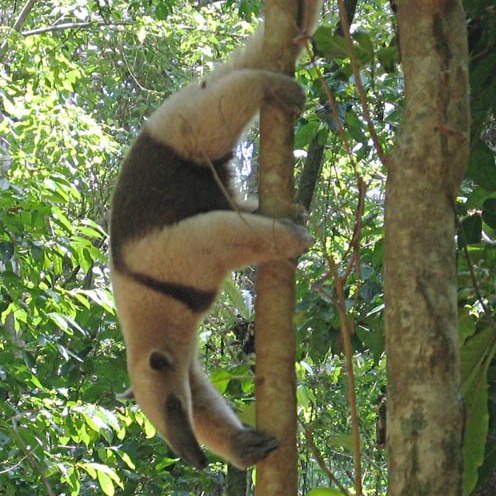
The northern tamandua (Tamandua mexicana) is a semi-arboreal mammal belonging to the order Pilosa and the family Myrmecophagidae, related to the giant anteater (Myrmecophaga tridactyla) and the silky anteater (Cyclopes didactylus). It has a robust body with short, dense fur that varies between two color morphs: individuals of uniform pale yellow or cream in northwestern populations, and individuals with a characteristic bicolor pattern — dark back and flanks forming a black 'jacket' or 'vest' over a golden background — in eastern and southeastern populations. The head is elongated and conical, with an extremely long tubular snout, rounded ears, and small eyes. It completely lacks teeth at all stages of life. Its forelimbs — especially the third claw — are disproportionately large and robust, designed for tearing open termite mounds and ant nests. The tail is long, strong, and prehensile in its distal half, with the ventral surface devoid of fur to maximize grip. Distributed from southern Mexico to northwestern Peru and Venezuela.

Added by

Anonymous Curator

Reviewed by

Under Review

Last modified by

Julia Trouin

TaxonomyBiological classification ranks placing this species within the tree of life, from Kingdom down to Genus.

PhylumRank below Kingdom. Groups organisms sharing a fundamental body plan (e.g., Chordata = vertebrates and some invertebrates).Chordata
ClassRank below Phylum. Subdivides by structural traits (e.g., Mammalia, Aves, Reptilia, Insecta).Mammalia
OrderRank below Class. Groups related families sharing common ancestry (e.g., Carnivora, Primates).Pilosa
FamilyRank below Order. Groups closely related genera (e.g., Felidae = cats, Canidae = dogs).Myrmecophagidae
GenusRank just above Species. The first word in the two-part binomial scientific name.Tamandua
Taxonomic AuthorityThe scientist who first formally described and published this species, followed by the year of publication.(Saussure, 1860)
Record Completeness
95%
Coming soon

Ecology & StatusHow this species lives: habitat preferences, diet, behavior, population status, and role in its ecosystem.

OriginWhether the species is native (evolved here), endemic (found only here), or introduced by human activity.

Native

Population TrendDirection of change in population size over time: increasing, stable, decreasing, or unknown.

Decreasing

Breeding SeasonTime of year when this species typically reproduces or flowers.

Year Round

Trophic RolePosition in the food chain: producer, herbivore, carnivore, omnivore, decomposer, or parasite.

Herbivore

Recent SightingsWhether this species has been observed in the wild in Costa Rica within recent years.

Yes

Habitat SummaryOverview of the specific ecosystems and environments where this species is found in Costa Rica. Multi-lang

The northern tamandua occupies a wide variety of forested and non-forested ecosystems: lowland and premontane tropical moist and dry forests, gallery forests, wooded savannas, shrublands, mangroves, and agricultural landscapes with remnant tree cover. It is a markedly semi-arboreal species that alternates terrestrial foraging with prolonged periods in the canopy, where it can rest perched on thick branches using its prehensile tail. It requires the simultaneous presence of active termite mounds — both on the ground and in trees — and ant nests of various arboreal and terrestrial ant species. In Costa Rica it is recorded in all ecosystems from sea level to 2,000 meters in altitude, with highest density in the humid forests of the Caribbean, Northern Zone, South Pacific, and Osa Peninsula.

BehaviourDaily activity patterns, movement, territory use, foraging style, and seasonal behavioral changes. Multi-lang

The northern tamandua is primarily nocturnal and crepuscular, although in areas with low human disturbance it may have diurnal activity. It alternates terrestrial foraging with resting periods in the canopy, where it can remain motionless for several hours perched on a thick branch with its tail coiled around the trunk. On the ground it moves with a characteristic knuckle-walking gait on its forelimb claws — to protect their sharp tips — with its head low, sniffing the ground and tree trunks. Its home range varies between 25 and 140 hectares depending on the availability of termite mounds and ant nests. An individual can consume up to 9,000 insects in a single night, visiting between 50 and 80 different nests. It emits a sharp nasal whistle when disturbed and, when feeling closely threatened, can emit a deep grunt.

Social ActivitySocial structure: whether the species is solitary, paired, or colonial; hierarchy and communication. Multi-lang

The northern tamandua is strictly solitary outside the reproductive period. Adult individuals maintain individual home ranges that may slightly overlap at the margins, but avoid direct contact through chemical communication — odoriferous marks from anal glands deposited on trunks and soil — and low-level vocalizations signaling their presence in an area. During courtship, male and female tolerate each other for a few days before and after copulation. The mother carries the young on her back for several months, orienting the juvenile's fur pattern in alignment with her own to improve the camouflage of the pair. Young become progressively independent between 6 and 12 months.

Feeding GuildWhat the species eats, how it forages or hunts, and its role as a consumer in the food web. Multi-lang

Obligate specialized myrmecophage. Its diet consists almost exclusively of termites and ants in proportions varying by seasonal and regional availability: during the dry season arboreal termites predominate (favored by greater accessibility in dry wood), while during the rainy season consumption of arboreal ants of the genus Azteca and Camponotus increases. It systematically avoids fire ants (Solenopsis spp.), army ants (Eciton spp.), and leaf-cutter ants (Atta spp.). It can consume up to 9,000 insects per night distributed across brief visits to 50–80 different nests. It does not store food or exhibit hoarding behavior.

Trophic Chain DetailsSpecific interactions in local food webs: prey species, predators, competitors, and scavengers. Multi-lang

Specialized myrmecophagous primary consumer. It feeds almost exclusively on termites (order Isoptera) and ants (family Formicidae), with preference for arboreal ant colonies of the genus Azteca and arboreal and subterranean termites. It actively avoids army ants (Eciton spp.) and leaf-cutter ants (Atta spp. and Acromyrmex spp.), possibly due to their aggressiveness and colony density. By controlling termite and ant populations in its territory, it indirectly regulates wood decomposition and nutrient recycling in the ecosystem. Its main predators are the jaguar (Panthera onca), puma (Puma concolor), ocelot (Leopardus pardalis), harpy eagle (Harpia harpyja), and solitary eagle (Buteogallus solitarius). The boa constrictor (Boa constrictor) can attack young individuals or those resting on the ground.

Reproductive BehaviourMating strategies, courtship displays, nesting or spawning behavior, and parental care. Multi-lang

Reproduction occurs year-round with no marked seasonality. Courtship is brief: the male locates the estrous female via chemical signals and both tolerate each other for a few days. After a gestation of 130–150 days, a single young is born — twins are extremely rare — with open eyes, complete fur, and a color pattern already defined. The young weighs between 400 and 450 g at birth. From the first hours of life the mother carries it on her back, where it remains for most of the first 6 months, nursing for approximately 3 months. The alignment of the juvenile's fur pattern on the mother's back improves camouflage of the pair against aerial predators. Full independence occurs between 9 and 12 months. Sexual maturity is reached between one and two years of age.

Physical Measures

Length (cm)

47.0 - 77.0 cm

Weight (Grams)

2.00 kg - 8.40 kg

Offspring per cycleTypical number of young (live births, eggs, or seeds) produced by one adult in a single reproductive event or breeding season.1 - 1
Sexual DimorphismObservable physical differences between males and females of the same species (e.g., size, coloration, features).No

Lifespan

Sexual MaturityAge at which the individual becomes capable of reproducing for the first time.

12 - 24 Months

Gestation / IncubationDuration from fertilization to birth (mammals) or to hatching (egg-laying species).

130 - 150

Lifespan EstimatedExpected duration of life from birth to natural death under wild conditions.
Males9 - 16 Years
Females9 - 16 Years

Evolutionary AdaptationsInherited traits and behaviors that improve the species' survival and reproduction in its specific environment. Multi-lang

Extraordinarily long vermiform tongue — up to 40 cm in extension from the tip of the snout — covered with backward-pointing microspines and viscous saliva produced by hypertrophied salivary glands. It can perform up to 150 extensions per minute when inserted into termite mound and ant nest galleries, capturing hundreds of insects per lick without need for chewing.
Disproportionately large forelimb claws — especially the third claw, which can exceed 8 cm — with exceptionally developed arm and shoulder musculature, capable of generating tearing force sufficient to open termite nests in hardwood and Azteca ant nests in tree trunks within seconds. This strength also constitutes its main active defense mechanism.
Muscular stomach with hardened internal lining and powerful peristalsis that functions like a gizzard: it mechanically grinds insects ingested whole through rhythmic muscular contractions and mixes them with sand, soil, and small hard particles that the animal deliberately ingests to increase grinding efficiency. This strategy completely compensates for the total absence of teeth.
Prehensile tail with bare ventral surface on the distal third, functioning as a fifth functional limb when climbing and resting in the canopy. The combination of this tail with curved forelimbs allows it to adopt a 'tripod' posture — supported on hind legs and tail — to free both arms for attacking a termite mound or defending itself with free hands in a vertical position.

Main ThreatsDocumented pressures reducing the population: habitat loss, hunting, disease, climate change, and invasive species. Multi-lang

Loss and fragmentation of forested habitat due to deforestation for livestock, agriculture, and urbanization. The northern tamandua requires large territories with high density of active termite mounds and ant nests — both arboreal and terrestrial — so landscape fragmentation drastically reduces foraging site availability and forces individuals to cross open pasture matrices where they are highly vulnerable to predators and vehicles.
Road kills: this constitutes one of the most documented causes of unintentional mortality for the species in Costa Rica, especially on routes crossing buffer zones of Corcovado National Park, Carara Biological Reserve, and biological corridors of the Northern Zone. Its slow movement and crepuscular-nocturnal habits make it especially vulnerable on unlit road sections.
Illegal capture for the exotic pet market: its peculiar appearance and apparently docile behavior in early captivity make it a target of wildlife trafficking in Mexico, Guatemala, Honduras, and Panama. However, it is an animal that does not adapt well to captivity without specialized facilities, developing chronic stress, serious nutritional problems from an inadequate diet, and dying prematurely in the hands of unprepared private individuals.

Interesting FactsSurprising or notable facts that highlight what makes this species unique or ecologically important. Multi-lang

The northern tamandua has no teeth at any stage of its life — not even milk teeth — making it one of the few completely edentulous mammals on the planet. To compensate for this absence, its tongue can perform up to 150 extensions per minute and its muscular stomach grinds insects with the same efficiency as a bird's gizzard, using sand and soil that the animal deliberately ingests as 'abrasive material' to support mechanical digestion.
Despite being a specialized consumer of social insects, the northern tamandua never completely destroys a nest: each attack lasts between 1 and 3 minutes — the maximum time it can tolerate the bites and stings of defending ants and termites — consuming only 1–2% of the nest population, and abandoning the site before the defensive response of the colony becomes massive. This 'grazing' behavior allows the nest to recover and be repeatedly visited in the future.
The northern tamandua possesses one of the most intense and persistent odors of any non-mustelid mammal in Central America: its anal glands produce a musky secretion detectable from several meters away that persists in the environment for hours. This pronounced odor has led to the animal receiving the informal nicknames 'chivo' or 'mico chivo' in several regions of Costa Rica and Panama, referring to the goat-like smell attributed to it.
When a northern tamandua feels cornered with no possibility of escape, it adopts a characteristic and highly effective defensive posture: it sits on its haunches and uses its tail as a third support point, leaving both arms completely free to deliver blows with its enormous forelimb claws. This posture has been documented as sufficiently dangerous to repel adult jaguars and pumas, and has caused serious injuries to domestic dogs and humans who have attempted to capture it.