
Costa Rica Species
Pipra mentalis
AnimaliaHighest rank in taxonomy. Groups all life into domains: Animalia, Plantae, Fungi, etc.IUCN LCInternational Union for Conservation of Nature — the world authority on species extinction risk, using standardized criteria. — Least Concern — widespread and abundant; not at immediate risk of extinction.In ProgressCurrent stage of this record in the editorial review workflow. Recent Sighting

Pipra mentalis

Red-capped Manakin

(Sclater, 1856)

Detailed Texts Multi-lang
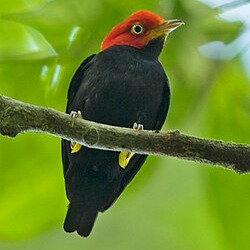
It is a small, plump, short-tailed passerine bird endowed with one of the most dramatic sexual dimorphisms in the tropics. The adult male is a dazzling sight: he possesses deeply velvety jet-black body plumage that contrasts explosively with a bright crimson-red head and nape. His eyes have a piercing white iris that stands out in the dark understory. Additionally, his thighs are adorned with intense lemon-yellow feathers, especially visible during his dances, and his beak is pale, almost horn-colored. The female, in sharp contrast, is entirely cryptic, with dull olive-green plumage on the upperparts and paler yellowish-green tones on the belly and throat, completely lacking the male's red, black, or yellow markings. Both have short but robust pale pinkish-brown legs, adapted for a firm grip during their acrobatics.

Added by

Anonymous Curator

Reviewed by

Under Review

Last modified by

Julia Trouin

TaxonomyBiological classification ranks placing this species within the tree of life, from Kingdom down to Genus.

PhylumRank below Kingdom. Groups organisms sharing a fundamental body plan (e.g., Chordata = vertebrates and some invertebrates).Chordata
ClassRank below Phylum. Subdivides by structural traits (e.g., Mammalia, Aves, Reptilia, Insecta).Aves
OrderRank below Class. Groups related families sharing common ancestry (e.g., Carnivora, Primates).Passeriformes
FamilyRank below Order. Groups closely related genera (e.g., Felidae = cats, Canidae = dogs).Pipridae
GenusRank just above Species. The first word in the two-part binomial scientific name.Pipra
Taxonomic AuthorityThe scientist who first formally described and published this species, followed by the year of publication.(Sclater, 1856)
Record Completeness
94%
Coming soon

Ecology & StatusHow this species lives: habitat preferences, diet, behavior, population status, and role in its ecosystem.

OriginWhether the species is native (evolved here), endemic (found only here), or introduced by human activity.

Native

Population TrendDirection of change in population size over time: increasing, stable, decreasing, or unknown.

Decreasing

Breeding SeasonTime of year when this species typically reproduces or flowers.

--

Trophic RolePosition in the food chain: producer, herbivore, carnivore, omnivore, decomposer, or parasite.

Frugivore

Recent SightingsWhether this species has been observed in the wild in Costa Rica within recent years.

Yes

Habitat SummaryOverview of the specific ecosystems and environments where this species is found in Costa Rica. Multi-lang

It exclusively inhabits the middle and lower strata (understory) of humid tropical rainforests, primary wet forests, and mature secondary growth. It is distributed from southeastern Mexico, passing through the entire Caribbean slope and southern Pacific of Costa Rica, down to western Ecuador. It requires a high density of fruiting shrubs and constant humidity, strictly avoiding dry forest zones or excessively disturbed areas.

BehaviourDaily activity patterns, movement, territory use, foraging style, and seasonal behavioral changes. Multi-lang

Females are stealthy, solitary, and silent birds that methodically scour the understory in search of fruiting shrubs. Males, conversely, congregate in exploded leks (traditional display areas) where they defend small individual display plots. They spend most of the day rehearsing their moves, meticulously cleaning their display branches of fallen leaves, and emitting high-pitched sounds to advertise their presence.

Social ActivitySocial structure: whether the species is solitary, paired, or colonial; hierarchy and communication. Multi-lang

They exhibit 'exploded lek' behavior. Unlike other species where males intensely cooperate, here they compete acoustically from a distance. Up to 5 males can cluster within a 50-meter radius, where each defends a tiny focal area (a specific branch). Females visit these 'arenas' to judge the male's physical and sonic display before choosing a mate.

Feeding GuildWhat the species eats, how it forages or hunts, and its role as a consumer in the food web. Multi-lang

Specialized frugivore with insectivorous supplements. They feed almost exclusively on tiny berries that they deftly pluck mid-flight (hover-gleaning). During the nesting season, females dramatically increase their hunting of insects and small spiders to provide essential amino acids to the rapidly growing chicks.

Trophic Chain DetailsSpecific interactions in local food webs: prey species, predators, competitors, and scavengers. Multi-lang

They play a stellar role as primary seed disseminators in the lower stratum. They are highly dependent on plant families Melastomataceae, Rubiaceae, and Heliconiaceae. Due to their tiny size and trusting nature during dances, males are frequent prey for small specialized raptors, owls, and arboreal vine snakes.

Reproductive BehaviourMating strategies, courtship displays, nesting or spawning behavior, and parental care. Multi-lang

A male's reproductive success depends on the perfection of his dance; only the most dominant copulate. After a few seconds of mating, the male is entirely excluded from rearing. The solitary, silent female builds a highly fragile and shallow hammock-like nest of fibers and spiderwebs, woven between a fork or two thin twigs, usually a few meters above a stream. She lays 2 white eggs with brownish speckles. The female incubates with extreme zeal for about 19 days. The naked chicks are fed exclusively by her with predigested seeds and insects, leaving the hammock at 14-15 days.

Physical Measures

Length (cm)

10.0 - 11.0 cm

Weight (Grams)

12 g - 17 g

Offspring per cycleTypical number of young (live births, eggs, or seeds) produced by one adult in a single reproductive event or breeding season.1 - 2
Sexual DimorphismObservable physical differences between males and females of the same species (e.g., size, coloration, features).Yes

Lifespan

Sexual MaturityAge at which the individual becomes capable of reproducing for the first time.

1 - 2 Years

Gestation / IncubationDuration from fertilization to birth (mammals) or to hatching (egg-laying species).

18 - 20

Lifespan EstimatedExpected duration of life from birth to natural death under wild conditions.
Males8 - 12 Years
Females8 - 12 Years

Sexual DimorphismPhysical differences in size, coloration, or morphology between males and females of this species.

Males Multi-lang

Completely velvety black body plumage that serves as a canvas to highlight his vibrant crimson red head and nape. He possesses bright yellow thighs that contrast during displays and denser upper wing musculature adapted for generating audible snaps.

Females Multi-lang

Completely lacks the striking colors of the male. She is uniformly olive-green, with faint yellowish hues on the underparts. This crypticity is indispensable for avoiding detection by predators, as she assumes one hundred percent of the work in incubating and feeding the young.

Evolutionary AdaptationsInherited traits and behaviors that improve the species' survival and reproduction in its specific environment. Multi-lang

The Moonwalk Display: During courtship, the male performs a backward slide along a branch (simulating gliding on ice), moving his feet at a speed almost imperceptible to the human eye. This extreme behavioral adaptation demonstrates his physical vigor, neuromuscular coordination, and genetic excellence to observing females.
High-Speed Wing Snaps: Males possess hypertrophied tendons and muscle insertions in their wings, along with stiffened secondary feathers. This allows them to strike their wings together above their back over 60 times per second, producing sharp, resonant snaps similar to breaking twigs, serving as an acoustic beacon in the dark forest.
Ultra-Fast Digestion: Feeding primarily on berries, they have evolved an extremely short and efficient digestive tract. They can process a fruit, extract its nutrients, and defecate the intact seed in just 12 to 18 minutes, making them hyperactive forest planters.

Main ThreatsDocumented pressures reducing the population: habitat loss, hunting, disease, climate change, and invasive species. Multi-lang

Understory Fragmentation: Human disturbance and cattle grazing in forests quickly destroy the delicate shrub layer of the understory, eliminating their feeding sites and the thin horizontal branches males obsessively need for their dances.
Nesting Vulnerability Near Water Bodies: By nesting at low heights, frequently over streams, abrupt changes in water levels induced by severe storms (exacerbated by climate change) can flood or wash away their nests.

Interesting FactsSurprising or notable facts that highlight what makes this species unique or ecologically important. Multi-lang

The Michael Jackson of the Jungle: The extraordinary level of coordination and the apparent frictionless gliding of the male have earned it the worldwide nickname of the 'Michael Jackson bird'. Its dance was documented in detail using high-speed cameras and popularized in BBC documentaries.
Pale-Eye Display: To maximize visual impact in the forest gloom, the adult male can rapidly dilate and constrict his black pupils, causing his pale white iris to flash or blink, adding yet another hypnotic element to his courtship choreography.