
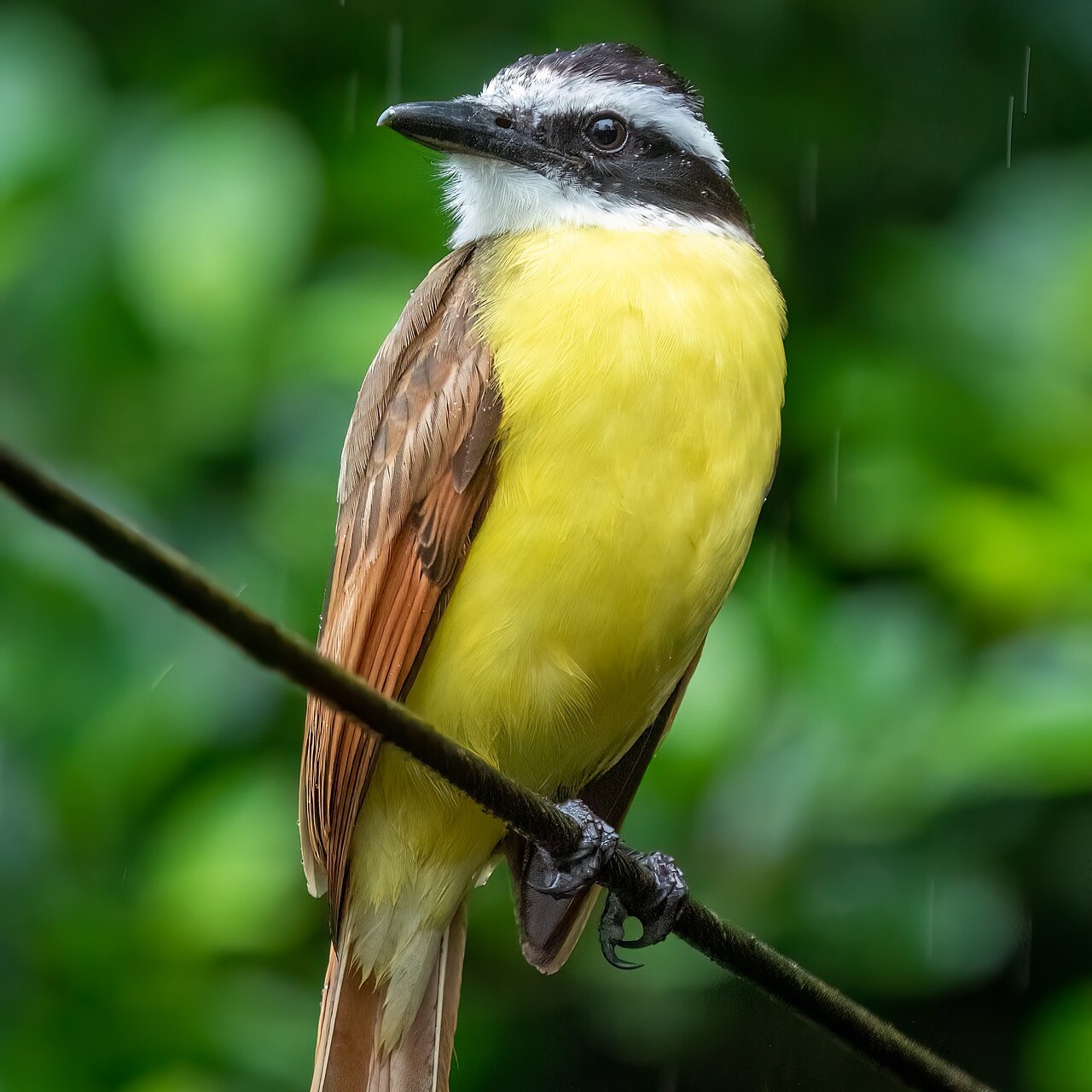
Pitangus sulphuratus
Great Kiskadee
(Linnaeus, 1766)
Added by
Anonymous Curator
Reviewed by
Under Review
Last modified by
Julia Trouin
TaxonomyBiological classification ranks placing this species within the tree of life, from Kingdom down to Genus.
Ecology & StatusHow this species lives: habitat preferences, diet, behavior, population status, and role in its ecosystem.
OriginWhether the species is native (evolved here), endemic (found only here), or introduced by human activity.
Native
Population TrendDirection of change in population size over time: increasing, stable, decreasing, or unknown.
Increasing
Breeding SeasonTime of year when this species typically reproduces or flowers.
--
Trophic RolePosition in the food chain: producer, herbivore, carnivore, omnivore, decomposer, or parasite.
Omnivore
Recent SightingsWhether this species has been observed in the wild in Costa Rica within recent years.
Yes
Habitat SummaryOverview of the specific ecosystems and environments where this species is found in Costa Rica. Multi-lang
The great kiskadee is one of the birds with the greatest ecological niche breadth in all of the Americas. It inhabits forest edges, open secondary forests, wooded gardens, urban and suburban parks, shade coffee plantations, river and lagoon margins, wooded grasslands, shrublands, mangroves, fruit tree plantations, and virtually any environment with trees or shrubs and nearby water availability. It avoids the interior of dense mature forests, leaving those to more specialized species. Its tolerance to urbanization is extraordinary: it is one of the few tropical birds that actively thrives in cities and has increased its populations in recent decades at the pace of urban expansion. In Costa Rica it is omnipresent in the Greater Metropolitan Area, inter-Andean valleys, forest edge zones of both slopes, and virtually all modified habitats in the country, from sea level to 2,000 meters in altitude.BehaviourDaily activity patterns, movement, territory use, foraging style, and seasonal behavioral changes. Multi-lang
The great kiskadee is diurnal, noisy, and conspicuous, being one of the most visible and frequently detected birds in the Costa Rican landscape. It spends most of its active time perched on exposed, prominent perches — high branches, power line cables, poles, fences — from which it proclaims its territory with the characteristic trisyllabic song or locates and pursues prey. It makes short sallies from the perch to capture flying insects, peck insects or small prey on the ground, collect fruits from adjacent vegetation, or dive into the water to capture fish or tadpoles. It is markedly territorial and actively defends the area around the nest by vigorously attacking intruders of its own species, potential nest predators — including snakes, raccoons, and owls — and even larger birds it considers threats, such as hawks. It does not migrate and maintains the same territory for years.Social ActivitySocial structure: whether the species is solitary, paired, or colonial; hierarchy and communication. Multi-lang
The great kiskadee lives in stable monogamous pairs that maintain an exclusive territory year-round. Pairs are very conspicuous and their daily interactions — pursuits, duet songs, collaborative nest defense — are easily observable in urban gardens and parks. Territorial defense is vigorous and joint: both pair members actively attack intruders of their own species, potential nest predators, and any bird that approaches the reproductive territory, including considerably larger raptors. This territorial aggressiveness makes the kiskadee the involuntary guardian of the territories of other small birds nesting nearby that benefit from its alarms and attacks on predators. It does not form mixed flocks and rarely tolerates conspecifics outside the pair in its territory.Feeding GuildWhat the species eats, how it forages or hunts, and its role as a consumer in the food web. Multi-lang
Generalist omnivore with multiple simultaneous foraging strategies. It consumes large insects captured in flight or on the ground (orthopterans, beetles, odonates, moths), arachnids, anole lizards, small frogs and tree frogs, young mice, small snakes, fish up to 8 cm captured by diving, tadpoles, soft ripe fruits (Ficus, Cecropia, Trema, Bursera), and large seeds. The proportion of each component varies seasonally: during the dry season large vertebrates and insects predominate when fruits are scarce; during the rainy season consumption of fruits and aquatic insects increases. Carrion is consumed opportunistically when available. It does not store food. It strikes large prey against the perch before consuming them.Trophic Chain DetailsSpecific interactions in local food webs: prey species, predators, competitors, and scavengers. Multi-lang
Omnivorous secondary consumer with variable trophic position depending on diet component. By consuming insects (primary plant consumers), it acts as a secondary consumer; by consuming small vertebrates such as lizards or frogs (secondary consumers), it acts as a tertiary consumer. Its diet includes large insects (orthopterans, beetles, odonates, lepidopterans), arachnids, lizards, small frogs, young mice, tree frogs, small snakes, fish up to 8 cm, tadpoles, ripe fruits of various species (Ficus spp., Cecropia spp., Trema micrantha), seeds, and carrion. Its main predators are raptors such as the broad-winged hawk (Buteo platypterus), sharp-shinned hawk (Accipiter striatus), bat falcon (Falco rufigularis), and arboreal snakes such as Leptophis ahaetulla for chicks. Eggs are preyed upon by rats (Rattus rattus), raccoons (Procyon lotor), and snakes. By consuming and dispersing seeds of Ficus spp. and other fruiting plants, it occasionally acts as a secondary seed disperser in edge habitats.Reproductive BehaviourMating strategies, courtship displays, nesting or spawning behavior, and parental care. Multi-lang
The breeding season in Costa Rica extends primarily from February to June, with the peak of nest construction in February-March. Both sexes participate in building the globular nest — the female more actively — over 10 to 15 days. The nest is a voluminous globular structure 30-40 cm in diameter with a downward-oriented tubular lateral entrance to hinder predator access, built with plant fibers, roots, dry leaves, lichens, and synthetic materials available in urban environments (plastic, cotton, string). The clutch consists of 2 to 4 cream-colored eggs with brown and reddish spots. Only the female incubates, for 16 to 18 days. Chicks hatch altricial — blind and with scant down — and are fed by both parents for 22 to 25 days in the nest. Both sexes defend the nest with extraordinary aggressiveness toward any intruder. A pair can produce up to two successful clutches per season. Juveniles reach sexual maturity at one year of age. The same pair may reuse the same nesting site in consecutive seasons.Physical Measures
Length (cm)
22.0 - 25.0 cm
Weight (Grams)
53 g - 72 g
Lifespan
Sexual MaturityAge at which the individual becomes capable of reproducing for the first time.
1 Years
Gestation / IncubationDuration from fertilization to birth (mammals) or to hatching (egg-laying species).
16 - 18