
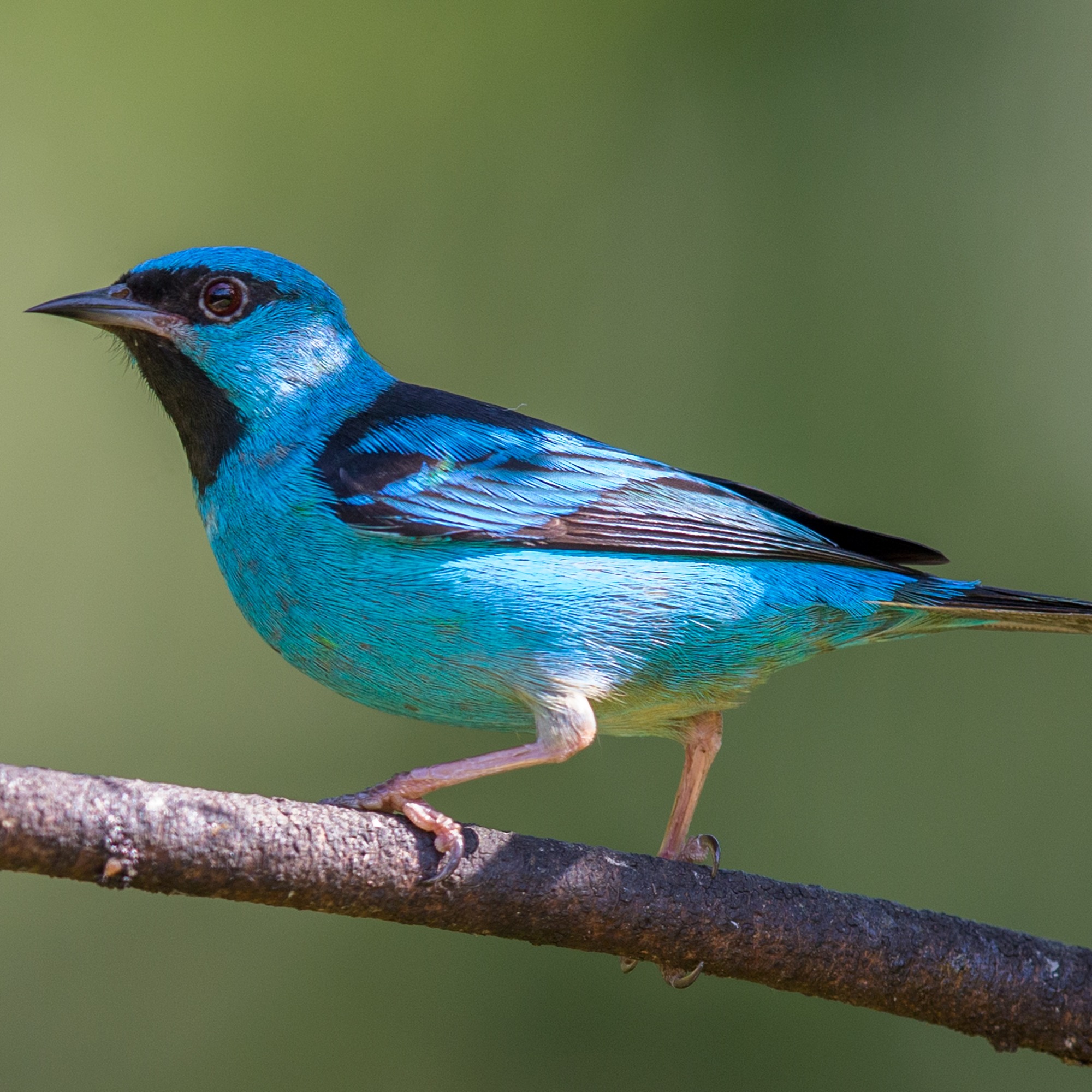
Dacnis cayana
Blue Dacnis
(Linnaeus, 1766)
Added by
Anonymous Curator
Reviewed by
Under Review
Last modified by
Julia Trouin
TaxonomyBiological classification ranks placing this species within the tree of life, from Kingdom down to Genus.
Ecology & StatusHow this species lives: habitat preferences, diet, behavior, population status, and role in its ecosystem.
OriginWhether the species is native (evolved here), endemic (found only here), or introduced by human activity.
Native
Population TrendDirection of change in population size over time: increasing, stable, decreasing, or unknown.
Stable
Breeding SeasonTime of year when this species typically reproduces or flowers.
--
Trophic RolePosition in the food chain: producer, herbivore, carnivore, omnivore, decomposer, or parasite.
Omnivore
Recent SightingsWhether this species has been observed in the wild in Costa Rica within recent years.
Yes
Habitat SummaryOverview of the specific ecosystems and environments where this species is found in Costa Rica. Multi-lang
It is widely distributed throughout the neotropical regions from Honduras, through all of Central America, to the Amazon basin, Bolivia, Paraguay, and northern Argentina. In Costa Rica, it is common in the lowlands and foothills of the Caribbean slope and the southern Pacific region, reaching up to 1,000 meters in altitude. It predominantly inhabits the upper canopy and edges of tropical humid forests, tall secondary forests, coffee plantations with native shade trees, and wooded gardens with fruit trees.BehaviourDaily activity patterns, movement, territory use, foraging style, and seasonal behavioral changes. Multi-lang
It is a diurnal bird, highly active and agile in its movements. It spends most of its time in the tops of tall trees, hopping through the foliage of the thinnest branches and adopting acrobatic upside-down postures to inspect leaves. Outside the breeding period, it shows highly gregarious and peaceful behavior, regularly integrating into large mixed canopy flocks alongside green honeycreepers, tanagers, and euphonias. It constantly communicates with subtle, high-pitched squeaks sounding like 'tsip' to coordinate group flights between treetops.Social ActivitySocial structure: whether the species is solitary, paired, or colonial; hierarchy and communication. Multi-lang
It is a markedly social bird outside the breeding season, with low aggressiveness and notable tolerance toward both conspecifics and other frugivorous species. It commonly travels in stable pairs or small family groups of 3 to 5 individuals that integrate into mobile mixed flocks. During mating, pairs become discreet and exclusive to protect the immediate surroundings of the nest.Feeding GuildWhat the species eats, how it forages or hunts, and its role as a consumer in the food web. Multi-lang
Omnivore specialized in fruits, arils, and nectar, significantly supplemented with insects. It consumes berries from melastome shrubs and mistletoes, pulp from large fruits, and canopy inflorescences of leguminous trees. It captures small beetles, ants, aphids, and larvae through meticulous leaf inspections and brief sally-flights.Trophic Chain DetailsSpecific interactions in local food webs: prey species, predators, competitors, and scavengers. Multi-lang
It functions as a crucial upper-level omnivorous consumer. It acts as a broad-spectrum seed disperser for trees such as Cecropia and various epiphytes, and as a complementary pollinator. Its diet includes fleshy arils, nectar, and small berries of Ficus and Loranthaceae, enriched with insects, aphids, and small spiders. It shares resources with the Red-legged Honeycreeper and the Green Honeycreeper. It is preyed upon by small-sized arboreal raptors such as forest falcons (Micrastur) and canopy climbing snakes like Corallus.Reproductive BehaviourMating strategies, courtship displays, nesting or spawning behavior, and parental care. Multi-lang
It establishes monogamous relationships. The female exclusively builds a deep, compact cup nest, neatly woven with fine plant fibers, moss, spider webs, and dry leaves, located at heights ranging from 5 to 15 meters in the fork of an upper branch or hidden among epiphytes. She usually lays 2 whitish or pale blue eggs with abundant reddish-brown freckles. The female carries out incubation alone for 13 days, a period during which the male constantly provides her with regurgitated food. Both parents feed the chicks with regurgitated insects and nectar for 14 to 15 days until they are able to fledge.Physical Measures
Length (cm)
12.0 - 13.0 cm
Weight (Grams)
13 g - 16 g
Lifespan
Sexual MaturityAge at which the individual becomes capable of reproducing for the first time.
1 Years
Gestation / IncubationDuration from fertilization to birth (mammals) or to hatching (egg-laying species).
13