
Costa Rica Species
Agalychnis spurrelli
AnimaliaHighest rank in taxonomy. Groups all life into domains: Animalia, Plantae, Fungi, etc.IUCN LCInternational Union for Conservation of Nature — the world authority on species extinction risk, using standardized criteria. — Least Concern — widespread and abundant; not at immediate risk of extinction.In ProgressCurrent stage of this record in the editorial review workflow. Recent Sighting

Agalychnis spurrelli

Gliding Tree Frog

Boulenger, 1913

Detailed Texts Multi-lang
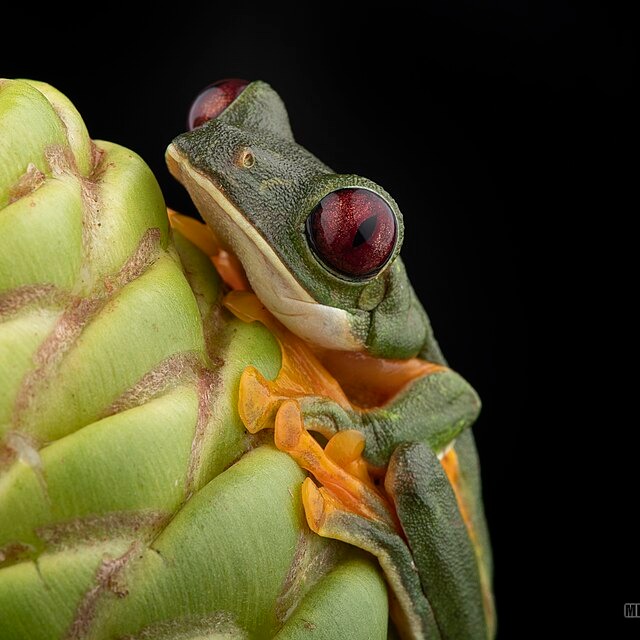
The gliding tree frog (Agalychnis spurrelli) is a fascinating nocturnal arboreal amphibian belonging to the leaf frog family (Phyllomedusidae). At first glance, it shares a familial resemblance with its famous cousin, the red-eyed tree frog (A. callidryas), but is distinguished by its striking dark ruby-red or maroon eyes, often with a reticulated pattern, and a more uniform, dense emerald-green dorsal skin. Its most extraordinary anatomical feature is the extensive development of interdigital webbing (webbing between the toes) on both its front and hind feet. These webs, combined with fringes of skin on the outer edges of its limbs, allow it to perform impressive gliding descents from the heights of the forest canopy. Its belly is a pale orange-yellow. It is a native species of humid lowland forests from Costa Rica to northwestern Ecuador. In Costa Rica, it is world-famous for its spectacular and massive 'explosive' reproductive events on the Osa Peninsula, where thousands of individuals descend from the canopy simultaneously after heavy rainstorms.

Added by

Anonymous Curator

Reviewed by

Under Review

Last modified by

Julia Trouin

TaxonomyBiological classification ranks placing this species within the tree of life, from Kingdom down to Genus.

PhylumRank below Kingdom. Groups organisms sharing a fundamental body plan (e.g., Chordata = vertebrates and some invertebrates).Chordata
ClassRank below Phylum. Subdivides by structural traits (e.g., Mammalia, Aves, Reptilia, Insecta).Amphibia
OrderRank below Class. Groups related families sharing common ancestry (e.g., Carnivora, Primates).Anura
FamilyRank below Order. Groups closely related genera (e.g., Felidae = cats, Canidae = dogs).Phyllomedusidae
GenusRank just above Species. The first word in the two-part binomial scientific name.Agalychnis
Taxonomic AuthorityThe scientist who first formally described and published this species, followed by the year of publication.Boulenger, 1913
Record Completeness
94%
Coming soon

Ecology & StatusHow this species lives: habitat preferences, diet, behavior, population status, and role in its ecosystem.

OriginWhether the species is native (evolved here), endemic (found only here), or introduced by human activity.

Native

Population TrendDirection of change in population size over time: increasing, stable, decreasing, or unknown.

Decreasing

Breeding SeasonTime of year when this species typically reproduces or flowers.

--

Trophic RolePosition in the food chain: producer, herbivore, carnivore, omnivore, decomposer, or parasite.

Insectivore

Recent SightingsWhether this species has been observed in the wild in Costa Rica within recent years.

Yes

Habitat SummaryOverview of the specific ecosystems and environments where this species is found in Costa Rica. Multi-lang

It is a strict inhabitant of the upper canopy of primary humid and very humid lowland forests, from sea level up to about 800 meters in elevation. It spends the vast majority of its life more than 15 to 20 meters high, hidden among the thick foliage. It descends to the understory almost exclusively during highly specific reproductive events, which require the formation of temporary pools or seasonal swamps created by torrential rains, preferably free of fish. In Costa Rica, its presence is notable in the southern Pacific, especially in and around Corcovado National Park.

BehaviourDaily activity patterns, movement, territory use, foraging style, and seasonal behavioral changes. Multi-lang

It is a strictly nocturnal frog. During the day, it enters a state of highly camouflaged lethargy in the highest parts of the canopy. At night it becomes active to forage for invertebrates, skillfully leaping among leaves and lianas. Its locomotion is a hybrid between agilely walking along thin branches gripping with its adhesive toe pads and leaping/gliding across open spaces. It is rarely seen near the forest floor except during explosive breeding events, where they exhibit highly unusual collective frenzy behavior, ignoring their usual caution and even climbing over one another.

Social ActivitySocial structure: whether the species is solitary, paired, or colonial; hierarchy and communication. Multi-lang

It is a highly solitary amphibian for most of the year, maintaining a wide territory in the rainforest canopy. Social tolerance occurs exclusively during the peak of the rainy season (often following a hurricane or strong cold front). On these nights, social behavior becomes chaotic: males abandon all territoriality and congregate by the thousands around the lagoons, emitting a deafening chorus of low barks. Mating competition is frenzied, often resulting in multiple males clinging desperately to a single female (multiple amplexus), sometimes accidentally drowning her.

Feeding GuildWhat the species eats, how it forages or hunts, and its role as a consumer in the food web. Multi-lang

Nocturnal arboreal insectivore. It relies heavily on its large eyes, which are extraordinarily adapted to low light, to locate moving prey. It is an ambush predator; it waits motionless on canopy leaves until a flying insect approaches, then lunges quickly to capture it. It primarily consumes moths, flies, grasshoppers, crickets, and other arthropods of the upper forest canopy.

Trophic Chain DetailsSpecific interactions in local food webs: prey species, predators, competitors, and scavengers. Multi-lang

As a secondary consumer, it feeds on a variety of flying insects and arboreal invertebrates (crickets, moths, spiders). Adult frogs fall prey primarily to nocturnal arboreal snakes (such as the cat-eyed snake, Leptodeira annulata), bats, owls, and primates. However, the greatest impact on the food chain occurs at the egg and tadpole stage. The huge exposed egg masses are a feast for snakes, polistine wasps, white-faced monkeys, and insects, while the tadpoles that manage to drop into the water face dragonfly nymphs, giant water bugs, and freshwater shrimp.

Reproductive BehaviourMating strategies, courtship displays, nesting or spawning behavior, and parental care. Multi-lang

Reproduction is inextricably linked to the seasonal rainfall regime. When the weather is right, males initiate a massive parachuting descent toward newly formed pools. After securing a mate via axillary amplexus (the male hugs the female from behind), the much heavier female (carrying the male and hundreds of eggs inside) carefully climbs up the lianas or hanging bushes projecting directly over the lagoon's water. There she deposits small, flat, gelatinous masses containing between 14 and 67 pale green eggs on the upper surface of the leaf. After about 6 to 8 days of incubation in the air, the synchronized movement of the embryos dissolves the jelly matrix, allowing the developed tadpoles to slip or drip off the leaf directly into the pool below, where they will begin a multi-week metamorphosis process.

Physical Measures

Length (cm)

4.8 - 7.2 cm

Weight (Grams)

10 g - 25 g

Offspring per cycleTypical number of young (live births, eggs, or seeds) produced by one adult in a single reproductive event or breeding season.14 - 67
Sexual DimorphismObservable physical differences between males and females of the same species (e.g., size, coloration, features).Yes

Lifespan

Sexual MaturityAge at which the individual becomes capable of reproducing for the first time.

1 - 2 Years

Gestation / IncubationDuration from fertilization to birth (mammals) or to hatching (egg-laying species).

6 - 8

Lifespan EstimatedExpected duration of life from birth to natural death under wild conditions.
Males4 - 8 Years
Females4 - 8 Years

Sexual DimorphismPhysical differences in size, coloration, or morphology between males and females of this species.

Males Multi-lang

Males are significantly smaller and lighter than adult females (measuring approximately 4.8 to 5.6 cm in length). During the breeding season, they develop nuptial pads (roughened skin patches) on the base of their thumbs, a crucial adaptation that provides a non-slip grip to hold onto the slippery female firmly during amplexus. They possess a vocal sac in their throat that allows them to emit the characteristic hoarse 'barking' call (gronk-gronk) to attract mates around seasonal ponds.

Females Multi-lang

Adult females exhibit marked gigantism relative to males, measuring between 6.0 and 7.1 cm in length and boasting a much wider and more voluminous body. This size difference is an anatomical requirement for housing the massive amount of unfertilized eggs in their abdomen prior to the arribadas. Females lack nuptial pads on their thumbs and do not possess a vocal sac, making them incapable of emitting the mating calls.

Evolutionary AdaptationsInherited traits and behaviors that improve the species' survival and reproduction in its specific environment. Multi-lang

Parachuting and Gliding: Its feet feature extremely developed interdigital webbing. When leaping from high in the trees, it extends all four limbs, stretching the webbing on its feet and the lateral skin folds of its body to form a 'parachute'. This allows it to slow its rate of descent and maneuver directionally in mid-air at an angle of up to 45 degrees, crossing considerable horizontal distances to escape predators (like arboreal snakes) or to head rapidly toward breeding ponds.
Diurnal resting camouflage: During the day, it clings tightly to the underside of canopy leaves. It adopts a very compact posture, tucking its colorful limbs under its body and closing its bright red eyes so that only its smooth green back is visible. Its coloration perfectly mimics leaf tissue, making it practically invisible to predatory birds and monkeys.
Explosive reproductive strategy: To overcome the high predation risk to their egg masses (preyed upon by snakes and wasps) and tadpoles, they have evolved to breed massively and simultaneously (predator swamping). The emergence of thousands of frogs at a single pond on the same night saturates predators, ensuring a large number of eggs survive by sheer numerical advantage.

Main ThreatsDocumented pressures reducing the population: habitat loss, hunting, disease, climate change, and invasive species. Multi-lang

Forest habitat loss and fragmentation: They strictly depend on mature, contiguous forest canopy. Indiscriminate deforestation for agriculture, monocultures, and development destroys their tree homes and isolates populations, preventing them from migrating to the limited seasonal water bodies they need to reproduce.
Climate change and altered rainfall patterns: Their 'explosive' reproductive cycle is triggered by highly specific meteorological events (torrential rains following a dry period). Climate change causes prolonged droughts or unpredictable rainfall, drying up temporary ponds before tadpoles can metamorphose or disrupting the natural cues for reproduction.

Interesting FactsSurprising or notable facts that highlight what makes this species unique or ecologically important. Multi-lang

The frog orgies of the Osa Peninsula: During intense rains between May and November, in hidden locations of Corcovado National Park, more than 10,000 gliding tree frogs can be observed descending from the trees at the same time to mate. The leaves of plants overhanging the ponds end up covered by hundreds of thousands of gelatinous eggs, in one of the most impressive natural spectacles of the Neotropical rainforest.
Despite its name, it doesn't actually 'fly', but rather glides in a controlled manner (parachuting). By spreading the toes of its hands and feet, it drastically increases its aerodynamic surface area. This not only slows its fall to prevent injury, but also allows it to change direction in mid-air by twisting its legs or shifting its center of gravity, enabling it to navigate around trunks or land on specific branches.