Costa Rica Species
Didelphis marsupialis
AnimaliaHighest rank in taxonomy. Groups all life into domains: Animalia, Plantae, Fungi, etc.IUCN LCInternational Union for Conservation of Nature — the world authority on species extinction risk, using standardized criteria. — Least Concern — widespread and abundant; not at immediate risk of extinction.In ProgressCurrent stage of this record in the editorial review workflow. Recent Sighting

Didelphis marsupialis

Common Opossum

Linnaeus, 1758

Detailed Texts Multi-lang
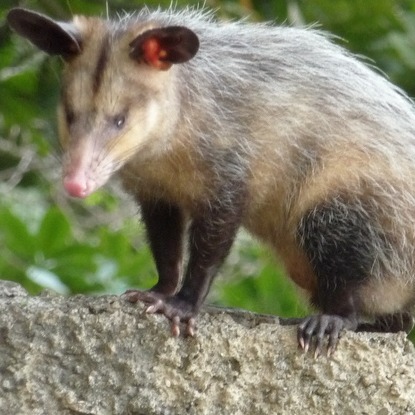
Didelphis marsupialis is a medium-sized marsupial with an appearance superficially reminiscent of a giant rodent. It has a conical, elongated snout, large, round, bare black ears, and dense, coarse fur that ranges from light gray to dark black. Its most recognizable feature (and where its Costa Rican name 'zorro pelón' or 'hairless fox' comes from) is its long prehensile tail, which is covered with fur only at the base, the rest being scaly and bare. Being a marsupial, females have a marsupium (pouch) on their belly where the young complete their postnatal development. They have 50 sharp teeth, more than any other land mammal in the region, which they use to process an extraordinarily broad omnivorous diet.

Added by

Anonymous Curator

Reviewed by

Under Review

Last modified by

Julia Trouin

TaxonomyBiological classification ranks placing this species within the tree of life, from Kingdom down to Genus.

PhylumRank below Kingdom. Groups organisms sharing a fundamental body plan (e.g., Chordata = vertebrates and some invertebrates).Chordata
ClassRank below Phylum. Subdivides by structural traits (e.g., Mammalia, Aves, Reptilia, Insecta).Mammalia
OrderRank below Class. Groups related families sharing common ancestry (e.g., Carnivora, Primates).Didelphimorphia
FamilyRank below Order. Groups closely related genera (e.g., Felidae = cats, Canidae = dogs).Didelphidae
GenusRank just above Species. The first word in the two-part binomial scientific name.Didelphis
Taxonomic AuthorityThe scientist who first formally described and published this species, followed by the year of publication.Linnaeus, 1758
Record Completeness
85%
Coming soon

Ecology & StatusHow this species lives: habitat preferences, diet, behavior, population status, and role in its ecosystem.

OriginWhether the species is native (evolved here), endemic (found only here), or introduced by human activity.

Native

Population TrendDirection of change in population size over time: increasing, stable, decreasing, or unknown.

Stable

Breeding SeasonTime of year when this species typically reproduces or flowers.

Year Round

Trophic RolePosition in the food chain: producer, herbivore, carnivore, omnivore, decomposer, or parasite.

Omnivore

Recent SightingsWhether this species has been observed in the wild in Costa Rica within recent years.

Yes

Habitat SummaryOverview of the specific ecosystems and environments where this species is found in Costa Rica. Multi-lang

It is one of the most adaptable and ubiquitous mammal species in the Neotropics. It inhabits tropical rainforests, dry forests, savannas, mangroves, and is extremely common in suburban and urban environments, where it takes advantage of garbage dumps, roofs, and gardens. It prefers areas near water sources. In Costa Rica, it is found throughout the country, from the coasts to altitudes near 2,000 meters above sea level, being a regular resident of cities and agricultural areas.

BehaviourDaily activity patterns, movement, territory use, foraging style, and seasonal behavioral changes. Multi-lang

It is a solitary, nocturnal animal and a wandering forager without strict territories. It has an incredibly varied and opportunistic diet that includes ripe fruits, insects, ticks, eggs, amphibians, reptiles, small mammals, and carrion. In urban and rural ecosystems, it acts as a silent pest controller (cleaning the environment of ticks, cockroaches, and rodents) and as an important seed disperser, helping to regenerate degraded forests.

Social ActivitySocial structure: whether the species is solitary, paired, or colonial; hierarchy and communication. Multi-lang

Strictly solitary. Only mothers group with their young or pairs during the brief copulation period. Males tend to be aggressive towards each other.

Feeding GuildWhat the species eats, how it forages or hunts, and its role as a consumer in the food web. Multi-lang

Omnivore / Scavenger.

Trophic Chain DetailsSpecific interactions in local food webs: prey species, predators, competitors, and scavengers. Multi-lang

Opportunistic omnivore. Its great abundance makes it a crucial base prey for almost all large Neotropical predators: ocelots, pumas, coyotes, nocturnal birds of prey (owls), and large constrictor snakes.

Reproductive BehaviourMating strategies, courtship displays, nesting or spawning behavior, and parental care. Multi-lang

Reproduction is a biological miracle: gestation lasts barely 12 to 14 days. The young are born in a fetal state (the size of a bee), blind, and hairless. They must instinctively crawl up the mother's belly to the marsupium, where they attach to one of the 13 teats. They remain in the pouch for about 60 days. As they grow, they leave the pouch and travel clinging to the mother's back for several more weeks before becoming independent.

Physical Measures

Length (cm)

35.0 - 50.0 cm

Weight (Grams)

1.00 kg - 3.50 kg

Offspring per cycleTypical number of young (live births, eggs, or seeds) produced by one adult in a single reproductive event or breeding season.5 - 13
Sexual DimorphismObservable physical differences between males and females of the same species (e.g., size, coloration, features).Yes

Lifespan

Sexual MaturityAge at which the individual becomes capable of reproducing for the first time.

6 - 8 Months

Gestation / IncubationDuration from fertilization to birth (mammals) or to hatching (egg-laying species).

12 - 14

Lifespan EstimatedExpected duration of life from birth to natural death under wild conditions.
Males1 - 2 Years
Females1 - 2 Years

Sexual DimorphismPhysical differences in size, coloration, or morphology between males and females of this species.

Males Multi-lang

Generally larger and heavier, possess more prominent canines, and a scent gland on the chest that stains the fur a yellowish hue.

Females Multi-lang

Smaller and possess a developed marsupium (pouch) in the ventral area to house the young.

Evolutionary AdaptationsInherited traits and behaviors that improve the species' survival and reproduction in its specific environment. Multi-lang

Venom Resistance: They have a remarkable natural resistance (and in many cases complete immunity) to the venom of snakes in the Viperidae family, such as the fer-de-lance (Bothrops asper) and the rattlesnake, allowing them to hunt and consume these dangerous reptiles.
Climbing Anatomy: They possess a prehensile tail that functions as a fifth limb and an opposable thumb without a nail (hallux) on the hind feet, traits that give them exceptional grip for climbing trees and structures with great agility.

Main ThreatsDocumented pressures reducing the population: habitat loss, hunting, disease, climate change, and invasive species. Multi-lang

Human Conflicts and False Beliefs: They are frequently killed due to their unappealing appearance (erroneously associated with giant rats), the unjustified fear that they transmit rabies, or sporadic attacks on poultry.
Roadkill: Due to their habit of foraging for food (carrion) near and on roads at night, they are one of the mammal species that die most from vehicular collisions.

Interesting FactsSurprising or notable facts that highlight what makes this species unique or ecologically important. Multi-lang

Low Body Temperature: Their body temperature (around 34-35°C) is too low for the rabies virus to survive easily. Therefore, it is extremely rare for a common opossum to carry or transmit this disease.
Thanatosis (Playing dead): Although more common in its North American relative (D. virginiana), when faced with an extreme threat, they can fall into an involuntary catatonic state, secreting a foul fluid from their anal glands to simulate decay.