Costa Rica Species
Jacana spinosa
AnimaliaHighest rank in taxonomy. Groups all life into domains: Animalia, Plantae, Fungi, etc.IUCN LCInternational Union for Conservation of Nature — the world authority on species extinction risk, using standardized criteria. — Least Concern — widespread and abundant; not at immediate risk of extinction.In ProgressCurrent stage of this record in the editorial review workflow. Recent Sighting

Jacana spinosa

Northern Jacana

(Linnaeus, 1758)

Detailed Texts Multi-lang
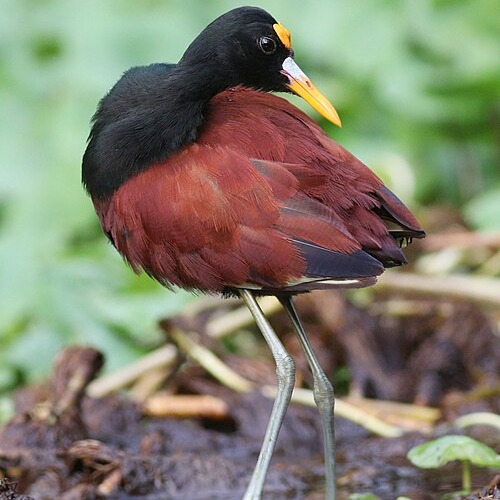
The Northern Jacana (Jacana spinosa) is an unmistakable medium-sized waterbird. Its body features rich cinnamon-rufous to dark chestnut plumage, which contrasts sharply with its jet-black head and neck. In flight, it reveals striking bright greenish-yellow flight feathers. Its face features a bright yellow bill topped by a large, fleshy yellow or orange frontal shield (wattle), with lobed wattles at the base. Its most extreme anatomical features are its grayish-green legs with disproportionately long toes and claws. Additionally, it possesses sharp spurs on the bend of its wings. It is a noisy, highly active bird that rarely swims, preferring to walk on floating vegetation.

Added by

Anonymous Curator

Reviewed by

Under Review

Last modified by

Julia Trouin

TaxonomyBiological classification ranks placing this species within the tree of life, from Kingdom down to Genus.

PhylumRank below Kingdom. Groups organisms sharing a fundamental body plan (e.g., Chordata = vertebrates and some invertebrates).Chordata
ClassRank below Phylum. Subdivides by structural traits (e.g., Mammalia, Aves, Reptilia, Insecta).Aves
OrderRank below Class. Groups related families sharing common ancestry (e.g., Carnivora, Primates).Charadriiformes
FamilyRank below Order. Groups closely related genera (e.g., Felidae = cats, Canidae = dogs).Jacanidae
GenusRank just above Species. The first word in the two-part binomial scientific name.Jacana
Taxonomic AuthorityThe scientist who first formally described and published this species, followed by the year of publication.(Linnaeus, 1758)
Record Completeness
85%
Coming soon

Ecology & StatusHow this species lives: habitat preferences, diet, behavior, population status, and role in its ecosystem.

OriginWhether the species is native (evolved here), endemic (found only here), or introduced by human activity.

Native

Population TrendDirection of change in population size over time: increasing, stable, decreasing, or unknown.

Stable

Breeding SeasonTime of year when this species typically reproduces or flowers.

Year Round

Trophic RolePosition in the food chain: producer, herbivore, carnivore, omnivore, decomposer, or parasite.

Insectivore

Recent SightingsWhether this species has been observed in the wild in Costa Rica within recent years.

Yes

Habitat SummaryOverview of the specific ecosystems and environments where this species is found in Costa Rica. Multi-lang

It is a resident strictly associated with shallow freshwater wetlands. It inhabits swamps, lagoons, slow-moving river margins, and temporary ponds, provided they are covered with dense floating vegetation (such as water lilies, water hyacinths, and water lettuce). In Costa Rica, it is a highly common species in the Pacific and Caribbean lowlands, standing out in protected wetlands like Palo Verde National Park, Caño Negro, and Tortuguero, from sea level up to 1,000 meters in elevation.

BehaviourDaily activity patterns, movement, territory use, foraging style, and seasonal behavioral changes. Multi-lang

It is a diurnal, hyperactive, and very vociferous bird, constantly emitting loud, piercing shrieks and cackles. It spends its time incessantly pecking at floating vegetation in search of food, often flipping lily pads over. If disturbed, it flies low with its legs dangling, emitting alarm calls. Females actively defend enormous territories from other intruding females, engaging in threat flights and displays of their wing spurs.

Social ActivitySocial structure: whether the species is solitary, paired, or colonial; hierarchy and communication. Multi-lang

Highly territorial and polyandrous. Females maintain large territories that encompass the smaller territories of several subordinate males (up to 4).

Feeding GuildWhat the species eats, how it forages or hunts, and its role as a consumer in the food web. Multi-lang

Insectivore / Carnivore of small invertebrates.

Trophic Chain DetailsSpecific interactions in local food webs: prey species, predators, competitors, and scavengers. Multi-lang

Omnivore with an insectivorous tendency. Its diet consists of aquatic and terrestrial insects, snails, worms, small fish, and occasionally aquatic seeds. Its eggs and chicks are frequent prey for caimans, water snakes, large wading birds, and birds of prey. Adults are hunted by crocodiles and hawks.

Reproductive BehaviourMating strategies, courtship displays, nesting or spawning behavior, and parental care. Multi-lang

Exhibits a classical polyandry mating system with sexual role reversal. The female mates with multiple males and lays a clutch (usually 4 highly camouflaged eggs with black scrawls) in the fragile floating nest built by each male. Once the eggs are laid, the female abandons rearing duties to patrol and defend the overall territory. The male assumes 100% of the incubation (22-28 days) and the exclusive care of the precocial chicks, which can walk and feed themselves within a few hours of hatching.

Physical Measures

Length (cm)

17.0 - 25.0 cm

Weight (Grams)

80 g - 150 g

Offspring per cycleTypical number of young (live births, eggs, or seeds) produced by one adult in a single reproductive event or breeding season.4 - 4
Sexual DimorphismObservable physical differences between males and females of the same species (e.g., size, coloration, features).Yes

Lifespan

Sexual MaturityAge at which the individual becomes capable of reproducing for the first time.

12 - 24 Months

Gestation / IncubationDuration from fertilization to birth (mammals) or to hatching (egg-laying species).

22 - 28

Lifespan EstimatedExpected duration of life from birth to natural death under wild conditions.
Males5 - 10 Years
Females5 - 10 Years

Sexual DimorphismPhysical differences in size, coloration, or morphology between males and females of this species.

Males Multi-lang

Significantly smaller and lighter (up to 50% less heavy than females). Their wing spurs are smaller, and their role is exclusively incubation and rearing.

Females Multi-lang

Much larger, bulkier, and heavier. They are the aggressive dominants, defend the territory, and hold harems of males. They do not participate in chick care.

Evolutionary AdaptationsInherited traits and behaviors that improve the species' survival and reproduction in its specific environment. Multi-lang

Super-Elongated Toes (Natural Snowshoes): Its toes and claws are exceptionally long. This adaptation works like snowshoes, distributing the bird's weight over a large surface area so it can walk and run on floating water lily pads without sinking.
Wing Spurs: They have a sharp, hard yellow spur on the bend (carpus) of each wing. These weapons are used in aggressive territorial combat between females, which fight fiercely to maintain control of their harems of males.

Main ThreatsDocumented pressures reducing the population: habitat loss, hunting, disease, climate change, and invasive species. Multi-lang

Wetland Loss and Pollution: The draining of swamps for agriculture and cattle ranching drastically reduces their habitat. Additionally, agrochemicals that run off into lagoons kill the aquatic insects that form the base of their diet.

Interesting FactsSurprising or notable facts that highlight what makes this species unique or ecologically important. Multi-lang

The Jesus Bird: In many local cultures and in English, the jacana family is colloquially called 'Jesus birds' because of the optical illusion that they are miraculously walking on the surface of the water.
Emergency Transport: If the nest floods or a predator approaches, the male can perform an amazing maneuver: he crouches, signals the chicks to get under his wings, and carries them hanging above the water to a safe place.