
Costa Rica Species
Pachira aquatica
PlantaeHighest rank in taxonomy. Groups all life into domains: Animalia, Plantae, Fungi, etc.IUCN LCInternational Union for Conservation of Nature — the world authority on species extinction risk, using standardized criteria. — Least Concern — widespread and abundant; not at immediate risk of extinction.In ProgressCurrent stage of this record in the editorial review workflow. Recent Sighting

Pachira aquatica

Provision Tree

Aubl., 1775

Detailed Texts Multi-lang
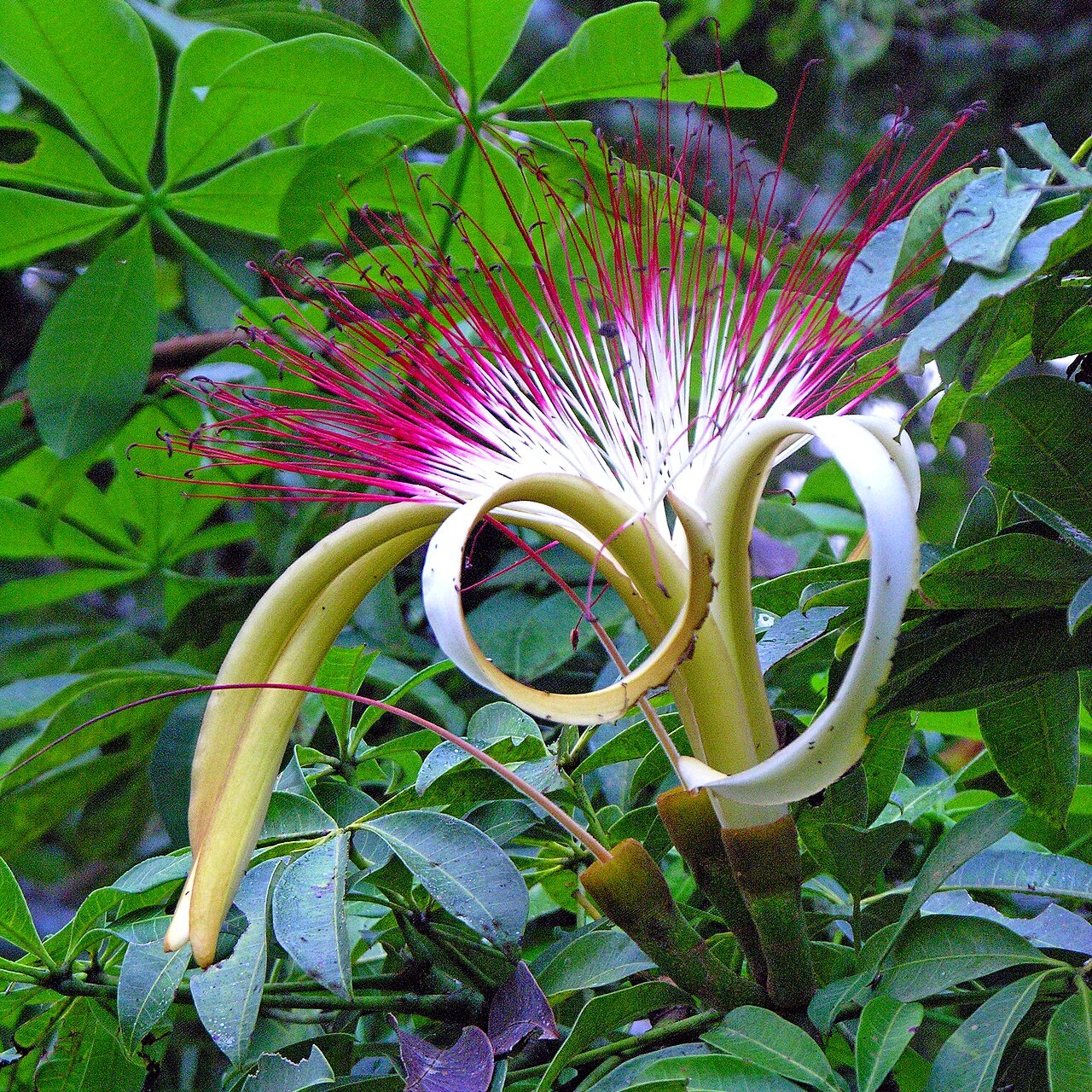
The provision tree or Malabar chestnut (Pachira aquatica) is a medium to large wetland tree, world-famous for being sold as an indoor houseplant under the name 'Money Tree' (usually with artificially braided trunks). In its natural Neotropical habitat, however, it is a robust and imposing tree that reaches up to 20 meters (65 feet) in height. It has a smooth, grayish-green trunk that is often swollen at the base (pachycaul). Its leaves are large, palmate, and bright green, typically with 5 to 9 leaflets. Its most spectacular feature is its enormous and exotic flowers: they open at night revealing hundreds of long stamens resembling a shaving brush, cream or yellowish at the base and intense red at the tips. The fruits are large woody capsules, resembling a brown football, which house highly nutritious and edible fleshy seeds. Its natural distribution extends from southern Mexico to northern South America, being very common in riparian zones and estuaries of Costa Rica.

Added by

Anonymous Curator

Reviewed by

Under Review

Last modified by

Julia Trouin

TaxonomyBiological classification ranks placing this species within the tree of life, from Kingdom down to Genus.

PhylumRank below Kingdom. Groups organisms sharing a fundamental body plan (e.g., Chordata = vertebrates and some invertebrates).Tracheophyta
ClassRank below Phylum. Subdivides by structural traits (e.g., Mammalia, Aves, Reptilia, Insecta).Magnoliopsida
OrderRank below Class. Groups related families sharing common ancestry (e.g., Carnivora, Primates).Malvales
FamilyRank below Order. Groups closely related genera (e.g., Felidae = cats, Canidae = dogs).Malvaceae
GenusRank just above Species. The first word in the two-part binomial scientific name.Pachira
Taxonomic AuthorityThe scientist who first formally described and published this species, followed by the year of publication.Aubl., 1775
Record Completeness
91%
Coming soon

Ecology & StatusHow this species lives: habitat preferences, diet, behavior, population status, and role in its ecosystem.

OriginWhether the species is native (evolved here), endemic (found only here), or introduced by human activity.

Native

Population TrendDirection of change in population size over time: increasing, stable, decreasing, or unknown.

Stable

Trophic RolePosition in the food chain: producer, herbivore, carnivore, omnivore, decomposer, or parasite.

--

Growth HabitPhysical form and structure of the plant: tree, shrub, herb, vine, epiphyte, aquatic, etc.

--

Leaf TypeLeaf characteristics: deciduous (seasonal shed), evergreen, simple, compound, needle-like, etc.

--

Flowering SeasonTime of year when this species typically reproduces or flowers.

--

Recent SightingsWhether this species has been observed in the wild in Costa Rica within recent years.

Yes

Habitat SummaryOverview of the specific ecosystems and environments where this species is found in Costa Rica. Multi-lang

It is a strictly hydrophilic (water-loving) species. In the wild, it inhabits wetland ecosystems, freshwater swamps, gallery forests along rivers, estuaries, and seasonally flooded plains. It develops optimally from sea level up to 500 meters in altitude, preferring poorly drained clay and muddy soils. It withstands extreme flooding during the rainy season, often growing with the base of its trunk and roots submerged in water for months.

Light & Water NeedsSunlight intensity and moisture levels this plant needs to grow and reproduce successfully. Multi-lang

Information not available in English. Help us expand this record!

BehaviourDaily activity patterns, movement, territory use, foraging style, and seasonal behavioral changes. Multi-lang

In Neotropical swamps, the Provision Tree visually shapes the estuary. Iguanas launch themselves from its low branches, and howler monkeys use its canopy to feed on its shoots. Its gigantic flowers are strictly adapted to crepuscular and nocturnal behavior (chiropterophily). In the late afternoon, the flower begins to peel open like a banana, revealing the enormous stamens and a strong, musky vanilla scent. This time window lasts merely a single night; by the next morning, having been pollinated by bats under the cover of darkness, the splendid flowers fade in color, lose their scent, and the thousands of stamens fall to the ground or river forming red carpets.

Toxicity / UsesToxic compounds present and their documented effects on humans or other organisms. Multi-lang

Information not available in English. Help us expand this record!

Physical Measures

Length (cm)

500.0 - 2000.0 cm

Reproductive StructuresFlowers, fruits, and seeds — the reproductive organs and their seasonal appearance.

Flower Photos (Max 2)

No image

Fruit Photos (Max 2)

No image

Evolutionary AdaptationsInherited traits and behaviors that improve the species' survival and reproduction in its specific environment. Multi-lang

Pachycaul trunk and buttresses: Its trunk frequently takes on a swollen or bottle-like shape at the base. This wood is spongy and functions as an immense water reservoir that allows it to survive if its swampy environment drastically dries out. Furthermore, it develops extensive buttress roots to anchor itself firmly in the unstable mud of the swamp.
Hydrochory (Water dispersal): The trees grow leaning over bodies of water. When the large woody capsule matures, it bursts audibly, launching its seeds directly into the river or estuary. The seeds have properties that allow them to float adrift for weeks, rapidly germinating as soon as they wash ashore on a damp sandbank downstream.
Foliar tolerance and lenticels: Its green bark is full of small fissures called lenticels, which allow it to perform gas exchange to breathe directly through the trunk when its root system is asphyxiated by stagnant, oxygen-deprived waters.

Main ThreatsDocumented pressures reducing the population: habitat loss, hunting, disease, climate change, and invasive species. Multi-lang

Wetland drainage and channelization: As a species confined to swampy environments, its greatest threat is the hydrological alteration of the landscape. The draining of marshes and floodplains for the expansion of cattle pastures or agricultural crops depresses the water table, eliminating the water-saturated environment the tree requires to survive and germinate.
Deforestation of gallery forests: Indiscriminate logging on riverbanks, where Pachira aquatica acts as a soil stabilizer and shade provider, leads to rapid bank erosion, undermining the trunks of mature trees until they collapse into the riverbed.

Interesting FactsSurprising or notable facts that highlight what makes this species unique or ecologically important. Multi-lang

The Money Tree Myth: The global fame of Pachira aquatica as the 'Money Tree' is not an ancient tradition, but a brilliant commercial invention. In 1986, a Taiwanese truck driver first braided the flexible stems of five seedlings grown in a single pot. This aesthetic, coupled with its 5 leaflets (associated with the five elements of Feng Shui), catapulted the plant to global success in Asia and the West as a living amulet to attract wealth and commercial prosperity.
The swamp peanut (Saba Nuts): Its seeds are not only edible but are delicious and highly nutritious. Raw, they have a slight green peanut flavor; when roasted or fried in oil, they acquire the taste and texture of a pure European chestnut (hence its common name). Historically, indigenous populations also ground these roasted seeds to make a bread-like flour or a hot beverage similar to hot chocolate.
It is an indestructible natural bonsai. The tree's popularity in the domestic landscaping market is due to its incredible resistance to human mistreatment. It can survive for months with inadequate watering and poor lighting in enclosed spaces without losing its thick green foliage. If its trunk is cut or mutilated, it easily sprouts back.