
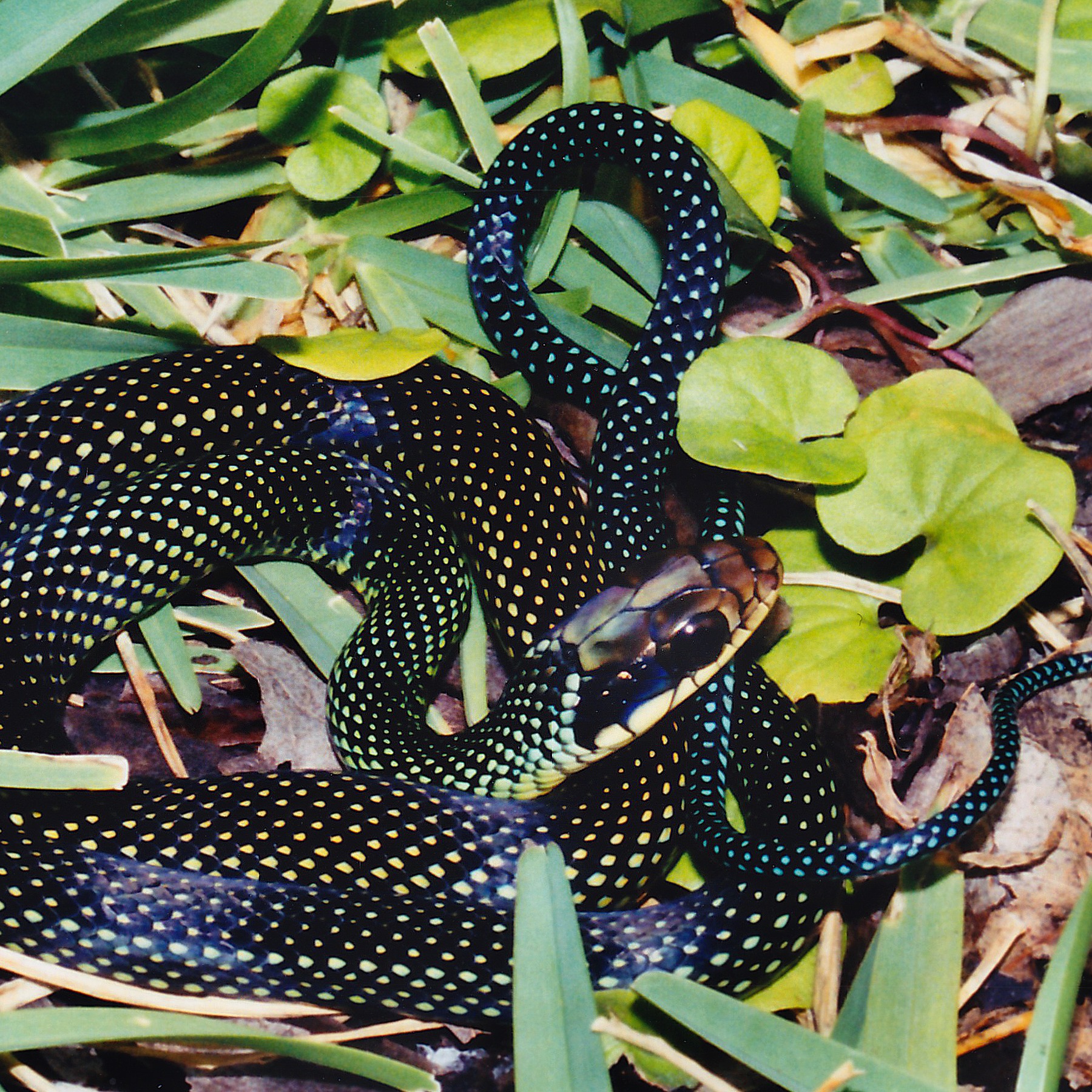
Drymobius margaritiferus
Speckled Racer
(Schlegel, 1837)
Added by
Anonymous Curator
Reviewed by
Under Review
Last modified by
Julia Trouin
TaxonomyBiological classification ranks placing this species within the tree of life, from Kingdom down to Genus.
Ecology & StatusHow this species lives: habitat preferences, diet, behavior, population status, and role in its ecosystem.
OriginWhether the species is native (evolved here), endemic (found only here), or introduced by human activity.
Native
Population TrendDirection of change in population size over time: increasing, stable, decreasing, or unknown.
Stable
Breeding SeasonTime of year when this species typically reproduces or flowers.
Wet Season
Trophic RolePosition in the food chain: producer, herbivore, carnivore, omnivore, decomposer, or parasite.
Carnivore
Recent SightingsWhether this species has been observed in the wild in Costa Rica within recent years.
Yes
Habitat SummaryOverview of the specific ecosystems and environments where this species is found in Costa Rica. Multi-lang
Found in a wide variety of habitats, from humid tropical forests and cloud forests to disturbed areas, gardens, and roadsides. It is a terrestrial and semi-arboreal species, common in Costa Rica and throughout Central America. It prefers areas with dense low vegetation near water bodies, where it seeks shelter and food.BehaviourDaily activity patterns, movement, territory use, foraging style, and seasonal behavioral changes. Multi-lang
It is an eminently diurnal reptile. Its activity level is high and constant during daylight hours, spending most of its time on the ground or on low branches searching for food. It is a nervous and alert snake, which reacts quickly to any external movement. At night, it takes refuge under fallen logs, rocks, or in abandoned burrows to rest.Social ActivitySocial structure: whether the species is solitary, paired, or colonial; hierarchy and communication. Multi-lang
It is a solitary animal. It does not show gregarious behaviors or group defense. Each individual patrols its own hunting territory, interacting with others of its species only during reproductive periods.Feeding GuildWhat the species eats, how it forages or hunts, and its role as a consumer in the food web. Multi-lang
Active carnivore. It feeds predominantly on lizards, frogs, and occasionally small rodents. Its hunting technique is fast: it detects the prey, approaches quickly, and captures it through a precise strike, often swallowing it while it is still alive.Trophic Chain DetailsSpecific interactions in local food webs: prey species, predators, competitors, and scavengers. Multi-lang
Acts as a vital secondary consumer in Neotropical ecosystems. Its diet helps control populations of small vertebrates that could otherwise become excessive in anthropogenic environments. At the same time, it is prey for diurnal raptors, predatory mammals, and other ophiophagous snakes.Reproductive BehaviourMating strategies, courtship displays, nesting or spawning behavior, and parental care. Multi-lang
Oviparous species. The female seeks humid and protected places, such as inside rotten logs or under deep leaf litter, to deposit between 2 and 8 eggs. Incubation lasts several weeks, and the young, upon birth, are perfect miniatures of the adults, ready to hunt from the first day.Physical Measures
Length (cm)
80.0 - 120.0 cm
Weight (Grams)
50 g - 150 g
Lifespan
Sexual MaturityAge at which the individual becomes capable of reproducing for the first time.
1 - 2 Years
Gestation / IncubationDuration from fertilization to birth (mammals) or to hatching (egg-laying species).
30 - 45