
PlantaeIUCN LCIn Progress Recent Sighting
Zamia neurophyllidia
Zamia / Nerve-leaf Cycad
D.W.Stev., 1993
Detailed Texts Multi-lang
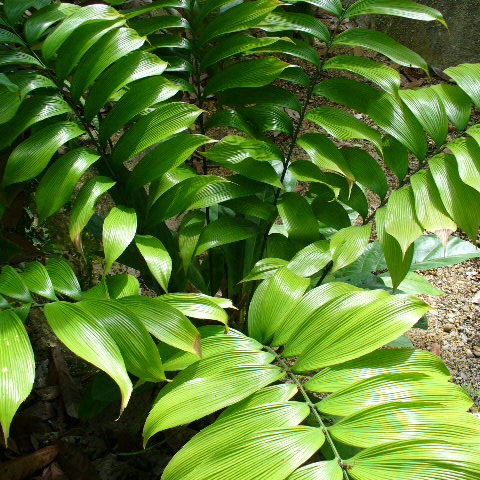
Zamia neurophyllidia is a low-growing cycad, described as a 'living fossil' that has persisted almost unchanged since the era of the dinosaurs. It is characterized by a short, cylindrical stem, often underground or decumbent, up to 60 cm in height. Its most distinctive feature is the foliage: it has lustrous, dark green pinnate leaves whose leaflets exhibit very prominent veins on the underside (hence the name neurophyllidia). The leaflets are elliptical to lanceolate and have slightly serrated margins towards the apex. Like all cycads, it does not produce true flowers or fruits, but strobili or cones: the male ones are slender and cylindrical, while the female ones are more robust and ovoid, with a velvety brown color. Upon maturity, the female cone releases fleshy seeds with a vibrant red or orange cover (sarcotesta). It is an architecturally elegant plant that inhabits the shady tropical understory.
Added by
Anonymous Curator
Reviewed by
Under Review
Last modified by
Julia Trouin
Taxonomy
PhylumCycadophyta
ClassCycadopsida
OrderCycadales
FamilyZamiaceae
GenusZamia
Taxonomic AuthorityD.W.Stev., 1993
Ecology & Status
Origin
Native
Population Trend
Stable
Growth Habit
--
Leaf Type
--
Flowering Season
Year Round
Recent Sightings
Yes
Habitat Summary Multi-lang
It is found in the understory of tropical wet lowland forests, often on limestone substrates or well-drained alluvial soils. It prefers deep shade environments where humidity is constant. It is a species native to the Central American Caribbean, with significant populations in Costa Rica and Panama, frequently associated with conserved primary forests.Light & Water Needs Multi-lang
Information not available in English. Help us expand this record!Behaviour Multi-lang
Zamia neurophyllidia exhibits a fascinating reproductive ecology based on insect pollination (entomophily), specifically small beetles (weevils). These beetles are attracted by chemical signals and heat produced by the male cones (thermogenesis). While feeding and mating there, they get covered in pollen and transport it to the female cones. The fleshy seeds are mainly dispersed by birds and small mammals attracted by the red sarcotesta.Toxicity / Uses Multi-lang
Information not available in English. Help us expand this record!Physical Measures
Length (cm)
30.0 - 150.0 cm
Reproductive Structures
Flower Photos (Max 2)
No imageFruit Photos (Max 2)
No imageEvolutionary Adaptations Multi-lang
Coralloid Roots: It develops specialized roots near the soil surface that house symbiotic cyanobacteria (Nostoc or Anabaena). These bacteria fix atmospheric nitrogen, allowing the Zamia to thrive in tropical forest soils where nutrients are often limited.
Chemical Defense (Azoxyglycosides): As a survival mechanism, it contains toxic compounds such as cycasin and BMAA in all its tissues. This potent chemical defense protects it from most mammalian herbivores, although some insect species have evolved to tolerate and sequester these toxins.
Main Threats Multi-lang
Habitat loss and fragmentation: Due to its extremely slow growth and dependence on specific microclimates in the primary understory, deforestation and the conversion of forests into pastures severely impact its regeneration capacity.
Interesting Facts Multi-lang
Coevolution with butterflies: The caterpillar of the butterfly Eumaeus godartii feeds on Zamia leaves, sequestering the plant's toxins (cycasin) to become toxic to its own predators. The butterfly's bright colors warn of this stolen toxicity.