
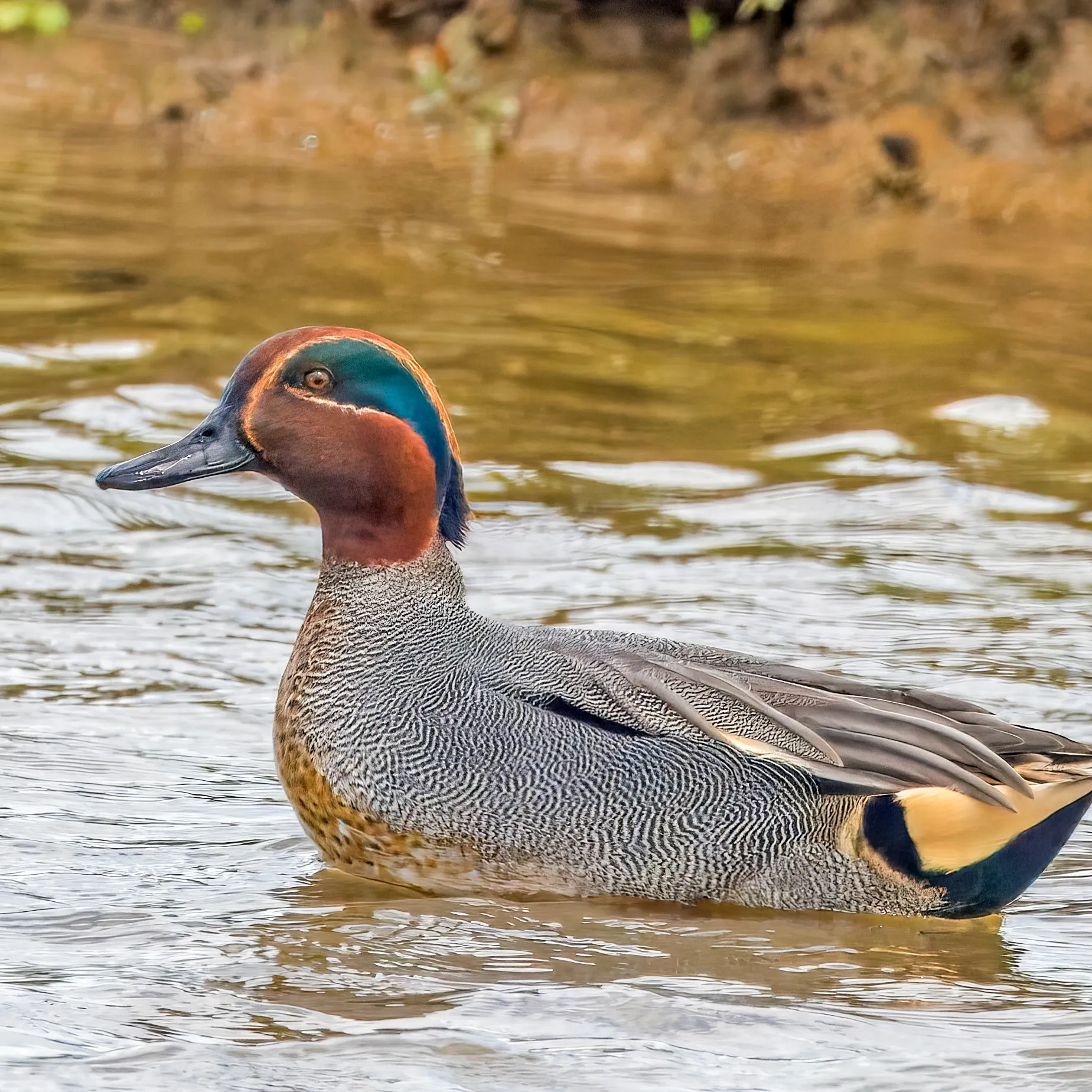
Anas crecca
Green-winged Teal
Linnaeus, 1758
Added by
Anonymous Curator
Reviewed by
Under Review
Last modified by
Julia Trouin
TaxonomyBiological classification ranks placing this species within the tree of life, from Kingdom down to Genus.
Ecology & StatusHow this species lives: habitat preferences, diet, behavior, population status, and role in its ecosystem.
OriginWhether the species is native (evolved here), endemic (found only here), or introduced by human activity.
Native
Population TrendDirection of change in population size over time: increasing, stable, decreasing, or unknown.
Increasing
Breeding SeasonTime of year when this species typically reproduces or flowers.
Year Round
Trophic RolePosition in the food chain: producer, herbivore, carnivore, omnivore, decomposer, or parasite.
Omnivore
Recent SightingsWhether this species has been observed in the wild in Costa Rica within recent years.
Yes
Habitat SummaryOverview of the specific ecosystems and environments where this species is found in Costa Rica. Multi-lang
Breeds across northern wetlands, preferring shallow freshwater marshes, tundra pools, brushy bogs, and small lakes with dense shoreline cover. In winter, it shifts to coastal lagoons, tidal mudflats, estuaries, and agricultural wetlands like flooded rice fields.BehaviourDaily activity patterns, movement, territory use, foraging style, and seasonal behavioral changes. Multi-lang
A highly active, diurnal dabbling duck that feeds by sifting mud or skimming water surfaces. It rarely dives. It is a long-distance nocturnal migrant that travels in large groups. During winter, they feed heavily at night if hunting pressure is high during the day. The male's voice is a distinctive, high-pitched metallic ringing whistle: 'krick-krick', while the female gives a high, sharp, short quack.Social ActivitySocial structure: whether the species is solitary, paired, or colonial; hierarchy and communication. Multi-lang
Exceedingly gregarious outside the nesting period. They form massive aggregations on wintering wetlands, staging lakes, and feeding grounds, often moving in tight, densely packed flocks that turn and twist in perfect unison.Feeding GuildWhat the species eats, how it forages or hunts, and its role as a consumer in the food web. Multi-lang
Aquatic surface-filtering omnivore.Trophic Chain DetailsSpecific interactions in local food webs: prey species, predators, competitors, and scavengers. Multi-lang
Omnivorous opportunistic feeder. Diet shifts to heavily focus on animal matter during the spring breeding season, including aquatic insects, midge larvae, small crustaceans, and snails. In autumn and winter, it transitions almost completely to plant matter, focusing on small seeds of sedges, pondweeds, grasses, and waste agricultural grain. Predators include peregrine falcons, marsh harriers, foxes, minks, and large owls.Reproductive BehaviourMating strategies, courtship displays, nesting or spawning behavior, and parental care. Multi-lang
Monogamous pairs form during winter months on wintering grounds. Courtship involves complex communal displays on the water. The female selects a well-hidden nest site on dry ground near water, often deep within dense grasses or brush. She scrapes a hollow, lines it with grass and copious dark down down feathers. She lays 6 to 12 cream-to-buff eggs and undertakes incubation entirely alone.Physical Measures
Length (cm)
34.0 - 38.0 cm
Weight (Grams)
250 g - 450 g
Lifespan
Sexual MaturityAge at which the individual becomes capable of reproducing for the first time.
10 - 12 Months
Gestation / IncubationDuration from fertilization to birth (mammals) or to hatching (egg-laying species).
21 - 23