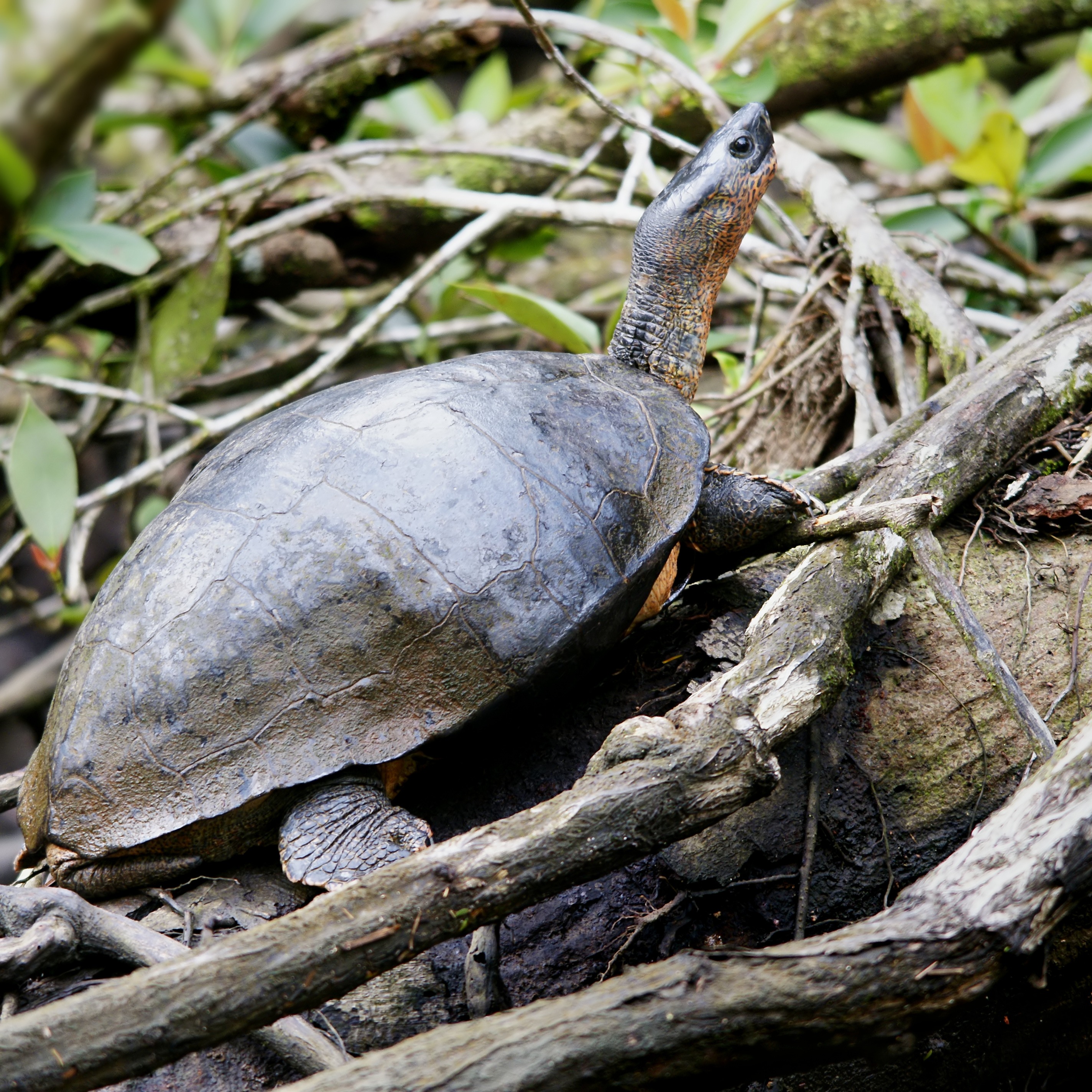
Rhinoclemmys funerea
Black Wood Turtle
Cope, 1875
Added by
Anonymous Curator
Reviewed by
Under Review
Last modified by
Julia Trouin
TaxonomyBiological classification ranks placing this species within the tree of life, from Kingdom down to Genus.
Ecology & StatusHow this species lives: habitat preferences, diet, behavior, population status, and role in its ecosystem.
OriginWhether the species is native (evolved here), endemic (found only here), or introduced by human activity.
Native
Population TrendDirection of change in population size over time: increasing, stable, decreasing, or unknown.
Decreasing
Breeding SeasonTime of year when this species typically reproduces or flowers.
Year Round
Trophic RolePosition in the food chain: producer, herbivore, carnivore, omnivore, decomposer, or parasite.
Omnivore
Recent SightingsWhether this species has been observed in the wild in Costa Rica within recent years.
Yes
Habitat SummaryOverview of the specific ecosystems and environments where this species is found in Costa Rica. Multi-lang
Inhabits wooded areas with high humidity, preferring slow streams, swamps, temporary ponds, and floodplains of humid tropical rainforests. It is both a terrestrial and aquatic species, spending much of its time among leaf litter and shallow water.BehaviourDaily activity patterns, movement, territory use, foraging style, and seasonal behavioral changes. Multi-lang
Mostly diurnal species with solitary habits. Although it spends much time in the water, it moves with agility on the forest floor. It is a discreet and cautious species, which usually retreats at the slightest sign of danger.Social ActivitySocial structure: whether the species is solitary, paired, or colonial; hierarchy and communication. Multi-lang
Solitary. Social interactions are minimal and, outside the reproductive season, they actively avoid other individuals. Males can be territorial if they encounter other males.Feeding GuildWhat the species eats, how it forages or hunts, and its role as a consumer in the food web. Multi-lang
Active forager. Explores both the water surface and the forest floor, using its sense of smell to locate decomposing organic matter or ripe fruits.Trophic Chain DetailsSpecific interactions in local food webs: prey species, predators, competitors, and scavengers. Multi-lang
Opportunistic omnivore. Its diet is very varied, including fallen fruits, flowers, tender leaves, insects, worms, crustaceans, and occasionally carrion. This dietary plasticity is key to its survival in the forest.Reproductive BehaviourMating strategies, courtship displays, nesting or spawning behavior, and parental care. Multi-lang
Oviparous species. The female lays its eggs in nests excavated in moist soil or under layers of leaf litter. Embryonic development depends on ambient climatic conditions.Physical Measures
Length (cm)
15.0 - 20.0 cm
Weight (Grams)
400 g - 1.00 kg
Lifespan
Sexual MaturityAge at which the individual becomes capable of reproducing for the first time.
5 - 8 Years
Gestation / IncubationDuration from fertilization to birth (mammals) or to hatching (egg-laying species).
3 - 5