Costa Rica Species
Jabiru mycteria
AnimaliaHighest rank in taxonomy. Groups all life into domains: Animalia, Plantae, Fungi, etc.IUCN LCInternational Union for Conservation of Nature — the world authority on species extinction risk, using standardized criteria. — Least Concern — widespread and abundant; not at immediate risk of extinction.In ProgressCurrent stage of this record in the editorial review workflow. Recent Sighting

Jabiru mycteria

Jabiru

(Lichtenstein, 1819)

Detailed Texts Multi-lang
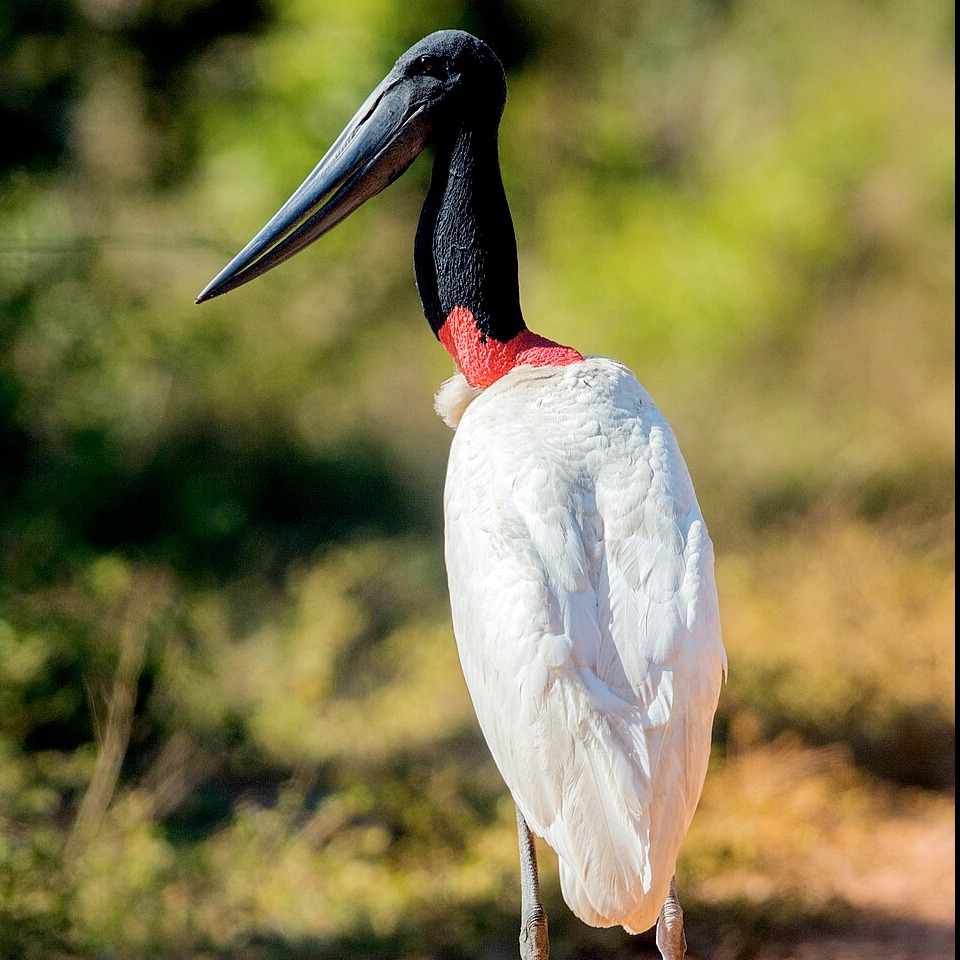
The Jabiru (Jabiru mycteria) is a monumental wading bird, holding the title of the tallest flying bird in Latin America. Its plumage is entirely immaculate white, contrasting sharply with its head and most of its neck, which are completely bare and jet black. At the base of the neck, it has a band of bare, elastic skin (gular sac) of an intense red or pink color, which it can inflate at will. Its bill is massive, black, very thick, and slightly upturned, giving it a prehistoric appearance. Its legs are long and black, perfectly adapted for wading in deep swamps. In flight, its wingspan can exceed 2.6 meters, soaring majestically with its neck and legs fully extended.

Added by

Anonymous Curator

Reviewed by

Under Review

Last modified by

Julia Trouin

TaxonomyBiological classification ranks placing this species within the tree of life, from Kingdom down to Genus.

PhylumRank below Kingdom. Groups organisms sharing a fundamental body plan (e.g., Chordata = vertebrates and some invertebrates).Chordata
ClassRank below Phylum. Subdivides by structural traits (e.g., Mammalia, Aves, Reptilia, Insecta).Aves
OrderRank below Class. Groups related families sharing common ancestry (e.g., Carnivora, Primates).Ciconiiformes
FamilyRank below Order. Groups closely related genera (e.g., Felidae = cats, Canidae = dogs).Ciconiidae
GenusRank just above Species. The first word in the two-part binomial scientific name.Jabiru
Taxonomic AuthorityThe scientist who first formally described and published this species, followed by the year of publication.(Lichtenstein, 1819)
Record Completeness
85%
Coming soon

Ecology & StatusHow this species lives: habitat preferences, diet, behavior, population status, and role in its ecosystem.

OriginWhether the species is native (evolved here), endemic (found only here), or introduced by human activity.

Native

Population TrendDirection of change in population size over time: increasing, stable, decreasing, or unknown.

Decreasing

Breeding SeasonTime of year when this species typically reproduces or flowers.

Dry Season

Trophic RolePosition in the food chain: producer, herbivore, carnivore, omnivore, decomposer, or parasite.

Carnivore

Recent SightingsWhether this species has been observed in the wild in Costa Rica within recent years.

Yes

Habitat SummaryOverview of the specific ecosystems and environments where this species is found in Costa Rica. Multi-lang

It is a species absolutely dependent on large freshwater wetlands. It inhabits extensive swamps, flooded savannas, shallow lagoons, and slow river margins. It requires tall, robust, isolated trees (like the Ceiba or Guanacaste tree) in the landscape to build its enormous nests. In Costa Rica, its population is highly restricted and located primarily in the Tempisque River basin (Palo Verde National Park) and the Caño Negro Wildlife Refuge, making it one of the most threatened species nationally.

BehaviourDaily activity patterns, movement, territory use, foraging style, and seasonal behavioral changes. Multi-lang

It is a bird of slow, calculated movements. It spends hours quietly wading in muddy water or standing motionless, waiting for prey. During the dry season, dozens of Jabirus may congregate around small, drying pools where fish are trapped. Despite their heaviness on the ground, they are excellent fliers that take advantage of rising thermal currents to soar at high altitudes with minimal effort, much like vultures.

Social ActivitySocial structure: whether the species is solitary, paired, or colonial; hierarchy and communication. Multi-lang

Generally solitary or in pairs during the breeding season. However, in the dry season, they can be gregarious and feed in relatively large groups when water resources are scarce.

Feeding GuildWhat the species eats, how it forages or hunts, and its role as a consumer in the food web. Multi-lang

Carnivore / Piscivore.

Trophic Chain DetailsSpecific interactions in local food webs: prey species, predators, competitors, and scavengers. Multi-lang

Apex predator of wetlands (Carnivore / Piscivore). Its main diet includes fish, eels, water snakes, frogs, small turtles, and to a lesser extent, small mammals and large invertebrates. Healthy adults have no natural predators. Eggs and chicks can be prey for raccoons, coatis, monkeys, or large eagles.

Reproductive BehaviourMating strategies, courtship displays, nesting or spawning behavior, and parental care. Multi-lang

Courtship involves synchronized walking, inflation of the gular sac, and loud bill-clattering. They build a huge stick nest (usually in the flat crown of a large tree) that is used for several seasons. The female lays 2 to 4 white eggs. Both male and female share incubation (about 30 days) and feeding of the chicks, which grow very slowly. The young take up to 110 days to fledge and learn to fly, completely depending on their parents' abundant fishing.

Physical Measures

Length (cm)

120.0 - 150.0 cm

Weight (Grams)

5.00 kg - 9.00 kg

Offspring per cycleTypical number of young (live births, eggs, or seeds) produced by one adult in a single reproductive event or breeding season.2 - 4
Sexual DimorphismObservable physical differences between males and females of the same species (e.g., size, coloration, features).Yes

Lifespan

Sexual MaturityAge at which the individual becomes capable of reproducing for the first time.

36 - 48 Months

Gestation / IncubationDuration from fertilization to birth (mammals) or to hatching (egg-laying species).

28 - 32

Lifespan EstimatedExpected duration of life from birth to natural death under wild conditions.
Males20 - 35 Years
Females20 - 35 Years

Sexual DimorphismPhysical differences in size, coloration, or morphology between males and females of this species.

Males Multi-lang

Males are between 20% and 25% larger and heavier than females, and possess a noticeably longer and thicker bill.

Females Multi-lang

Smaller and lighter, but with plumage and skin coloration exactly the same as the male.

Evolutionary AdaptationsInherited traits and behaviors that improve the species' survival and reproduction in its specific environment. Multi-lang

Tactile, Upturned Bill: Its heavy black bill is not straight, but curves slightly upwards. This allows it to wade in muddy, murky waters with its bill slightly open, moving it from side to side; upon feeling prey (like an eel or fish) by touch, it snaps it shut in an instant.
Gular Sac (Red Neck): The red band at the base of its neck is an expandable skin pouch that serves two functions: it acts as a thermoregulation mechanism in the intense heat of flooded savannas and inflates with air during courtship displays or aggression.

Main ThreatsDocumented pressures reducing the population: habitat loss, hunting, disease, climate change, and invasive species. Multi-lang

Critical Habitat Loss and Droughts: The draining of wetlands for agriculture (like rice paddies and sugarcane) and prolonged periods of extreme drought dry up the shallow lagoons where their prey concentrates, causing the reproductive failure of entire colonies.
Felling of Nesting Trees: Because they use the same nests for decades, the felling of large trees (like ceibas) in wetlands eliminates their ancestral nesting sites.

Interesting FactsSurprising or notable facts that highlight what makes this species unique or ecologically important. Multi-lang

Monumental Nests: Their nests are colossal works of engineering. They add sticks and branches to the same nest year after year, until they create platforms that can measure over 2 meters wide and 1 meter deep, becoming so heavy they sometimes break the branch holding them.
A Silent Giant: Lacking developed syringeal muscles (the vocal organ of birds), the Jabiru is a mute bird. They communicate visually and by emitting a loud clattering sound by rapidly snapping the mandibles of their enormous bill (bill-clattering).