FungiIUCN NEIn Progress Recent Sighting
Pycnoporus sanguineus
Scarlet Bracket Fungus / Cinnabar Bracket
(L.) Murrill, 1904
Detailed Texts Multi-lang
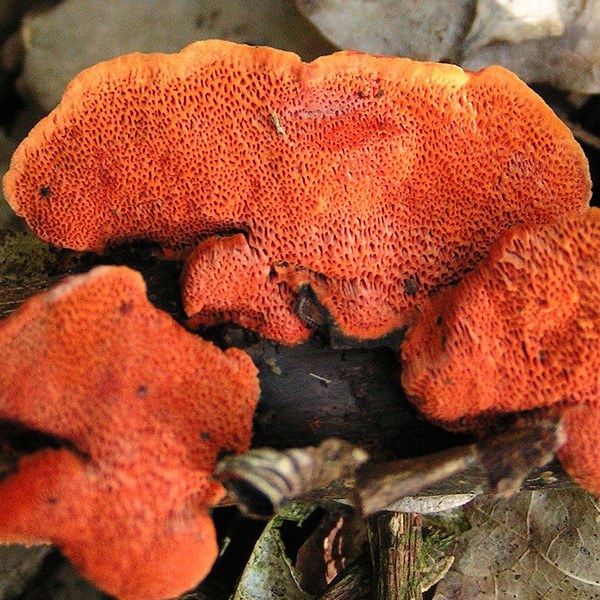
Pycnoporus sanguineus is a beautiful polypore fungus, characterized by its bright scarlet or cinnabar-orange color that remains even after drying. The fruiting body is shelf-, fan-, or semicircle-shaped, with a diameter of 2 to 10 cm. Its upper surface is smooth or finely zoned, leathery, and firm in texture. The lower surface (the hymenium) features tiny pores of the same intense red color. Unlike other fungi, it lacks a defined stalk and grows directly attached to wood. It is a saprophytic organism that causes white rot in wood, efficiently decomposing lignin. Its vibrant coloration makes it stand out in the forest landscape as one of the most photogenic fungal species in tropical and subtropical regions.
Added by
Anonymous Curator
Reviewed by
Under Review
Last modified by
Julia Trouin
Taxonomy
PhylumBasidiomycota
ClassAgaricomycetes
OrderPolyporales
FamilyPolyporaceae
GenusPycnoporus
Taxonomic Authority(L.) Murrill, 1904
Ecology & Status
Origin
Native
Population Trend
Stable
Edibility
--
Cap Shape
--
Hymenium Type
--
Fruiting Season
Year Round
Recent Sightings
Yes
Habitat Summary Multi-lang
It inhabits a wide variety of ecosystems, from wet tropical rainforests to dry forests and disturbed open areas. It is found growing almost exclusively on dead logs and branches of broad-leaved trees exposed to the sun. It is notable for its resistance to direct solar radiation, allowing it to colonize wood in open areas where other fungi quickly dry out. In Costa Rica, it is extremely common throughout the country, from the coasts to the mountains.Substrate Multi-lang
Information not available in English. Help us expand this record!Behaviour Multi-lang
It is a primary agent of wood decomposition (white rot). By degrading lignin, it returns essential nutrients to the forest soil. Its bright red color may serve as a warning signal (aposematism) of its hardness or lack of palatability for herbivorous invertebrates. The fruiting bodies can be colonized by small beetles from the Erotylidae family.Physical Measures
Length (cm)
2.0 - 10.0 cm
Hymenium Structures
No hymenium surface images available.
Evolutionary Adaptations Multi-lang
Photoprotective Pigmentation (Cinnabarin): Its intense red color is due to pigments like cinnabarin, which act as a natural sunscreen. This adaptation allows it to survive and continue producing spores on logs exposed to full sunlight, an ecological niche that few fungi can occupy.
Long-lasting Leathery Texture: Unlike fleshy mushrooms, its fruiting body is hard and resistant. This structure allows it to persist for months in the environment, intermittently releasing spores whenever there is sufficient moisture.
Main Threats Multi-lang
Habitat loss and wood removal: Systematic removal of fallen logs in agricultural and urban landscapes reduces available colonization sites, although the species is highly resilient.
Interesting Facts Multi-lang
Antibiotic Properties: Scientific studies have shown that Pycnoporus sanguineus produces compounds with antibacterial and antifungal activity, which the fungus uses to prevent other microorganisms from competing for the same log.
Use in Bioremediation: Due to its ability to break down complex chemical compounds, this fungus is studied for cleaning industrial effluents and degrading synthetic dyes.