
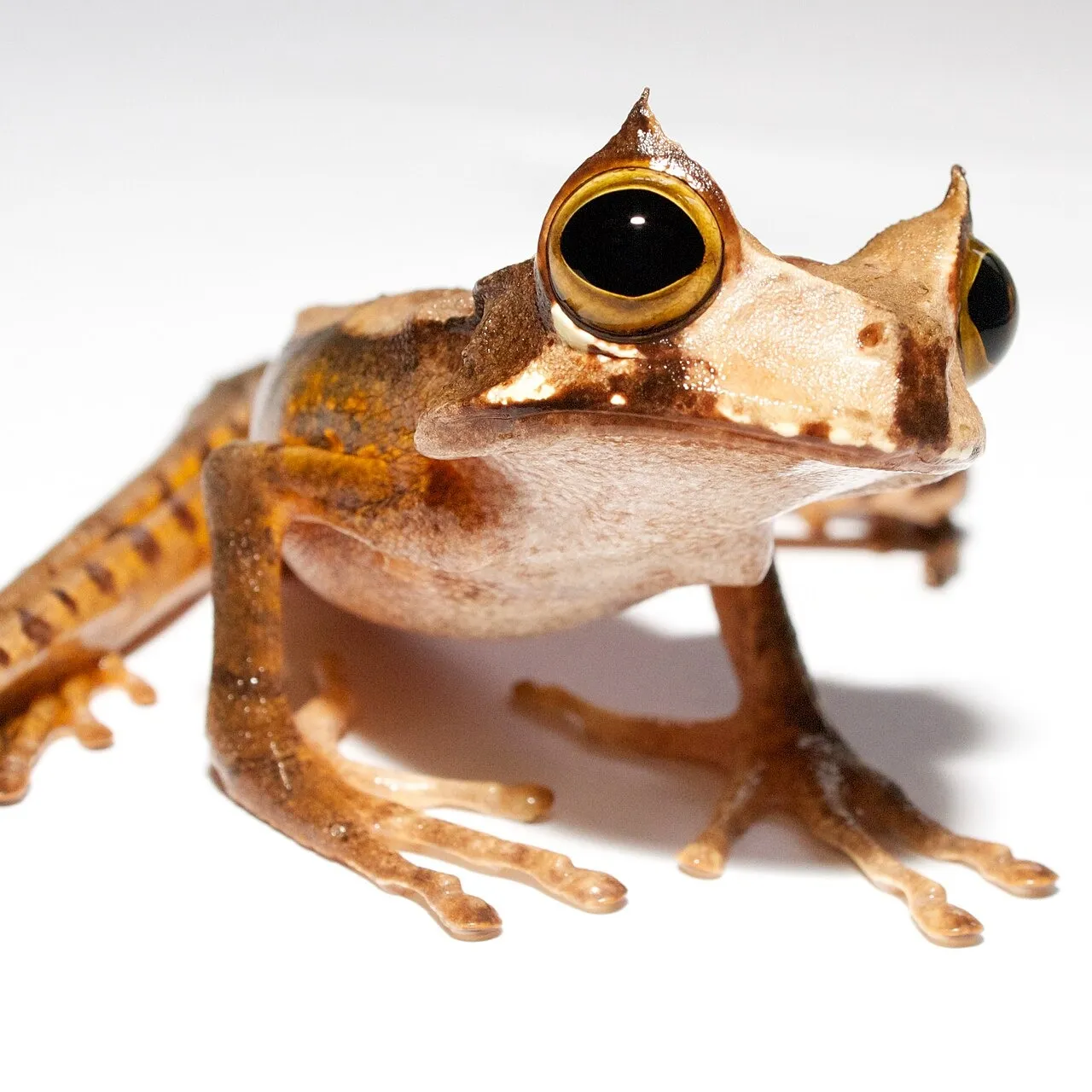
Gastrotheca cornuta
Horned Marsupial Frog
Boulenger, 1898
Added by
Anonymous Curator
Reviewed by
Under Review
Last modified by
Julia Trouin
TaxonomyBiological classification ranks placing this species within the tree of life, from Kingdom down to Genus.
Ecology & StatusHow this species lives: habitat preferences, diet, behavior, population status, and role in its ecosystem.
OriginWhether the species is native (evolved here), endemic (found only here), or introduced by human activity.
Native
Population TrendDirection of change in population size over time: increasing, stable, decreasing, or unknown.
Decreasing
Breeding SeasonTime of year when this species typically reproduces or flowers.
Year Round
Trophic RolePosition in the food chain: producer, herbivore, carnivore, omnivore, decomposer, or parasite.
Carnivore
Recent SightingsWhether this species has been observed in the wild in Costa Rica within recent years.
Yes
Habitat SummaryOverview of the specific ecosystems and environments where this species is found in Costa Rica. Multi-lang
Inhabits primary tropical moist lowland forests and premontane wet forests, demonstrating an extreme reliance on undisturbed, contiguous old-growth tree stands. It is a strict canopy specialist, living high above the ground at elevations ranging from 100 up to roughly 1,000 meters. Geographically, it is located along the Caribbean and Pacific slopes of southern Central America and northwestern South America, establishing fragmented populations in Costa Rica, Panama, western Colombia, and northwestern Ecuador.BehaviourDaily activity patterns, movement, territory use, foraging style, and seasonal behavioral changes. Multi-lang
Strictly nocturnal and highly arboreal, remaining hidden within the multi-layered canopy foliage during daylight hours. At night, it moves slowly and deliberately along branches, employing vertical clinging tactics rather than explosive jumps to avoid falling from extreme heights. Males utilize a distinct acoustic strategy, emitting a loud, single, explosive pop or click that sounds like a water droplet hitting a surface, functioning as a territorial advertisement call designed to penetrate the dense rainforest canopy.Social ActivitySocial structure: whether the species is solitary, paired, or colonial; hierarchy and communication. Multi-lang
Maintains a solitary social structure, with wide spatial distribution within the forest canopy. Contact between individuals is strictly driven by reproductive biological requirements. Males establish calling sites on tall branches, utilizing sharp acoustic signals to define territories and avoid physical confrontation with adjacent calling males.Feeding GuildWhat the species eats, how it forages or hunts, and its role as a consumer in the food web. Multi-lang
Arboreal canopy invertivore, specialized in large nocturnal flying and crawling insects.Trophic Chain DetailsSpecific interactions in local food webs: prey species, predators, competitors, and scavengers. Multi-lang
Acts as an specialized secondary consumer in the canopy ecosystem. Its diet is largely composed of medium-to-large nocturnal insects, orthopterans, katydids, and small arboreal invertebrates. Because of its permanent high-altitude lifestyle, adult frogs are mostly vulnerable to specialized avian predators such as forest falcons, owls, and larger arboreal colubrid snakes. Since they bypass the aquatic tadpole stage, they do not participate in aquatic food chains.Reproductive BehaviourMating strategies, courtship displays, nesting or spawning behavior, and parental care. Multi-lang
Possesses a unique, specialized brooding reproductive investment strategy. During amplexus on branches, the male assists in pushing the fertilized eggs into an opening on the lower back of the female, which seals into a closed internal pouch (marsupium). The eggs develop inside this vascularized chamber for months. There is no free-swimming tadpole stage; development is completely direct. When development completes, the female uses her hind feet to open the pouch slits and releases up to several dozen tiny, fully developed froglets directly into the canopy foliage.Physical Measures
Length (cm)
6.8 - 8.5 cm
Weight (Grams)
30 g - 75 g
Lifespan
Sexual MaturityAge at which the individual becomes capable of reproducing for the first time.
20 - 26 Months
Gestation / IncubationDuration from fertilization to birth (mammals) or to hatching (egg-laying species).
60 - 95